
Quick Answer:
Artificial turf maintenance comes down to a two-tier system: routine surface care you handle yourself, and professional deep cleaning once or twice a year that addresses what surface maintenance cannot reach. The DIY tier includes weekly debris removal and pet waste rinsing, brushing every 2 to 4 weeks to keep fibers upright, and seasonal infill checks. The professional tier removes the urine compounds, bacteria, and fine debris that accumulate in the infill layer over months of use. A well maintained artificial turf installation lasts 15 to 20 years. Neglected turf, particularly in pet households, comes up for replacement far sooner, because infill saturation is not something surface maintenance can reverse.
DIY maintenance handles the surface. TurFresh handles what is underneath.
TurFresh professional cleaning removes the urine compounds, bacteria, and compacted debris that accumulate in the infill layer where rinsing and brushing stop. Over 150,000 services completed. Pet safe same day. Backed by our 30-day odor removal guarantee.
✔ Pet Safe✔ Kid Safe✔ 150,000+ Services✔ 30-Day Guarantee
Key Takeaways
✅ Artificial turf maintenance has two tiers, and both matter. DIY surface care prevents debris and bacteria from accumulating on top. Professional deep cleaning removes what has already built up in the infill layer below. Skipping either tier creates different problems over time.
✅ Frequency should match use intensity, not a fixed calendar. A lightly used yard without pets needs professional cleaning once a year. A multi-dog household needs it every 3 to 4 months. Matching the schedule to actual use prevents problems rather than reacting to them.
✅ Brushing against the grain is the most impactful DIY technique. Fibers compressed by foot traffic and pets need to be lifted back to an upright position. Brushing with the grain pushes them further down. Always brush against the natural lean of the fibers using synthetic bristles.
✅ Infill is not maintenance free. Infill settles and disperses over time, especially in high-traffic zones. Checking and topping up infill seasonally protects the turf backing and maintains surface stability. Depleted infill is one of the primary causes of premature turf wear.
✅ Reblooming is different from brushing. Regular brushing is surface maintenance. TurfBloom reblooming is a professional service using powered grooming equipment that restores fiber position and redistributes compacted infill more thoroughly than any hand tool. It is the professional equivalent of brushing, not a replacement for professional deep cleaning.
Artificial Turf Maintenance Schedule by Use Level
There is no single artificial turf care schedule, and anyone who hands you one without asking about your dogs is guessing. A yard with two shepherds and a yard used twice a month accumulate at completely different rates. Match the schedule to the use, not to a calendar.
One note before the schedules. Artificial grass maintenance, synthetic turf maintenance, and synthetic grass maintenance all describe the same routine on the same surface. Whichever term your installer used, what follows applies.
Putting greens follow a different protocol than standard turf. See our backyard putting green maintenance guide for fiber-specific care.
Light use, no pets
Weekly: remove visible debris with a leaf blower or soft rake.
Monthly: full surface rinse, brush fibers against the grain.
Seasonally: check infill levels, inspect edges and seams.
Annually: professional deep cleaning.
Moderate use, one dog
Weekly: remove debris, rinse pet zones, apply enzyme cleaner to potty areas.
Every 2 to 3 weeks: brush all high-traffic and pet zones against the grain.
Monthly: full surface rinse and brush, infill spot check.
Every 6 months: professional deep cleaning.
Heavy use, multiple dogs
2 to 3 times per week: rinse pet zones, remove solid waste immediately.
Weekly: brush high-use zones against the grain, enzyme treatment of potty areas.
Monthly: full surface brush and rinse, infill inspection.
Every 3 to 4 months: professional deep cleaning.
Commercial, kennels, dog runs
Daily: waste removal, end-of-day rinse of all zones.
Weekly: full surface enzyme treatment and brush.
Monthly: professional deep cleaning minimum.
📌 The clearest signal that your schedule needs adjusting: if odors return within 48 to 72 hours of a correct cleaning session, the infill is accumulating faster than your current schedule addresses. Shorten the interval between professional services.
That is the short answer on how to maintain artificial turf: match the interval to the use, then adjust it based on what the yard actually tells you.
For a detailed guide on timing by household type, see our post on how often to schedule professional turf cleaning.
Step 1: Remove Debris Regularly
Everything else in artificial turf maintenance depends on this step happening first. Leaves, twigs, pine needles, and organic matter sit on the surface and start to break down, which is how you get mold, bacteria, and blocked drainage. Soil would digest that material. Turf just holds it.
Use a leaf blower on a low setting for the first pass. It lifts debris out of the fiber bed without tearing fibers or throwing infill around. Follow with a soft plastic rake or turf comb for whatever the blower missed.
Do this before you rinse. Rinsing a surface covered in leaves does not clean it, it pushes the mess down into the fiber bed where it is harder to get out.
What to avoid: metal rakes and rigid garden tools with metal tines. They tear synthetic fibers and abrade the backing. Every pass with a metal tool does damage you cannot see, and it adds up.
How debris blocks drainage
Artificial turf drains through perforations in the backing, and that system works beautifully right up until something covers it. Organic debris does not just sit on top. It breaks down into a fine sludge that works into the infill and settles over the drainage holes.
Once that happens the sequence is predictable. Water pools instead of draining. The surface stays damp for hours after rain or a rinse. Damp plus trapped organic matter is exactly how mold, mildew, and the smell that comes with them get started.
Weekly debris removal is not about appearance. It is about keeping the drainage doing the job it was built to do.
Step 2: Rinse the Surface
Rinsing clears dust, pollen, and residue. In pet households it also dilutes urine and moves it through the drainage layer, which lowers the bacterial load between enzyme treatments.
A garden hose with a fan nozzle at normal pressure is all you need. Work from one end to the other so the water moves through the drainage layer instead of pooling in one spot.
Do not use a pressure washer on residential turf. It displaces infill, it can damage the backing where the turf is already worn, and it buys you nothing that a hose does not.
In hot climates, rinsing also drops the surface temperature, and turf gets hotter than most people expect. Researchers at UNLV and the Desert Research Institute measured artificial turf running roughly 62 degrees Fahrenheit above air temperature and about 69 degrees above irrigated natural grass. A Brigham Young University study recorded a peak of 200 degrees on a 98-degree afternoon.
Here is the part that usually gets left out: the cooling does not last. Testing shows the surface climbing back over 120 degrees within about five minutes of a hose-down. Rinse right before the kids or the dog go out, not an hour ahead, and treat shade and cooler infill as the real fix. Heat also flattens fibers, and our guide on restoring flattened artificial turf from heat covers what to do once brushing stops working.
One more sequencing detail. Do not rinse right before brushing. Wet infill clumps under the bristles instead of spreading out. Let the surface dry first. For the full walkthrough, see our guide on how to clean artificial turf step by step.
Step 3: Brush Fibers Against the Grain
If you only remember one thing about how to care for artificial turf, remember this one. Brushing is what decides whether your lawn looks three years old or ten. Fibers get flattened by feet, dogs, and furniture, and they need to be lifted back up. Do it consistently and the surface stays upright and full. Skip it for six months and the fibers develop a compression memory that gets harder to reverse every week you wait.
How to brush correctly
Look across the surface at a low angle and you will see which way the fibers lean. Brush the opposite way. Use a stiff synthetic-bristle brush or a power broom, work across in multiple passes, then do a second pass at 90 degrees to the first. That cross-brushing pattern lifts fibers far more evenly than going one direction.
Spend extra time on the zones that take the most punishment: the doorway, the path the dog runs, wherever people cut across. Those compress faster than everything around them and they need brushing more often, not on the same schedule as the rest of the yard.
Brushing tools
Hand brush with synthetic bristles: nylon or polypropylene, roughly 4 to 5 inches long. Fine for small yards and spot work.
Power broom: a rotating synthetic-bristle head that covers ground faster and reaches deeper into the fiber bed. Worth it above roughly 500 square feet, and worth it for compaction that hand brushing only half fixes.
TurFresh TurfComb: built for artificial grass. Lifts fibers and pulls embedded pet hair in the same pass.
What not to use: metal rakes, wire brushes, and rigid plastic tools. They chew up fiber tips and the backing.
Step 4: Manage Pet Waste and Odor
Pet waste is the single biggest reason turf starts to smell, and the main driver of infill saturation in residential yards. Handle it right and the yard smells clean for years. Handle it loosely and you are calling someone within 18 months.
Solid waste: remove it immediately. Every hour it sits raises the bacterial load in that zone. Rinse after.
Urine: rinse the spot after each use in the heavy zones. In a low-use yard or in cooler months, weekly is usually enough. Multi-dog household in summer is a different animal: rinse the potty zones daily, or the uric acid crystallizes in the infill and you have lost the easy version of this problem.
Enzyme treatment: apply TurFresh BioS+ to pet zones with full dwell time, at least weekly in a moderate-use yard and after any significant mess. The enzymes break uric acid and ammonia down at a molecular level instead of covering them. Apply it, let it sit, then rinse. Rinsing too early stops the reaction before it finishes, which is the most common way people waste a bottle of enzyme cleaner.
Odor signal: if you can smell it within 48 to 72 hours of a correct enzyme session, the infill has gone past what any surface product reaches. That is an extraction job.
Step 5: Check and Replenish Infill
Infill is the granular material between the fibers. It holds the blades upright, spreads weight, shields the backing from UV, and manages moisture. Most residential systems use silica sand, coated silica sand, zeolite, or cork.
It does not stay where it was installed. Foot traffic pushes it toward the edges. Rinsing moves it downstream. In pet zones it packs down hard. What you end up with is uneven coverage, soft spots, and stretches of backing carrying more stress than they were built for.
Check it seasonally by pressing down in the busiest areas. If the surface feels hard, or you can see the backing through the blades, that zone has run low. Top it up with the same material the installer used. If you do not know what that was, they will.
TurFresh TurFill is a deodorizing infill option that adds ongoing odor control to the structural job standard infill already does. Worth considering in a pet household where smell is the recurring issue.
Step 6: Prevent the Damage That Maintenance Cannot Fix
Every step above is about keeping turf clean. This one is about keeping it intact, and it is the step people skip because nothing looks wrong yet.
Turf is durable. It is not indestructible. The damage in this section does not brush out, rinse off, or respond to any service we or anyone else offers. Once a fiber melts, it is melted.
Move heavy things around
A planter, a bench, a squat rack, anything that parks in one spot for months crushes the fibers underneath into a flat patch that stops coming back. Rotate outdoor furniture every few weeks. Put gym equipment on a protective base and shift it occasionally.
Five minutes of moving furniture beats a permanent wear zone you cannot groom out.
Keep flame and heat away from the turf
Fire pits, grills, and stray embers melt synthetic fibers on contact. Melted turf does not recover and there is no cleaning process that reverses it. The fix is a patch or a section replacement, and both cost more than moving the grill.
If the grill has to live near the turf, put a heat-resistant mat under it and keep real distance, not polite distance.
No gum on the turf
Chewing gum works its way down into the fiber bed and then collects dirt around itself until you have a sticky grey patch that catches everything. Getting it out properly takes a thorough cleaning session.
Making it a household rule takes one conversation. Pick the conversation.
Fix seams and tears early
Punctures, tears, and lifting seams spread. A small puncture in a corner nobody walks through can wait. A lifting seam in a doorway cannot, because every step across it makes it wider.
A synthetic grass patch kit handles minor punctures and small tears well enough. Anything involving seams, edges, or the drainage layer should go to a professional. This is the one repair where doing it yourself regularly costs more than it saves: a patch that is not seated correctly works loose, takes infill with it, and turns a fifteen-minute job into a section replacement.
What Is Turf Reblooming and When Do You Need It?
Reblooming is a professional service that uses powered grooming equipment to restore fiber position and redistribute compacted infill more thoroughly than any hand tool manages. Think of the difference between vacuuming a carpet and having it professionally groomed. The equipment reaches deeper, applies even pressure, and gets results that a brush and a Saturday afternoon will not.
TurFresh TurfBloom is the reblooming service: powered fiber agitation, infill redistribution, and light cleaning in one visit. On turf where fibers have been flat for a long time, the difference tends to show the same day.
You need it when fibers in the busy zones stop responding to hand brushing, when the surface still looks flat despite a routine you have actually been keeping, or as part of an annual professional visit.
What reblooming does not do is clean. It fixes fiber position and infill distribution. It does nothing about the bacteria, urine compounds, and fine organic debris sitting in the infill. Those are two different problems, which is why the two services are usually done together. For a full comparison, see our guide on routine vs deep cleaning for turf.
📌 If turf older than two years has never been rebloomed, the first session usually surprises people. Fibers that looked permanently dead often come back, as long as the material underneath still has some resilience left.
Signs Your Artificial Turf Needs Professional Attention
Home care covers debris, rinsing, and grooming. These are the signals that it has stopped being enough.
Persistent odor within 48 to 72 hours of cleaning. If it comes back that fast after a correct enzyme session, the source sits below anything you can spray. Extraction is the only thing that reaches it.
Fibers that no longer respond to brushing. If a zone will not lift after two thorough sessions, either the fibers have compression fatigue or the infill has packed below what a hand tool can move. Powered TurfBloom grooming is the fix.
Matting in traffic lanes that will not go away. Matting that hand brushing does not resolve within a few days needs attention before the fiber fatigue becomes permanent.
Slow drainage after rain or rinsing. Water pooling, or draining noticeably slower than it did on day one, means debris or compacted infill is blocking the drainage layer.
More than 12 months since the last professional service in a pet household. Even when the surface looks fine. Infill accumulation happens where you cannot see it, and annual cleaning is prevention, not repair.
What a professional visit actually includes
TurFresh runs a 10-point process. The parts that do the heavy lifting for maintenance:
👉 Re-blooming turf fibers
👉 Tucking loose seams
👉 Removing embedded pet hair
👉 De-compacting infill
👉 Restoring drainage
👉 Deep cleaning and odor treatment
Scheduling runs anywhere from monthly to twice a year depending on how hard the yard gets used.
How Long Does Artificial Turf Last with Proper Maintenance?
A well maintained artificial grass installation typically lasts 15 to 20 years. What decides where you land in that range: installation quality, fiber material, UV exposure, how hard the yard gets used, and whether professional cleaning actually happens on a schedule.
In pet households, that last factor outweighs the rest. Turf cleaned on a schedule matched to its use holds both performance and appearance far longer than turf that only ever gets rinsed. Infill saturation in neglected pet turf is the most common reason we see a yard come up for replacement early, and it is almost always avoidable.
In arid, high-UV markets like Phoenix, Las Vegas, and inland Southern California, UV degradation starts to matter around year 8 to 10. Products with UV inhibitors hold up considerably better in those markets. The maintenance routine does not change based on which product you bought.
One more thing worth checking before you skip a service. Many turf warranties expect routine maintenance and some require proof of it. Terms vary by manufacturer and installer, but debris removal, brushing, infill management, and timely repairs show up as conditions again and again. Keeping a simple log of what was done and when costs you nothing and protects coverage you already paid for.
For a breakdown of service pricing, see our guide on how much does turf cleaning cost.
If it has been over a year, the infill needs attention.
TurFresh professional cleaning reaches the infill and backing layers that rinsing and brushing cannot access. We remove what has accumulated over months of use and restore your turf to the condition it should be in. Over 150,000 services completed across California, Arizona, Texas, Nevada, and Florida.
✔ Pet Safe✔ Kid Safe✔ 150,000+ Services✔ 30-Day Guarantee
Frequently Asked Questions
What is artificial turf maintenance?
Artificial turf maintenance involves two tiers: regular DIY surface care and periodic professional deep cleaning. DIY maintenance includes weekly debris removal, rinsing pet zones, brushing fibers against the grain every 2 to 4 weeks, applying enzyme cleaner to pet areas, and seasonal infill checks. Professional cleaning once or twice a year removes what accumulates in the infill layer that surface maintenance cannot reach.
How do you care for artificial turf?
Artificial turf care follows a simple weekly rhythm: clear debris, rinse the surface and any pet zones, and brush the fibers against their natural lean every 2 to 4 weeks. Check infill levels each season and top up where the surface feels hard. Book professional cleaning once a year for a low-use yard, every 6 months with one dog, and every 3 to 4 months with multiple dogs.
How often should artificial turf be cleaned?
Frequency depends on use intensity. Light-use yards without pets need professional cleaning once a year. Yards with one dog need it every 6 months. Multi-dog households need it every 3 to 4 months. Commercial facilities and kennels need monthly professional service. DIY surface maintenance should happen weekly for pet areas and monthly for low-use zones regardless of professional service schedule.
How long does artificial turf last with proper maintenance?
A well maintained artificial grass installation typically lasts 15 to 20 years. Lifespan depends on installation quality, fiber material, UV exposure, use intensity, and whether professional cleaning is performed on a schedule matched to actual use. Neglected pet turf comes up for replacement considerably sooner because of infill saturation that surface maintenance cannot reverse.
What shortens the lifespan of artificial turf?
The primary causes of shortened lifespan are debris buildup that clogs drainage and compresses fibers, compacted or depleted infill that exposes the backing, untreated pet waste that saturates the infill layer, fiber fatigue from heavy traffic without brushing, and lack of professional maintenance. In arid climates, UV degradation becomes a factor after 8 to 10 years.
What is turf reblooming?
Turf reblooming is a professional service that uses powered grooming equipment to restore fiber position and redistribute compacted infill more thoroughly than hand brushing. TurFresh TurfBloom is the professional reblooming service. It is different from professional deep cleaning, which addresses bacteria, urine compounds, and organic debris in the infill layer. Both services address different problems and are often performed together.
How do you remove pet odors from artificial turf?
Remove solid waste immediately and rinse the area. Apply a turf-safe enzyme cleaner such as TurFresh BioS+ to the affected zone with full dwell time, then rinse again. The enzyme formula breaks down uric acid and ammonia at a molecular level. If odor returns within 48 to 72 hours of a correct enzyme treatment, the source is in the infill layer and professional extraction is needed.
Can you repair a hole or tear in artificial turf yourself?
Minor punctures and small tears can be handled with a synthetic grass patch kit. Anything involving seams, edges, or the drainage layer should go to a professional. A patch that is not seated correctly works loose over time, takes infill with it, and turns a small repair into a section replacement.
Does artificial turf maintenance affect the warranty?
Often, yes. Many turf warranties expect routine maintenance and some require proof of it. Terms vary by manufacturer and installer, but debris removal, brushing, infill management, and timely repairs are common conditions. Keeping a simple log of what was done and when helps support warranty compliance.
Does artificial turf need professional cleaning?
Yes. Professional cleaning is the maintenance step that home care cannot replicate. Surface rinsing and brushing address what is visible. Uric acid crystals, fine organic debris, and bacteria accumulate in the infill layer over months of use and require commercial-grade extraction equipment to remove. For pet households especially, professional cleaning is not optional maintenance.
Share
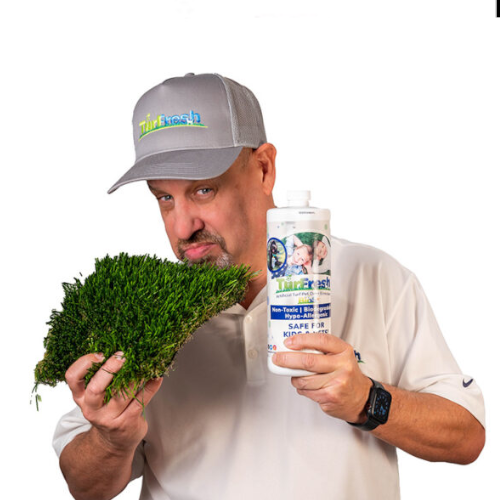

John Pla is the owner of TurFresh and an expert with over 20 years of experience in artificial turf cleaning and maintenance. John’s passion for sustainability, community impact, and innovative solutions has made him a trusted figure in the artificial grass industry and beyond.