
TL;DR
Yes – restoring turf fibers can significantly reduce pet odor, but only when the process targets the compacted infill layer where urine residue accumulates. Regular rinsing and surface cleaning don’t reach that depth. TurfBloom™ by TurFresh decompacts the infill, releases embedded odor sources, and applies organic odor-neutralizing treatment at the source – delivering results that surface-only cleaning cannot.
⚡ Quick Answer: Does fiber restoration help with pet odor?
Yes. Turf fiber restoration works by de-compacting the infill layer where pet urine accumulates and dries over time. When fibers are compacted, urine residue becomes locked in and continues releasing odor no matter how often the surface is rinsed. TurfBloom™ loosens that compacted infill, restores fiber alignment, and allows organic odor-neutralizing formulas to penetrate the full depth of the contaminated layer – addressing the source rather than masking the symptom.
If your artificial turf still smells like dog urine after hosing it down, the problem isn’t on the surface – it’s underneath it. Over time, pet waste works its way deep into the infill layer, where it gets locked in by compacted fibers and continues releasing odor no matter how often you rinse.
Turf fiber restoration addresses this at the source. By de-compacting the infill and reviving the fiber structure, the process unlocks embedded odor sources and allows professional-grade treatments to reach where they need to go. This guide explains exactly how the process works, what you should realistically expect, and when restoration alone is enough – versus when a combined approach delivers better results.
What Causes Pet Odor in Artificial Turf?
Pet odor in artificial turf is caused by urine that has absorbed into and bonded with the infill material – not the surface fibers themselves.
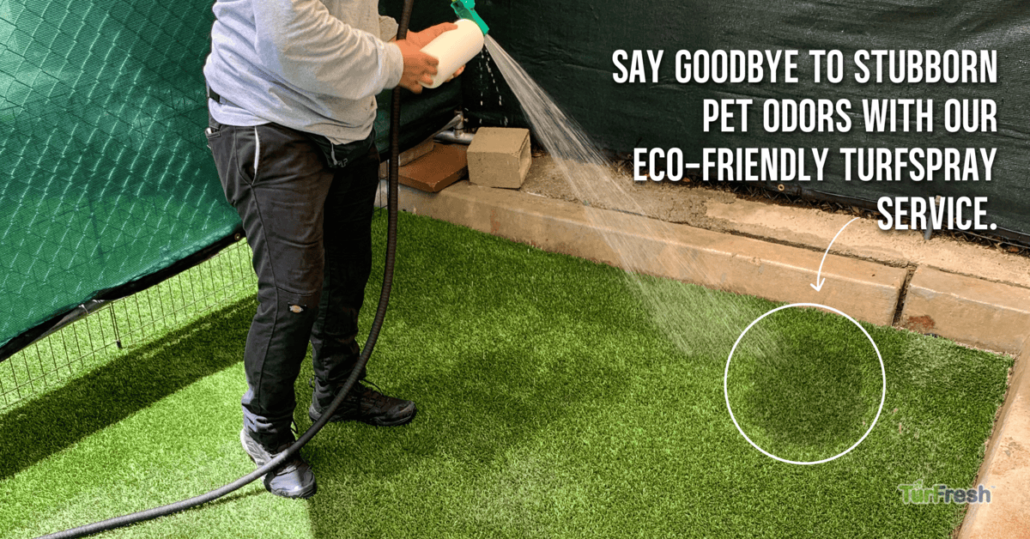
When a dog urinates on turf, the liquid passes through the fiber layer and saturates the infill below. In new, properly maintained turf, that liquid drains away cleanly. But as turf ages and infill compacts from repeated foot traffic and pet use, drainage slows. Urine pools, concentrates, and eventually dries inside the packed infill – creating a persistent odor source that sits just below the surface where cleaning products rarely reach.
How Urine Gets Trapped in Compacted Infill
Compacted infill is the primary reason pet odor becomes chronic in artificial turf.
As infill granules pack tightly together from use, two problems emerge simultaneously. First, drainage is restricted – so urine lingers longer in the infill rather than passing through. Second, the dense surface makes it nearly impossible for any cleaning agent applied from above to reach the contaminated material below.
Urine residue accumulates layer by layer until the smell is effectively embedded in the structural layer of the turf. Standard spray treatments can neutralize what they contact, but they simply can’t penetrate compacted infill deeply enough to eliminate the full source.
Why Rinsing and Surface Cleaning Don’t Fully Work
Rinsing removes surface waste – but rarely reaches the infill layer where odor originates.
Most rinse water runs off the compacted surface before it penetrates deep enough to flush out residue underneath. Even enzyme-based sprays applied from the top have limited reach when infill is tightly packed – the active ingredients can’t contact the bacteria producing the odor at depth.
This is why turf that gets regularly rinsed can still smell intensely of pet urine – especially in hot weather, when heat activates the dried residue and amplifies the release of ammonia compounds.
💡 Pro Tip
If your turf smells worse on hot summer days than it does right after rain, that’s a clear sign of embedded infill contamination – not a surface problem. Heat activates dried urine residue and causes it to off-gas ammonia compounds. Hosing it down offers temporary relief, but the odor returns within hours because the source is still there.
What Is Turf Fiber Restoration – and What Does It Actually Do?
Turf fiber restoration is a professional process that loosens compacted infill, revives flattened fibers, and restores the turf’s original drainage capacity and structural performance.
It is not a cleaning service. While cleaning removes surface contaminants, restoration works on the physical structure of the turf – specifically the infill layer and fiber alignment. TurfBloom™ by TurFresh is TurFresh’s dedicated fiber revival and infill decompaction service, built specifically for this purpose.
How Decompaction Releases Embedded Odor Sources
Decompaction is the core mechanism that makes fiber restoration effective for pet odor.
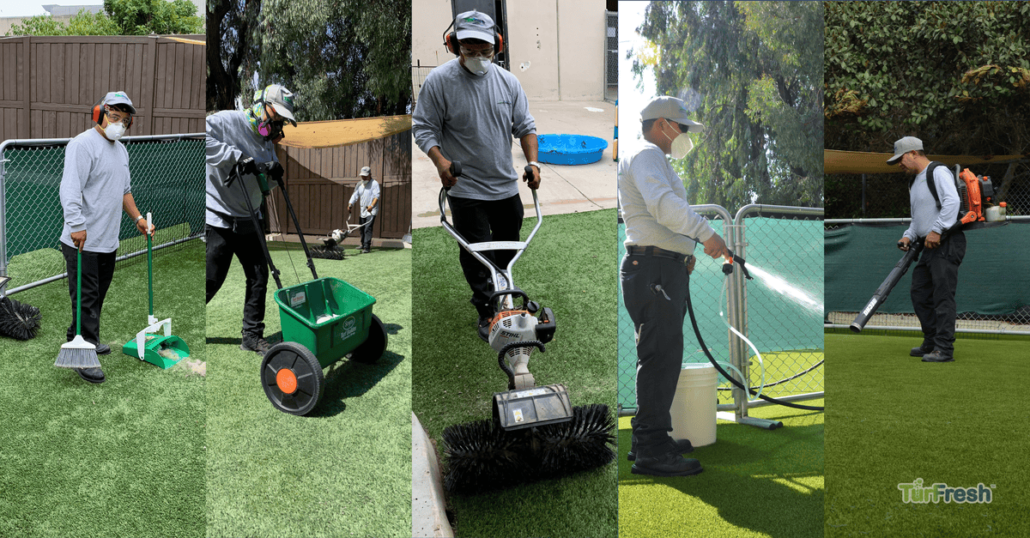
By agitating and lifting the compacted infill layer, decompaction reopens drainage channels, dislodges trapped urine residue, and creates space for odor-neutralizing treatments to penetrate the full depth of the infill. Think of compacted infill like a saturated sponge that has been squeezed tightly shut. Rinsing the outside doesn’t clean the inside. Decompaction is what opens the sponge back up.
Once the infill layer is de-compacted, odor-eliminating formulas – including TurFresh’s BioS+ – can reach the bacteria-laden residue that was previously inaccessible. This is the step that makes the difference between temporary odor reduction and lasting results.
What TurfBloom™ Does Step by Step
Here is what happens during a TurfBloom™ service:
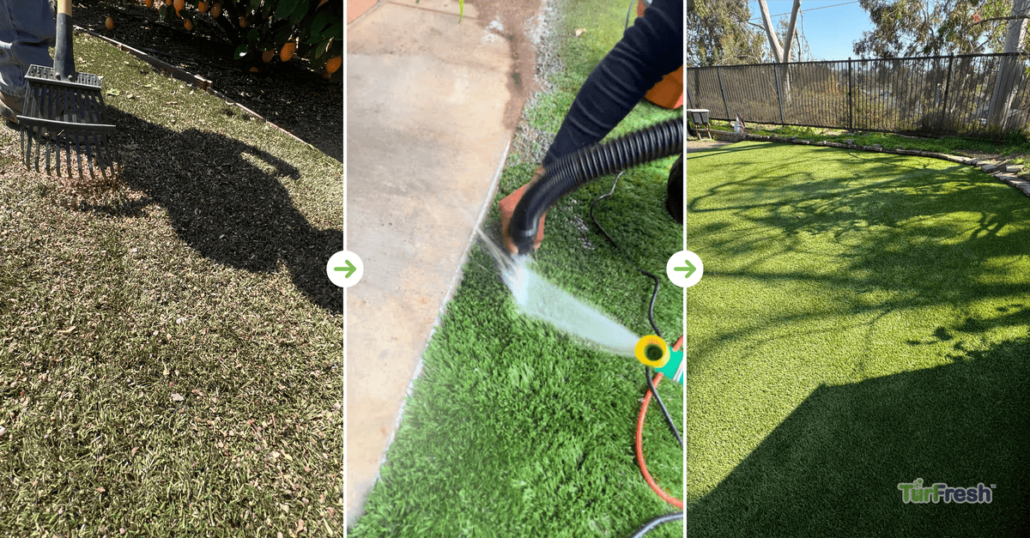
👉 1. Technicians inspect the turf for compaction severity, fiber lay, and drainage condition.
👉 2. Specialized equipment decompacts the infill layer without damaging the backing or fiber roots.
👉 3. Flattened fibers are systematically lifted and realigned to restore their upright position.
👉 4. BioS+ or BioX – TurFresh’s non-toxic, organic odor-eliminating formulas – are applied to the now-accessible infill to neutralize bacterial odor sources at depth.
👉 5. The infill is groomed back to a consistent, even distribution across the turf surface.
👉 6. The turf is assessed for drainage and structural health before the service is complete.
📌 The result is turf that drains properly, fibers that stand upright, and an infill layer that is no longer harboring concentrated odor.
Does Restoring Turf Fibers Actually Reduce Pet Odor?
Yes – turf fiber restoration measurably reduces pet odor, particularly in cases where chronic smell persists despite regular rinsing and surface cleaning.
The key distinction is mechanism. Cleaning removes what is on the surface. Restoration removes what is embedded in the structure. For pet owners dealing with persistent, heat-activated odor that does not respond to surface treatments, restoration addresses the actual source rather than masking it.
What Results to Expect After TurfBloom™
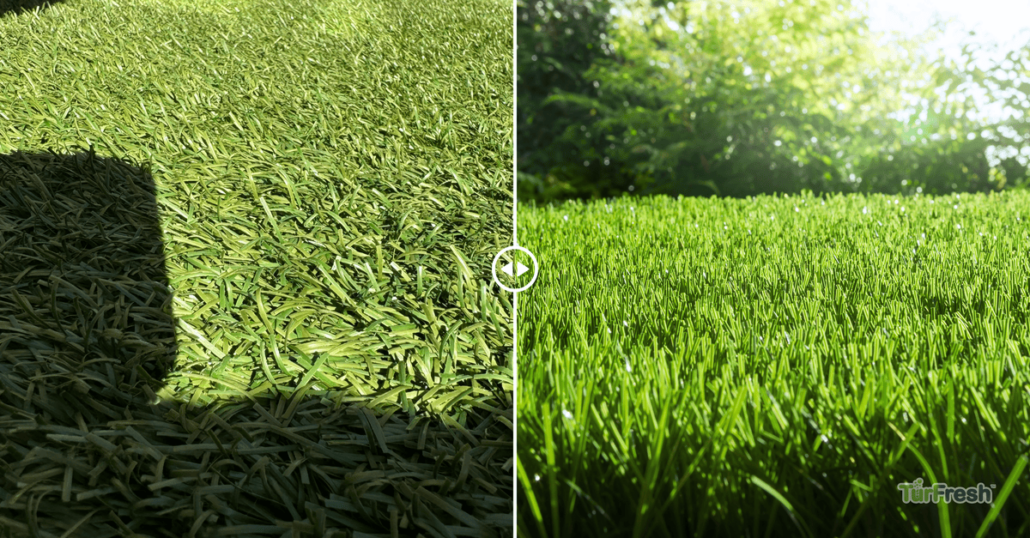
After a TurfBloom™ service, most pet owners notice a significant reduction in odor – particularly the persistent heat-day urine smell that returns repeatedly after rinsing.
Additional results typically include:
➧ Improved drainage speed and consistency throughout the turf area
➧ Fibers returning to an upright position, reducing the matted or flattened appearance
➧ Better penetration and effectiveness for future cleaning product applications
➧ Longer intervals between noticeable odor buildup compared to pre-service condition
➧ Improved overall turf appearance, texture, and playability
Results are most dramatic on turf that has not been professionally serviced in two or more years, or that experiences high daily pet activity from multiple or large-breed dogs.
When Fiber Restoration Alone Isn’t Enough
Fiber restoration is highly effective for odor caused by embedded infill contamination – but it is not a substitute for professional deep cleaning when surface contamination is also present.
If your turf has active waste residue, algae growth, mold, or heavy surface buildup, TurfClean™ – TurFresh’s deep-cleaning service – should be performed alongside or prior to TurfBloom™. In the most common scenario for pet owners, both services are most effective when combined: TurfClean™ removes surface contamination while TurfBloom™ addresses what is below the surface.
TurfBloom™ vs. TurfClean™ – Which Does a Pet Owner Need?
The right service depends on where your odor problem originates. Most pet owners benefit from both – but understanding what each service targets helps you prioritize correctly.
Category ➡️ TurfClean™ ➡️ TurfBloom™
👉 Primary function ➡️ Deep surface cleaning + pet odor removal ➡️ Fiber revival + infill decompaction
👉 Targets ➡️ Surface waste, bacteria, algae, odor agents on fibers ➡️ Compacted infill, embedded urine residue, restricted drainage
👉 Odor mechanism ➡️ Neutralizes odor agents on fiber surfaces ➡️ Releases and treats odor trapped in the infill layer
👉 Best for ➡️ Regular maintenance, post–rain cleanups, visible surface contamination ➡️ Persistent odor despite cleaning, matted fibers, aging or heavy–use turf
👉 Typical frequency (pet households) ➡️ Every 3–6 months ➡️ Every 6–12 months (more often for 3+ dogs)
👉 Can be combined? ➡️ Yes – most effective when paired with TurfBloom™ ➡️ Yes – most effective when paired with TurfClean™
💡 Pro Tip
If your turf is both dirty on the surface and compacted below – which is common after 12-18 months of regular pet use – TurFresh recommends scheduling TurfClean™ and TurfBloom™ together. The combination delivers the most complete odor elimination in a single service visit, and is more cost-effective than two separate appointments.
How Often Should Pet Owners Schedule Fiber Restoration?
For households with one to two dogs, TurfBloom™ is recommended every 6-12 months depending on turf usage and the severity of odor buildup.
Homes with three or more dogs, large or high-activity breeds, or high-traffic turf zones may benefit from restoration every 4-6 months. The best guide is the condition of your turf – not just a fixed calendar.
Key indicators that it is time for TurfBloom™:
🔑 Odor persists more than 24 hours after thorough rinsing
🔑 Fibers appear consistently flat, matted, or compressed across high-use zones
🔑 Turf drains noticeably slower than it did when it was newer
🔑 Surface cleaning and spray treatments are producing diminishing odor results over time
🔑 Hot-day odor spikes are occurring that were not present when the turf was first installed
5 Things You Can Do Between Professional Services
✅ Professional restoration delivers the most effective and lasting results, but these maintenance habits meaningfully extend the time between service needs:
✅ Rinse high-use zones two to three times per week – not the entire lawn. Focus on the specific areas where your dog urinates most frequently to flush fresh residue before it has a chance to dry into the infill.
✅ Apply BioS+ monthly to active pet areas. Its non-toxic, organic formula breaks down urine at the bacterial level without harsh peroxides, masking fragrances, or compounds harmful to pets or children.
✅ Brush fibers regularly with a stiff-bristle broom in the direction opposite to the natural fiber lay. This slows premature matting and extends the structural life of the fiber between professional restorations.
✅ Avoid placing rubber-backed furniture, mats, or planters directly on turf for extended periods. These items restrict drainage in concentrated areas and accelerate localized infill compaction.
📌Schedule TurfClean™ before peak summer heat. Embedded residue off-gases most intensely when temperatures rise, so entering summer with a clean surface significantly reduces seasonal odor spikes.
💡 Pro Tip: BioS+ is safe immediately after application
BioS+ contains no harsh peroxides, masking fragrances, or toxic compounds. Pets and children can return to the turf area immediately after application – no waiting period, no airing out, no rinsing required.
Frequently Asked Questions
Does turf fiber restoration remove pet urine smell for good?
• Restoration significantly reduces pet odor by addressing the compacted infill where urine residue accumulates. Results are long-lasting but not permanent – ongoing pet use will gradually recompact infill over time. Pairing TurfBloom™ with regular TurfClean™ services and monthly BioS+ applications delivers the most durable odor control between professional visits.
How long does TurfBloom™ take, and when can pets return to the turf?
• A typical TurfBloom™ service takes one to three hours depending on the size and condition of the turf. Because TurFresh uses BioS+ and BioX – non-toxic, organic formulas – pets and children can return to the turf immediately after the service is complete. No waiting period or airing out is required.
Why does my artificial turf smell worse in hot weather even after cleaning?
• Heat activates dried urine residue in the infill layer, triggering the release of concentrated ammonia compounds. If the infill is compacted, that residue was never fully flushed out during surface cleaning. Intensifying heat-day odor that persists even after regular maintenance is the most reliable indicator that fiber restoration – not just surface cleaning – is needed.
Can I restore turf fibers myself with DIY tools?
• Some homeowners use power brooms or landscape rakes for basic fiber lifting, and these tools do improve fiber appearance. However, they do not achieve the deep infill decompaction that professional equipment provides. DIY methods rarely reach the infill depth required to release embedded pet odor, making them useful for maintenance between services but not a substitute for professional restoration.
Is turf fiber restoration worth it, or should I just replace the turf?
• For structurally sound turf – turf with no cracked backing, seam separation, or drainage failure – restoration is almost always the financially superior option. Turf replacement typically costs $8-$20+ per square foot installed. A professional TurfBloom™ service restores full functionality and eliminates embedded odor at a fraction of that cost, typically extending the useful life of the turf by several years.
How do I know if my turf needs fiber restoration or just cleaning?
• If odor persists more than 24 hours after thorough rinsing, fibers appear consistently matted, or drainage has visibly slowed compared to when the turf was newer, restoration is likely what you need. If the problem is primarily visible surface waste or contamination without embedded odor, cleaning may be sufficient – though combining both services in one visit delivers the most complete outcome for pet households.
Does TurfBloom™ work on all types of artificial turf infill?
• TurfBloom™ is compatible with the most common residential and commercial infill types, including crumb rubber, silica sand, and organic infill blends. TurFresh technicians assess infill type and compaction condition during the initial inspection to ensure the appropriate decompaction method and product formula are applied for that specific turf.
Ready to Eliminate Pet Odor at the Source?
If your artificial turf still smells despite regular rinsing and surface cleaning, the problem is below the surface – and TurfBloom™ is built to fix it. TurFresh has completed 150,000+ professional services across the U.S., backed by a ✅ 30-Day Satisfaction Guarantee on Every Service.
Not sure which service is right for your turf? Our team will assess your specific situation and recommend the most effective combination of services for your pet load and turf condition.
Ready for an Odor-Free Yard?
📞 Call (855) 444-8873 or 📱 text (714) 709-2551 to get started.
Professional Artificial Grass Cleaning
🛒 Turf Cleaning Products | Deep Clean Your Turf and Infill
Give your family and pets the clean, fresh outdoor space they deserve.
👉 New customers receive 10% OFF
Share

John Pla is the owner of TurFresh and an expert with over 20 years of experience in artificial turf cleaning and maintenance. John’s passion for sustainability, community impact, and innovative solutions has made him a trusted figure in the artificial grass industry and beyond.