Routine Turf Maintenance vs Deep Cleaning: Which Tier Do You Actually Need?
Apr 1, 2020 · 20 min read · By John Pla, Founder of TurFresh
Quick Answer: Routine turf maintenance vs deep cleaning is not a choice between one or the other. It is a two-tier system where the right balance depends entirely on how your yard is used. Tier 1 (light use, no pets or one small dog): DIY surface maintenance every 1 to 4 weeks plus one professional deep cleaning per year is sufficient. Tier 2 (pet household with one or two dogs): DIY weekly plus professional deep cleaning every 3 to 6 months. Tier 3 (multi-dog or pet-intensive): DIY daily rinsing plus professional deep cleaning every 4 to 12 weeks. Professional deep cleaning is not overkill for Tier 2 and Tier 3 households it is the only tool that reaches the infill layer where urine compounds, bacteria, and fine organic debris accumulate beyond the reach of any surface routine. The signal that your DIY tier is no longer sufficient: pet odor that returns within 48 hours of a correct DIY cleaning session with full dwell time.
You have not failed at maintenance. You have a Tier 3 lawn and a Tier 1 schedule.
Once urine compounds crystallize in the infill layer, no surface treatment reaches them. TurFresh professional deep cleaning extracts what DIY stops at, resets the infill to a clean baseline, and backs it with a 30-day odor removal guarantee. Over 150,000 services completed across California, Arizona, Texas, Nevada, and Florida.
Book Your Deep Cleaning✔ Pet-Safe✔ Kid-Safe✔ 150,000+ Services✔ 30-Day Guarantee
Key Takeaways
✅ Professional deep cleaning is not overkill. It depends entirely on your tier. A light-use yard without pets genuinely only needs one professional cleaning per year or less. Calling that overkill for a pet-intensive household with three large dogs misunderstands the problem. The tier framework below gives you the specific answer for your situation rather than a one-size-fits-all verdict.✅ DIY routine maintenance and professional deep cleaning solve different problems at different layers. DIY handles the surface: debris, fresh pet waste, light rinsing, fiber brushing. Professional cleaning handles the infill layer: urine crystals, embedded bacteria, compacted organic debris, and drainage restoration. Both are necessary. Neither replaces the other.
✅ The 48-hour signal tells you your tier has shifted. If pet odor returns within 48 hours of a complete, correctly executed DIY cleaning session including enzyme treatment with full dwell time, the contamination source has moved below the surface into the infill layer. No surface product reaches it at that stage. This is the reliable signal that professional cleaning is no longer optional.
✅ DIY consistency matters more than DIY intensity. A few minutes of surface maintenance every week does more for turf lifespan than a heavy cleanup once every few months. The goal of DIY routine maintenance is to slow infill saturation, not to replace professional cleaning. Consistent light maintenance extends the interval between professional services.
✅ Premium artificial turf rated for 15 to 20 years can fail in 8 to 10 years without the correct tier of professional maintenance. Uric acid from unmanaged pet use breaks down backing adhesives and degrades infill over time. The cost of premature replacement, typically $5,000 to $15,000 for a residential installation, consistently exceeds the cost of a correct professional cleaning schedule over the same period.
What DIY Routine Maintenance Actually Does (and What It Does Not)
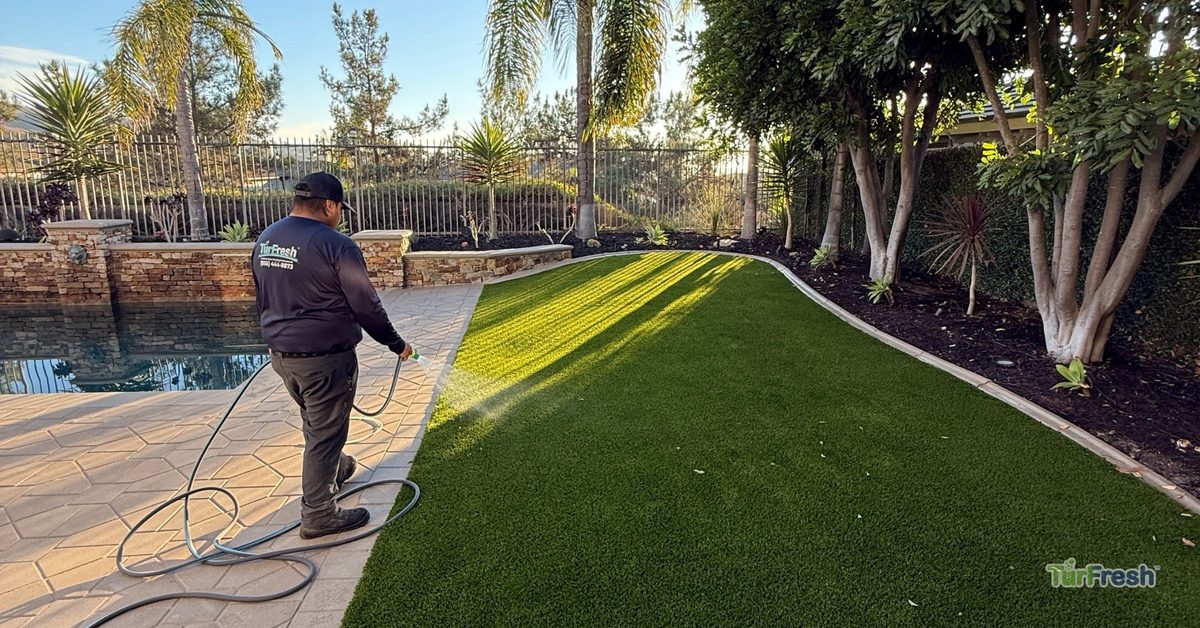
Understanding the exact capability boundary of DIY maintenance is the foundation of the tier decision. Most turf owners either over-rely on DIY or dismiss it entirely. Both are mistakes.What DIY routine maintenance does well:
Surface debris removal keeps the turf looking clean and prevents organic material from working its way into the fiber bed where it becomes harder to remove. Weekly rinsing of pet zones flushes fresh urine through the drainage layer before it has a chance to concentrate in the infill. Brushing against the grain every 2 to 4 weeks keeps fibers upright, improves drainage efficiency, and slows the matting that makes turf look aged. Enzyme spot treatment with TurFresh BioS+ applied to confirmed pet zones after rinsing breaks down uric acid at the surface before it migrates downward.
What DIY routine maintenance does not do:
DIY surface maintenance does not reach the infill layer. The layer of silica sand or rubber granules between the fiber blades is where urine compounds, bacteria, and fine organic debris accumulate over months of use. A garden hose delivers water pressure sufficient to flush the surface and penetrate the upper fiber layer. It does not deliver the extraction force needed to draw crystallized uric acid and bacterial colonies out of the infill granules. An enzyme spray applied at the surface reacts with what it contacts in the upper fiber layer. It does not penetrate 3 to 4 centimeters into the infill bed where saturation accumulates over time.
This is not a failure of DIY tools. It is a physical limitation of surface-applied maintenance. Professional deep cleaning uses extraction equipment specifically designed to reach that layer. The two approaches are complementary, not competitive.
The 3-Tier Framework: Which Schedule Is Right for Your Yard
Tier 1: Light-Use Yards and What They Actually Need
If your yard has no pets or one small dog with low daily use, professional deep cleaning once a year is a legitimate and sufficient schedule. This is not a compromise. It is the correct tier for your situation.The annual professional service resets what has accumulated in the infill over 12 months of light use: fine dust, pollen, minor organic debris, and the low-level bacterial load that builds up even in low-use conditions. It also provides an opportunity for fiber restoration and infill redistribution that DIY brushing cannot fully replicate.
Between annual professional services, a consistent monthly DIY routine is sufficient for Tier 1:
Remove surface debris with a leaf blower or plastic rake weekly. Rinse the full surface monthly, or after any heavy use event. Brush against the grain every 4 to 6 weeks to keep fibers upright and infill distributed. Inspect the perimeter for weed germination along edges after rain.
There is no need for enzyme treatment between professional visits for a Tier 1 yard without active pet use. If a pet accident occurs, rinse the zone immediately, apply BioS+ enzyme treatment, allow 10 minutes of dwell time, then rinse again. This single-event response is sufficient for low-frequency pet use.
📌 If you have a Tier 1 yard and the turf is more than 3 years old without a professional cleaning, schedule one service before deciding your ongoing tier. Accumulated infill debris from years of light use often produces a significant before-and-after contrast on the first professional service.
Tier 2: Pet Households and the Right Balance Between DIY and Professional
A household with one or two dogs represents the most common situation for TurFresh customers, and also the situation where incorrect tier selection creates the most problems. Tier 2 households that operate on a Tier 1 schedule are the primary source of "the smell keeps coming back" calls.One medium dog urinating on a 500 square foot turf area deposits approximately 1 to 2 liters of urine per day depending on the dog's size and water consumption. Over 12 weeks, that is 85 to 170 liters of urine processed through the turf system. Weekly rinsing flushes a significant portion at the surface level, but the fraction that penetrates into the infill accumulates as the infill's capacity to neutralize uric acid becomes progressively saturated.
For a Tier 2 yard, the weekly DIY routine is non-negotiable: rinse pet zones after every use if possible, or a minimum of 3 times per week. Apply BioS+ enzyme treatment to confirmed pet zones after rinsing, 2 to 3 times per week, with 10 minutes of dwell time minimum before the final rinse. Brush the full yard against the grain every 2 to 3 weeks. Check infill levels in high-use zones every 2 to 3 months and top up with TurFill deodorizing infill when the surface feels hard or backing becomes visible between fibers.
Professional TurfClean service every 3 to 6 months provides the infill-layer extraction that the DIY routine cannot. The 3-month interval applies to two larger dogs, a hot climate, or a yard under 500 square feet where urine concentration is higher. The 6-month interval applies to one smaller dog in a moderate climate with a consistent weekly DIY routine.
Tier 3: Pet-Intensive Yards and Why the Schedule Is Different
Tier 3 is not a scaled-up version of Tier 2. It is a qualitatively different maintenance situation. Two large dogs or three dogs of any size generate a volume of daily urine that overwhelms the infill's neutralization capacity significantly faster than any weekly DIY routine can prevent.The practical reality for Tier 3 households: even a perfect DIY routine significantly slows infill saturation but does not prevent it. The daily rinsing requirement is not theoretical. A 75-pound dog deposits 1 to 2.5 liters of urine per day. Two such dogs on a 400 square foot turf area deposit enough urine per week to exceed the safe threshold for infill neutralization without daily flushing and weekly enzyme treatment.
The professional cleaning interval for Tier 3 is not about severity of the problem. It is about maintaining a clean baseline before the infill reaches the saturation threshold where odor becomes self-sustaining. A 6-week professional cleaning at a Tier 3 household keeps the infill below saturation. Waiting 12 weeks means two professional cleanings worth of accumulated uric acid crystals must be extracted rather than one.
For Tier 3 households, TurFresh offers recurring monthly and bi-monthly professional cleaning plans. The per-service cost on a recurring plan is lower than individual bookings, and the consistent interval produces consistently better results than irregular crisis cleanings.
📌 The most common mistake in Tier 3 households is doing one professional cleaning after the odor becomes severe, experiencing dramatic improvement, then returning to a Tier 1 DIY schedule. The odor returns within 4 to 6 weeks because nothing has changed about the daily urine volume. The correct response is to use the clean infill baseline as the starting point for a consistent Tier 3 professional schedule, not as evidence that one cleaning is enough.
What Professional Deep Cleaning Actually Does That DIY Cannot
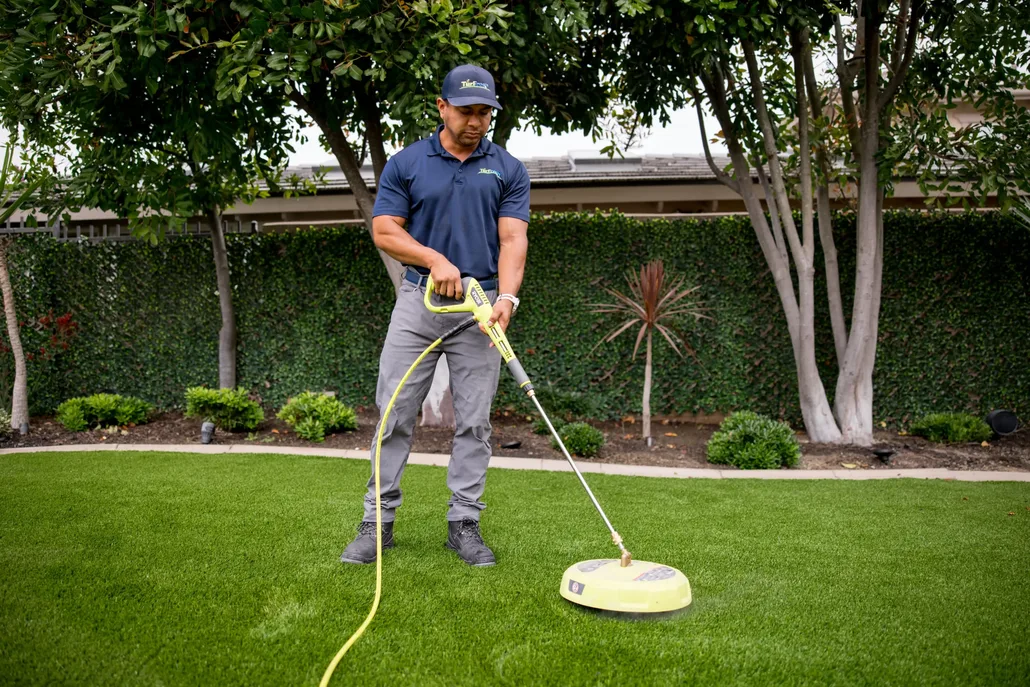
TurFresh TurfClean service uses a multi-step process specifically designed to address what surface maintenance stops at.
Hot-water extraction: flushes pet waste compounds, bacteria, and fine organic debris out of the infill layer using extraction equipment that generates the pressure and temperature needed to reach below the fiber line. This is the step that no surface rinse can replicate.
BioX bacterial treatment: applied as part of the professional service, BioX is TurFresh's disinfection formula that eliminates bacteria and pathogens at the infill level. BioX is non-toxic and requires no waiting period after application. Dogs can return to the surface as soon as it dries.
Infill decompaction: powered grooming equipment redistributes compacted infill from high-use zones back to an even level across the surface. This restores drainage efficiency, fiber support, and the cushioning function that prevents matting.
Fiber restoration: powered brushing lifts fibers that have matted in high-traffic zones back toward vertical. For yards requiring more intensive fiber restoration, TurfBloom service adds a dedicated reblooming step that addresses fiber fatigue from prolonged compaction.
Post-service inspection: technicians assess the infill condition and identify any zones requiring additional attention, infill replenishment, or the TurfBloom fiber restoration service.
The result is a surface that has been cleaned at the layer where problems originate, not treated at the surface where symptoms are visible.
Can Compacted Infill Block Deep Cleaning From Reaching Trapped Odor?
Yes. When infill has compacted tightly enough, even professional extraction equipment struggles to fully reach urine residue locked deep inside the packed granules. In these cases, fiber restoration needs to decompact the infill first so extraction and disinfection treatments can penetrate the full depth of the contaminated layer.
Think of severely compacted infill like a sponge that has been squeezed shut and left that way for months. Spraying water on the outside of a squeezed sponge does not clean what is trapped inside it. The sponge has to be opened back up first. TurfBloom's decompaction step does exactly that: it agitates and lifts the packed infill so BioX and hot-water extraction can actually contact the bacteria and uric acid crystals they are designed to break down.
This is why the Tier 3 service column above includes TurfBloom annually alongside TurfClean, and why Tier 2 households that have gone two or more years without a professional visit often see TurfClean alone underperform on the first service. Once infill compaction has reached that point, decompaction is not a cosmetic add-on. It is what makes the deep clean fully effective.
📌 If a professional TurfClean service has already been done correctly and odor persists, ask whether the infill was severely compacted going into that visit. A follow-up TurfBloom service to decompact the infill, followed by a repeat TurfClean pass, resolves this in nearly all cases where the first service underperformed for this reason.
The Signal That Your DIY Tier Has Shifted
Turf use conditions change. A household that added a second dog in May is operating at a different tier in June than it was in April. A hot summer in Phoenix accelerates infill saturation compared to the same yard in February. Moving from a Tier 1 or Tier 2 schedule to the correct tier for your current conditions is straightforward once you know the signal.The 48-hour signal: apply BioS+ enzyme treatment correctly to confirmed pet zones after a thorough rinse. Use the full recommended dilution. Allow the full 10-minute minimum dwell time. Rinse completely. If urine odor has returned to a noticeable level within 48 hours, the contamination source is in the infill layer below the surface. Surface enzyme treatment cannot reach it. This is the signal to move to the next tier on the professional cleaning schedule.
Supporting signals that confirm the tier has shifted:
The surface feels hard and rocky underfoot in pet zones rather than having slight give. This indicates infill has compacted below the fiber line from saturation. Rinsing no longer visibly reduces the odor level even temporarily. The smell is present before any rinsing has occurred. Fibers in high-use zones stay flat after brushing rather than lifting and holding their position.
Any single one of these signals indicates the current professional cleaning interval is too long for the current use conditions. Shorten the interval and add a professional cleaning before the scheduled date to reset the infill baseline.
What Each Tier Costs and Why It Is the Right Investment
Tier 1 cost
Annual professional TurfClean service for a typical 400 to 600 square foot residential yard ranges from $150 to $350 depending on location and yard condition. DIY maintenance costs are minimal: BioS+ spot treatment for occasional pet accidents, a plastic rake or TurfComb, and time for monthly rinsing. Total annual cost for a Tier 1 household: $200 to $400 including DIY supplies.Complete Guide
📖 5 Maintenance Tips to Extend the Life of Your Artificial Turf, the complete care schedule: debris, brushing, pet waste, infill, and professional cleaning frequency.
Tier 2 cost
Two professional TurfClean services per year for a Tier 2 household ranges from $300 to $700 depending on frequency and yard size. DIY maintenance costs include BioS+ enzyme treatment used 2 to 3 times per week, which runs approximately $15 to $25 per month for the concentrate format. Total annual cost for a Tier 2 household: $500 to $1,000 including DIY supplies.Tier 3 cost
Monthly or bi-monthly professional TurfClean service for a Tier 3 household ranges from $1,200 to $4,200 per year depending on frequency and yard size. On a recurring plan, per-service rates are lower than individual bookings. Total annual cost for a Tier 3 household: $1,400 to $4,500 including DIY supplies.The replacement cost comparison
Replacing a 500 square foot residential artificial turf installation costs $5,000 to $15,000 depending on turf grade, location, and disposal of the existing system. Unmanaged uric acid accumulation in a Tier 3 household operating on a Tier 1 schedule can reduce a 15-year installation to 6 to 8 years by degrading the backing adhesive and clogging drainage perforations. The cost difference between consistent professional maintenance and early replacement is significant across the installation's rated lifespan.
One professional assessment tells you exactly what your yard needs and what it does not.
TurFresh technicians evaluate your infill condition, fiber health, and drainage function during every service visit and give you a straightforward recommendation for the right maintenance schedule. No upsell pressure. If a Tier 1 annual cleaning is right for your yard, that is what you will hear. Over 150,000 services completed. Backed by our 30-day odor removal guarantee.
Schedule Your Assessment✔ Pet-Safe✔ Kid-Safe✔ 150,000+ Services✔ 30-Day Guarantee
Frequently Asked Questions
What is the difference between routine turf maintenance and deep cleaning?
Routine turf maintenance handles surface-level care: debris removal, rinsing, brushing fibers upright, and spot enzyme treatment for pet zones. It addresses what is visible on the fiber surface. Deep cleaning uses professional extraction equipment to reach the infill layer beneath the fibers, where urine compounds, bacteria, and fine organic debris accumulate over months of use. Both are necessary and they work at different layers of the turf system.Is professional turf cleaning overkill for a yard with light use and no pets?
No, but it is needed much less frequently. A light-use yard without pets needs professional deep cleaning once per year, or possibly once every 18 months. That single annual service removes accumulated dust, pollen, and low-level bacterial load that surface maintenance cannot fully address. For a pet-intensive household, the same logic does not apply. Professional cleaning every 4 to 12 weeks is appropriate for multi-dog households, not overkill.How do I know when DIY maintenance is no longer enough?
The most reliable signal is pet odor that returns within 48 hours of a correctly executed DIY cleaning session with enzyme treatment and full dwell time. When this happens consistently, the contamination source has moved into the infill layer where surface products cannot reach it. Other signals include a hard, rocky surface feel underfoot in pet zones, fibers that stay flat after brushing, and odor that is present before any cleaning has been done.How often should artificial turf be professionally cleaned?
Frequency depends on use tier. Tier 1 (light use, no pets or one small dog): once per year. Tier 2 (one or two medium dogs with daily use): every 3 to 6 months. Tier 3 (two or more large dogs or three or more dogs of any size): every 4 to 12 weeks. In hot climates during summer months, use the shorter end of each range. Consistent DIY maintenance between professional visits extends the effective interval.What does TurFresh professional deep cleaning include?
TurFresh TurfClean service includes hot-water extraction to flush the infill layer, BioX bacterial treatment and disinfection, powered infill decompaction to restore drainage and cushioning, fiber brushing to lift matted blades, and a post-service inspection of infill condition and fiber health. Dogs can return to the turf as soon as the surface dries, typically 1 to 2 hours after service. No waiting period is required.Can I skip DIY maintenance if I have professional cleaning done regularly?
No. DIY routine maintenance and professional deep cleaning serve different purposes at different layers. Daily DIY rinsing of pet zones slows infill saturation and keeps the surface safe between professional visits. Professional cleaning resets the infill layer every few months. Eliminating DIY maintenance between professional visits means the infill saturates faster and requires more intensive extraction at each professional service, often shortening the effective interval between services.What is TurFresh BioS+ and where does it fit in a DIY routine?
TurFresh BioS+ is an enzyme cleaner formulated for artificial turf pet zones. It uses bacterial enzyme technology to break down uric acid and organic waste compounds at a molecular level rather than masking them with fragrance. It is used as part of the DIY routine between professional visits: apply to confirmed pet zones after rinsing, allow a minimum 10-minute dwell time, then rinse thoroughly. The correct dilution for the concentrate is 3.2 oz per 28.2 oz water for a 32 oz ready-to-use bottle. One 32 oz bottle covers approximately 500 square feet.Why does my turf still smell after a professional TurfClean service?
If odor persists after a correctly performed TurfClean service, the most common cause is infill that was severely compacted before the visit. Compacted infill can block extraction equipment from reaching urine residue at full depth. A follow-up TurfBloom service to decompact the infill, followed by a repeat TurfClean treatment, resolves this in nearly all cases.