Best Turf Cleaner for Dog Urine: How to Choose and What Actually Works
Nov 9, 2025 · 14 min read · By John Pla, Founder of TurFresh
If your turf still smells after cleaning, the cleaner is almost always the problem, not the turf. After 20 years and more than 130,000 turf cleaning services across the U.S., TurFresh has seen the same pattern repeat: most homeowners try two or three products before finding one that actually works. This guide breaks down how to choose the best turf cleaner for dog urine, what the chemistry differences actually mean in practice, and when each type of cleaner performs well or falls short.
TL;DR The best turf cleaner for dog urine is one that neutralizes odor compounds in the infill and backing, not just surface bacteria. Enzymatic cleaners like TurFresh BioS+ are a reliable choice for routine maintenance and mild to moderate pet use. For persistent or heavy odor in hot climates, an oxygenated cleaner like TurFresh BioX delivers more consistent results because it is not affected by heat or drying conditions the way enzymes can be.
Quick Answer To clean synthetic grass and remove dog urine odor: remove debris, rinse, then apply a turf-safe cleaner that targets urine residue and ammonia compounds in the infill and backing. If the smell returns within 24 to 48 hours, the product did not reach the real odor source.
The product is not the problem. The application might be.
TurFresh has cleaned over 130,000 turf surfaces. We built BioS+ and BioX after seeing what actually fails in the field. Pet safe from the moment it dries.
Schedule Your Turf Cleaning✔ Pet Safe✔ Eco Friendly✔ 20+ Years of Experience✔ 30-Day Guarantee
What is the best turf cleaner for dog urine?
The best turf cleaner for dog urine is one that neutralizes odor compounds from urine residue in the infill and backing, not just surface bacteria. Most cleaners that fail do so because they treat the visible surface while leaving the ammonia salts that have already settled below the turf fibers. After cleaning more than 130,000 turf surfaces across the U.S., TurFresh has seen three types of cleaners dominate the market, and they behave very differently in real conditions: • Peroxide-based turf cleaners • Enzymatic turf cleaners • Oxygenated turf cleanersWhat to look for when choosing a turf cleaner for dogs
Before comparing products, these are the criteria that actually matter in practice: ✔ Targets urine residue in the infill and backing, not just surface bacteria ✔ Pet and kid safe immediately after drying, not after hours of downtime ✔ Performs consistently outdoors in heat, humidity, and changing conditions ✔ Does not bleach, stiffen, or damage turf fibers or backing over time ✔ Neutralizes ammonia-related odor compounds, not just masks smell with fragrance If a cleaner requires keeping pets off the turf for several hours after application, or if the label says "stay off until dry" with no indication of when that is, treat that as a flag for family safety.Are peroxide-based turf cleaners a good idea?
Peroxide-based turf cleaners can look effective at first but are often a poor long-term choice. The foaming and fizzing reaction feels satisfying and can look like a deep clean, but the chemistry does not only affect bacteria. Over time, it can also affect turf fibers, infill, and backing.Common issues with peroxide-based cleaners:
⚠️ Odors can return in 24 to 48 hours, sometimes worse than before ⚠️ Repeated use can contribute to bleaching, fiber burn, stiffness, and fading ⚠️ They can dry out infill and reduce turf lifespan ⚠️ Hydrogen peroxide can irritate paws, skin, and eyes ⚠️ Long post-application downtime suggests the product is not truly family-safeBottom line: Peroxide-based cleaners are often harsh, short-lived, and carry risk for turf longevity and pet safety with repeated use.
Are enzyme turf cleaners effective for artificial grass?
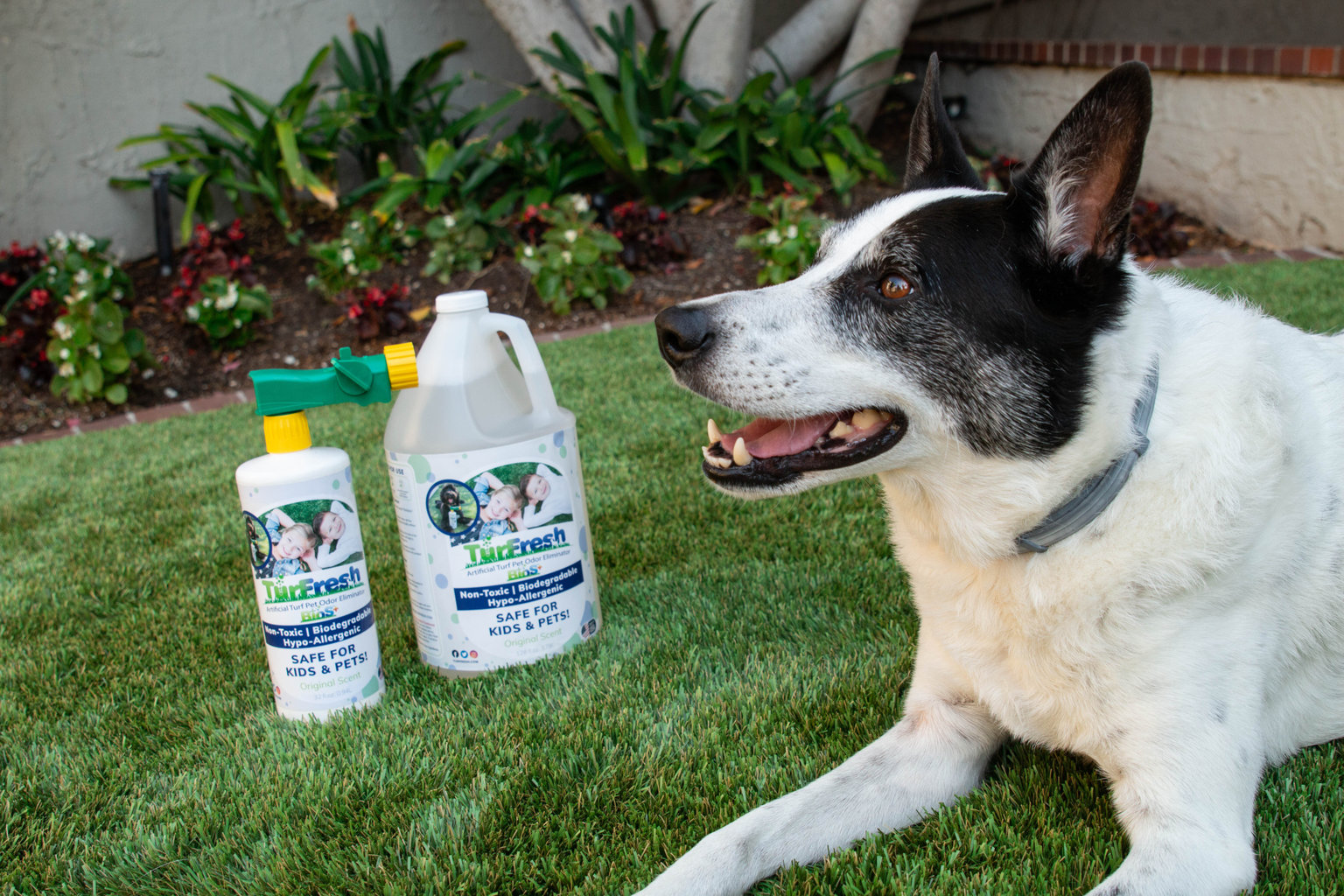
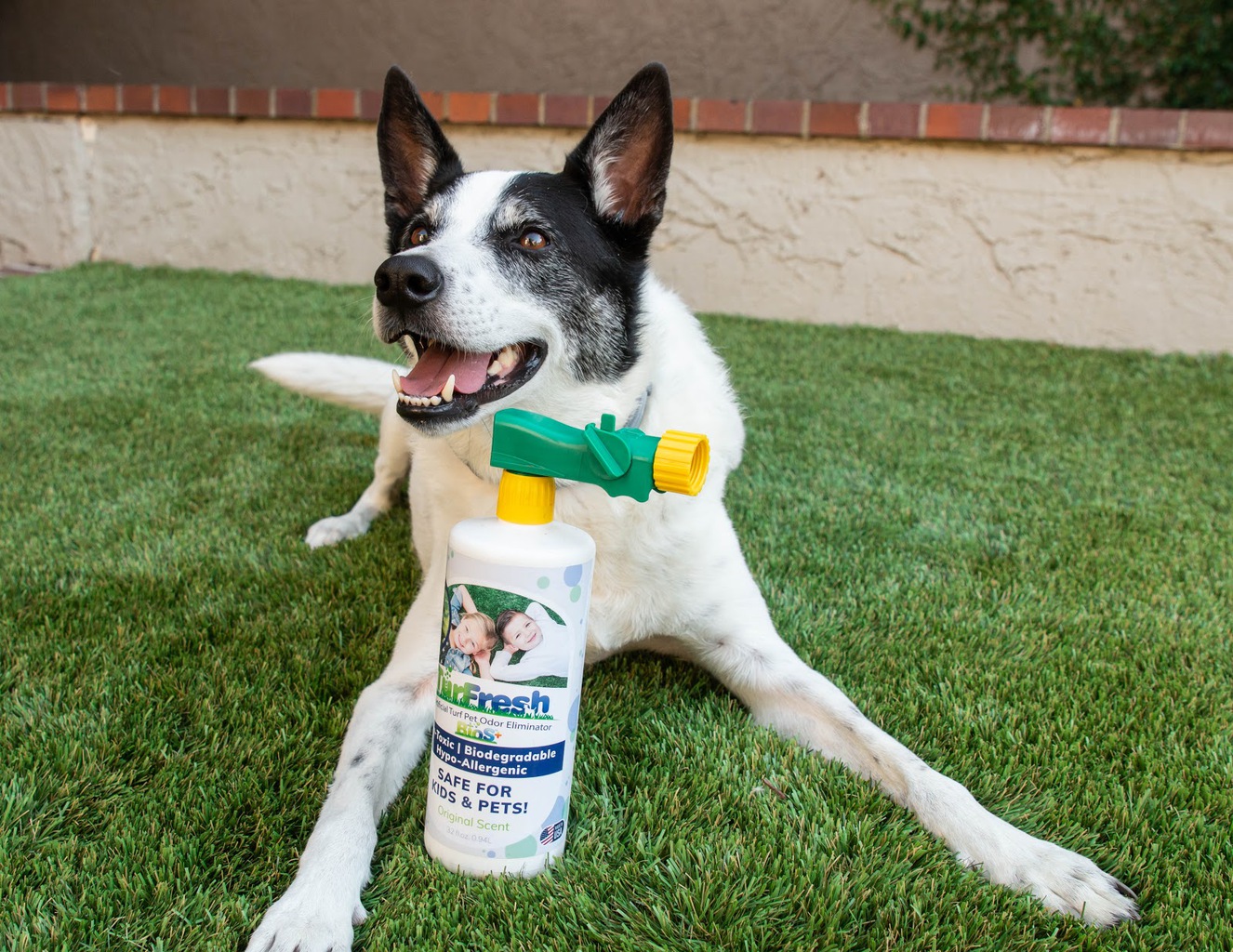
Enzymatic turf cleaners can be highly effective and are a reliable option for routine maintenance. They use beneficial bacteria to digest organic waste like pet urine and feces at a molecular level. For most homeowners with mild to moderate pet use, enzymatic cleaners are a safe and natural first choice. TurFresh BioS+ is an enzymatic turf cleaner designed specifically for synthetic grass and pet odor control. It uses beneficial bacteria to reduce harmful bacteria and support a deeper clean.Where enzymatic cleaners work best:
✔ Mild to moderate pet use ✔ Regular maintenance routines with consistent application ✔ Conditions that support dwell time without immediate dryingWhere enzymatic cleaners can struggle:
⚠️ In hot, dry weather, the biology can dry out before finishing the job ⚠️ In high-heat regions like California, Nevada, Texas, and Arizona, more frequent applications may be needed ⚠️ Very high-use pet zones with multiple dogs may exceed what enzyme biology can process consistentlyVerdict: Enzymatic cleaners are a strong, natural option and the right starting point for most households. In hot climates or heavy-use situations, results can be inconsistent.
What is the best turf cleaner for persistent pet odor?
For persistent or recurring odors, especially in hot climates or yards with multiple dogs, an oxygenated turf cleaner delivers more consistent results because it is not dependent on biological activity that can be disrupted by heat or drying. TurFresh BioX is an oxygenated turf cleaner that uses controlled, stable oxygen release to neutralize odor compounds at a molecular level. Unlike enzymatic cleaners, BioX does not rely on living organisms that can dry out or lose efficacy in outdoor conditions.BioX is designed for:
👍 Strong, recurring odors that return quickly after cleaning 👍 High-traffic pet zones with multiple dogs 👍 Hot, dry climates where enzyme cleaners can struggle 👍 Consistent performance across changing weather conditionsBioX product attributes:
• Non-toxic and free of bleach, alcohol, and harsh chemicals • Pet and kid safe • Does not fade, burn, or damage turf fibers • Designed to neutralize ammonia-related compounds, not mask themVerdict: TurFresh BioX is the stronger choice for heavy pet use, persistent odors, and hot-climate yards where consistency matters most.
BioS+ vs BioX: which turf cleaner should you choose?
 A simple decision guide:
Choose TurFresh BioS+ (enzymatic) when:
👉 You have 1 to 2 dogs with moderate daily use 👉 You want a natural, biology-based approach for ongoing maintenance 👉 You are in a mild climate or can apply in the evening when heat is lower 👉 Odor is manageable and you want to stay on top of it before it builds upChoose TurFresh BioX (oxygenated) when:
👉 Odor returns within a day or two despite regular cleaning 👉 You have multiple dogs or a small yard with high daily use 👉 You are in a hot, dry climate: California, Nevada, Arizona, Texas 👉 You need reliable results regardless of weather or application conditionsPractical tip: If you are reapplying frequently and still fighting odor, the cleaner is probably not reaching the deeper residue in the infill. That is when to switch from BioS+ to BioX, or to schedule a professional deep clean.
How does TurFresh compare to Simple Green and other popular cleaners?
Simple Green Outdoor Odor Eliminator is a widely available enzymatic option that works well for general outdoor use and light pet odor. It is safe for pets and easy to find at hardware stores. For light to moderate pet use on smaller turf areas, it is a reasonable choice. Where TurFresh BioS+ and BioX differ is in formulation specificity. Both were developed specifically for synthetic turf systems after years of field service on pet turf installations. They are designed to reach the infill layer where urine residue accumulates, not just the blade surface where Simple Green concentrates its action. For a casual backyard with one dog and light use, Simple Green can work. For persistent odor in a dedicated pet zone, a turf-specific formula outperforms a general outdoor cleaner.Why does artificial turf still smell after cleaning?
If your turf smells after cleaning, the odor source is almost always in the infill and backing, not on the turf blade surface. When dog urine enters the turf system, it breaks down into ammonia-related compounds that bind to infill granules and turf backing. Surface cleaners, including many well-rated products, only treat what they can physically contact. They cannot reach what has settled below the fibers.Practical tip: Odor that is strongest on hot afternoons or after light rinsing almost always points to buildup in the infill, not surface contamination. That is the signal that a surface cleaner will not solve it.
How to clean synthetic grass the right way
The most effective cleaning routine addresses the full turf system, not just the surface: 👉 1. Remove solid waste and debris before applying any cleaner. 👉 2. Rinse the area, especially high-use pet zones. 👉 3. Apply turf cleaner, focusing on areas pets use most consistently. 👉 4. Allow full dwell time per product instructions. Do not skip this step. 👉 5. For persistent odor zones, rinse and repeat on a regular schedule. Treat pet zones more frequently than the rest of the turf. Most odor problems start in small, repeat-use areas and spread from there.Professional cleaning reaches the infill where DIY products can't.
TurFresh's proven process cleans down to the infill and backing. Most yards are back to fresh the same day. Safe for pets and kids immediately after service.
Schedule Your Turf Cleaning✔ Pet Safe✔ Eco Friendly✔ 20+ Years of Experience✔ 30-Day Guarantee
Why does TurFresh experience matter for turf cleaner recommendations?
TurFresh was founded in 2003 and has completed more than 130,000 turf cleaning projects across the U.S. BioS+ and BioX were developed from that field experience: seeing what products failed in real conditions, what homeowners reported after 30 days, and what chemistry delivered results that held up in hot, dry climates with heavy pet use. That is a different starting point than a general pet product line adding "turf" to its label.Practical tips for turf cleaner success
✅ If the smell returns within 24 to 48 hours, your cleaner did not neutralize the odor source in the infill and backing. ✅ Treat pet zones more often than the rest of the lawn. Most odor starts in small repeat-use areas. ✅ Avoid reactive products that require long downtime after application. That is a safety signal. ✅ In hot, dry climates, apply enzyme cleaners in the evening or early morning to maximize dwell time before heat. ✅ For persistent odor, prioritize products that remove urine odor compounds, not products that mask smell with fragrance.Frequently Asked Questions
What is the best turf cleaner for dog urine?
The best turf cleaner for dog urine is one that neutralizes odor compounds in the infill and backing where urine residue accumulates. TurFresh BioS+ is a strong enzymatic choice for routine maintenance and mild to moderate pet use. For persistent or recurring odors, especially in hot climates, TurFresh BioX delivers more consistent results because it is not dependent on biological activity that can dry out outdoors.What is the best enzyme cleaner for artificial grass?
The best enzyme cleaner for artificial grass is one formulated specifically for synthetic turf and pet waste. TurFresh BioS+ is designed for this purpose and uses beneficial bacteria to reduce harmful bacteria and break down urine residue. Enzymatic cleaners work best when applied under conditions that allow dwell time without immediate drying.Can I use hydrogen peroxide on artificial grass?
Hydrogen peroxide-based cleaners can irritate paws, skin, and eyes and may contribute to turf bleaching or stiffness over time. Many peroxide-based turf cleaners provide short-lived results and can be harsh on turf materials with repeated use.How do I get dog urine smell out of artificial turf?
Rinse the affected area, apply a turf-safe odor eliminator designed for synthetic turf that targets urine residue and ammonia compounds in the infill and backing. Allow full dwell time before rinsing. If the odor returns within 24 to 48 hours, the issue is below the surface and requires a deeper-reaching cleaner or professional treatment.How does TurFresh BioS+ compare to Simple Green for turf?
Simple Green Outdoor Odor Eliminator is a good general enzymatic cleaner for light pet use and outdoor surfaces. TurFresh BioS+ is formulated specifically for synthetic turf systems and is designed to reach the infill layer where most pet odor accumulates. For persistent or heavy pet use, a turf-specific formula outperforms a general outdoor cleaner.What should I spray on turf for dog pee?
Spray a turf cleaner made for pet urine and synthetic grass that targets odor compounds and urine residue, not just surface bacteria. Avoid harsh chemicals that require long downtime or may irritate pets. TurFresh BioS+ or BioX are both designed specifically for this purpose.How often should I clean synthetic grass if I have dogs?
Most pet households do best with light rinsing after each heavy-use session and a full enzyme or oxygenated treatment of pet zones once a month. Frequency depends on the number of dogs, yard size, and climate. High-traffic potty zones need more attention than the rest of the turf.Why does my synthetic turf smell worse after it gets wet?
When turf gets wet, odors trapped in the infill and backing release more strongly. This almost always means urine residue was never neutralized at the source. Rinsing activates the ammonia compounds already in the infill, which is why the smell intensifies rather than decreasing.Do enzymatic turf cleaners work in hot climates?
Enzymatic cleaners can work in hot climates but may struggle if they dry out too quickly. In high-heat regions like California, Nevada, Arizona, and Texas, apply in the evening or early morning, follow dwell time carefully, and consider TurFresh BioX for more consistent performance.About TurFresh
Founded in 2003, TurFresh is an artificial turf cleaning and maintenance company. Using proprietary BioS+ and BioX technologies, TurFresh has completed over 130,000 turf cleaning projects across the U.S., helping families and businesses maintain clean, odor-free, pet-safe environments.Related reading
- Does Bleach Kill Dog Urine Smell? What Actually Works on Turf
- TurFresh Enzyme Cleaner: How BioS+ Works and When to Use It
- Remove Skunk Smell from Artificial Grass: What Actually Works
Ready for an Odor-Free Yard? 📞 Call (855) 444-8873 or 📱 text (714) 709-2551 to get started. Professional Artificial Grass Cleaning Turf Cleaning Products | Deep Clean Your Turf and Infill Give your family and pets the clean, fresh outdoor space they deserve. 👉 New customers receive 10% OFF