
Quick Answer:
What is fake grass called? The most common names are artificial grass, synthetic turf, and artificial turf, all describing the same product. AstroTurf is a brand name from the 1960s that became so widely used it now works as a common term for the entire category, similar to how Kleenex refers to all facial tissues. Other names you may encounter include fake turf, synthetic grass, and lawn turf. Modern artificial grass is made from polyethylene or polypropylene fibers engineered to replicate the appearance and feel of natural grass, and it is used in residential yards, commercial landscapes, dog runs, putting greens, and sports facilities.
Start fresh. One professional cleaning restores what time and use have built up.
TurFresh professional cleaning removes the bacteria, urine compounds, and debris that accumulate in artificial grass over time, reaching the infill layer where rinsing stops. Over 150,000 services completed. Pet safe. Backed by our 30-day odor removal guarantee.
✔ Pet Safe✔ Kid Safe✔ 150,000+ Services✔ 30-Day Guarantee
Key Takeaways
✅ What is fake grass called? Artificial grass, synthetic turf, and artificial turf, and all three mean the same product. The terminology varies by region, context, and generation but describes the same category of manufactured grass surface. AstroTurf is a brand name, not a product category.
✅ Modern artificial grass looks and feels significantly different from early versions. The stiff, plastic-looking turf of the 1960s bears little resemblance to current products, which use soft polyethylene fibers engineered to replicate the texture and movement of natural grass.
✅ Artificial grass requires less maintenance than natural grass but is not zero maintenance. Mowing, watering, and fertilizing are eliminated. Occasional rinsing, brushing, and annual professional cleaning keep the surface clean, hygienic, and long lasting.
✅ Residential turf is different from sports field turf. Athletic facilities use heavier infill systems, sometimes including crumb rubber. Residential installations typically use silica sand or organic infill and are designed for aesthetics and pet use rather than high impact sports.
✅ A well maintained artificial grass installation lasts 15 to 20 years. Lifespan depends on installation quality, fiber material, climate exposure, use intensity, and whether professional cleaning is performed on a regular schedule.
What Is Fake Grass Called? All the Names Explained
Ask five people what is fake grass called and you will get five answers. None of them are wrong. The names piled up over sixty years, and most of them point at the same roll of plastic grass.
The answer depends on who is talking, not on what is in the ground. Here is what each name actually means.
Artificial grass. The default term in the United States for residential and commercial lawns. Installers use it. Retailers use it. Homeowners use it. If you only learn one name, learn this one.
Synthetic turf. Same product, different room. You hear “synthetic turf” at a school district meeting about a football field, and “artificial grass” when your neighbor is talking about her backyard.
Fake grass. What people actually say out loud. There is no technical distinction here. It is the same thing, called the honest way.
Artificial turf. Interchangeable with artificial grass. Slightly more formal, which is why it shows up in facility contracts and commercial proposals more than in driveway conversations.
AstroTurf. Not a category. A brand, and a very specific one. More on that below, because the story is better than most people expect.
Lawn turf and turf grass. These two are slippery. They sometimes mean artificial grass, and they sometimes mean natural sod. Context usually sorts it out, but if you are getting a quote, ask which one the contractor means before you sign anything.
Fake turf and synthetic grass. More variants. Same product.
People ask this a dozen ways. What do you call fake grass. What is artificial grass called. Another word for fake grass. Every one of those questions has the same answer, because there is no official fake grass name or artificial grass name to find. There is only the one your installer, your neighbor, and your city's permit office each happen to use.
📌 What is fake grass called? It changes with the speaker, not with the product. AstroTurf, fake grass, synthetic turf, artificial grass: same roll, four names.
What Is the Difference Between Artificial Grass and Natural Grass?
One is a living plant system. The other is a manufactured surface that sits on top of a prepared base. Everything else follows from that.
Natural grass grows. It takes water and nutrients, it repairs itself when something tears it up, and it cools the air around it. It also demands mowing, irrigation, fertilizer, weed control, and periodic renovation to keep looking like anything.
Artificial grass does none of that. It does not grow, it does not need water to stay green, and it cannot heal a damaged fiber. What it asks for instead is surface hygiene. That is a very different job from lawn care, and it catches people off guard.
Complete Guide
📖 5 Maintenance Tips to Extend the Life of Your Artificial Turf covers the full care schedule: debris, brushing, pet waste, infill, and professional cleaning frequency.
Maintenance comparison
Natural grass wants: mowing every one to two weeks in growing season, watering several times a week in dry climates, seasonal fertilization, weed control, and reseeding wherever the lawn gave up.
Artificial grass wants: a rinse every week or two, brushing every two to four weeks so the fibers stay upright, pet waste picked up promptly, and professional deep cleaning once or twice a year to deal with what settles into the infill.
Cost comparison
Installation costs more than laying sod. Considerably more. What changes the math is everything you stop paying for afterward: the water bill, the mowing service, the fertilizer, the equipment. In most warm climate installations the gap closes somewhere between year five and year eight, though local water rates move that number around a lot.
Appearance
Natural grass browns in drought, thins out where the dog runs, and turns to mud after a storm. Artificial grass looks the same in February as it does in August. Whether that consistency reads as an advantage depends entirely on what you wanted from a yard.
Is Artificial Grass the Same as Turf or AstroTurf?
Is turf fake grass? Sometimes. Turf on its own means either natural sod or the synthetic kind, depending entirely on who is speaking. Artificial grass is the category. AstroTurf is one company inside it.
The origin is worth knowing, because it explains why the brand name stuck to everything.
The Houston Astrodome opened in 1965 with a clear roof, built so real grass could grow inside a domed stadium. Outfielders could not track fly balls through the glare, so the panels were painted over. That fixed the glare and killed the grass. The dead field was replaced in 1966 with a Monsanto product called ChemGrass, renamed AstroTurf once it arrived in Houston. The first Major League game on it, in April 1966, was played with turf on the infield only, because there was not enough of it to go around yet.
Sixty years later people still call every synthetic lawn AstroTurf, the way they call every tissue a Kleenex. It is the single biggest reason there is no settled answer to the question of what is fake grass called.
Does the distinction matter? Almost never. If a neighbor asks whether you put in AstroTurf, they mean artificial grass. The only place it counts is a commercial purchase order, where the brand determines the warranty and the spec.
Is Artificial Grass Better for Pet Owners?
For most dog households, yes. But the reason people get it and the reason they end up happy with it are two different things.
Here is what natural grass does with a dog in the yard: dead yellow rings from urine, bare dirt along whatever path the dog runs, mud tracked inside for three days after every rain, and holes wherever the digging instinct wins. Keeping a real lawn presentable in a warm climate with an active dog is a losing fight. Most people stop trying by the second summer.
Artificial grass ends all of that. Urine drains through the backing when the drainage was installed correctly. Solid waste comes off the surface. The yard looks the same in November as it did in June.
Now the part that gets glossed over in most sales conversations.
Pet urine does not disappear when it drains. Ammonia and bacterial compounds stay behind in the infill layer and build up week after week. Nothing you spray on the surface reaches them. This is why so many turf owners call us around month fourteen, convinced the product failed, when what actually happened is that nobody told them the infill needed servicing. Enzyme products like TurFresh BioS+ handle the maintenance between visits. Professional cleaning handles the layer underneath.
📌 Artificial grass is not zero maintenance for a pet household. It removes the lawn damage. It does not remove the odor problem, and the odor problem is the one that gets worse if you ignore it.
Is Artificial Grass Cheaper Than Natural Grass?
Over ten years, usually yes, if you are in a warm dry climate. Over three years, usually no. The break even point is the whole question, and it moves depending on where you live.
In Phoenix, Las Vegas, and Southern California, where irrigation runs most of the year and water is expensive, most homeowners cross into savings somewhere around year three to five. In a cooler, wetter place where grass grows on its own and the sprinklers barely run, that same crossover can take seven to ten years. If you are in the second group, do the math before anyone talks you into it.
What comes off your bills: irrigation water, mowing service, fertilizer, herbicide, pesticide, and periodic lawn renovation.
What goes on: the installation, professional cleaning once or twice a year, and eventual replacement after 15 to 20 years.
Is Artificial Grass Environmentally Friendly?
It depends on which environmental problem you are trying to solve, and anyone who gives you a clean yes or no is selling something.
The case for it is water. According to the EPA, outdoor use accounts for about 30 percent of household water use nationally, and in dry regions like the Southwest that figure can reach 60 percent. Artificial grass takes that number to roughly zero for the lawn area. It also removes the pesticides, herbicides, and synthetic fertilizers that wash into storm drains, along with the fuel burned by mowing equipment.
The case against it is material. Artificial grass is a petroleum product and it does not biodegrade when its life is over. Crumb rubber infill, made from recycled tires, has drawn scrutiny in athletic settings. Residential installations generally use silica sand or organic alternatives, which carry fewer of those concerns.
If you are in drought country in California, Arizona, Nevada, or Texas, the water argument tends to dominate everything else. In a region with steady rainfall and cheap water, it is a much closer call.
What Happens After You Install Artificial Grass?
Nobody asks this before they buy. Almost everybody wishes they had.
Week one. Your new turf may look flat and pressed down. It shipped in a roll, and the fibers held the shape. Brush it hard against the grain and it stands back up. This is not a defect, and you do not need to call the installer.
The first month. You work out your routine. Where the dog goes, how often you rinse, which products are worth buying. Most people find it takes far less time than the lawn did, which is the entire point.
Months six to twelve. Traffic patterns start to show. The path from the door to the gate, the spot where the kids land off the trampoline. Brushing those zones regularly keeps the fibers upright. Leave it long enough and the matting stops coming back. Heat makes this worse, and our guide on restoring flattened artificial turf from heat covers what to do when brushing alone stops working.
Year one. Book the first professional cleaning. Rinsing has been handling the surface this whole time, and the surface was never the problem. Fine debris and, in pet homes, urine compounds have been collecting in the infill since day one. An annual clean resets that layer. Skip it for three or four years and you get the smell that people assume means the turf is ruined.
Do that much and the installation holds up for 15 to 20 years while giving you back the weekends you used to spend behind a mower.
The best thing you can do now is start with a professional clean.
TurFresh professional cleaning removes what accumulates in the infill layer over time, restoring your turf to a clean and hygienic baseline. Book your first cleaning and see the difference. Over 150,000 services completed across California, Arizona, Texas, Nevada, and Florida.
✔ Pet Safe✔ Kid Safe✔ 150,000+ Services✔ 30-Day Guarantee
Frequently Asked Questions
What is fake grass called?
Fake grass is most commonly called artificial grass or synthetic turf. Other names include artificial turf, fake turf, and synthetic grass. AstroTurf is a brand name that has become widely used to describe the entire category, similar to how Kleenex refers to all facial tissues. All of these terms describe the same basic product: a manufactured surface made from synthetic fibers designed to replicate the appearance of natural grass.
Is AstroTurf the same as artificial grass?
AstroTurf is a brand name for one manufacturer's line of synthetic turf products. Artificial grass is the broader product category. All AstroTurf is artificial grass, but not all artificial grass is AstroTurf. In everyday conversation, most people who say AstroTurf mean artificial grass in general, regardless of the manufacturer.
What is the difference between artificial grass and synthetic turf?
There is no meaningful technical difference. Artificial grass and synthetic turf describe the same product. Synthetic turf is more commonly used in commercial, athletic, and facility contexts. Artificial grass is more commonly used in residential landscaping conversations. Both terms refer to manufactured grass-like surfaces made from synthetic fibers.
Is artificial grass cheaper than real grass?
Artificial grass costs more to install but is typically less expensive over a 10-year period for properties in warm, dry climates. Water savings, the elimination of mowing and lawn care services, and reduced chemical costs offset the installation premium within 3 to 8 years depending on local costs and climate.
How long does artificial grass last?
A well maintained artificial grass installation typically lasts 15 to 20 years. Lifespan depends on installation quality, fiber material, climate exposure, and whether regular maintenance including professional cleaning is performed. Neglected pet turf may require replacement sooner due to infill saturation.
Does artificial grass need maintenance?
Yes, but significantly less than natural grass. Mowing, watering, fertilizing, and chemical treatments are eliminated. What remains is periodic rinsing, brushing every 2 to 4 weeks, pet waste management, and professional deep cleaning once or twice a year. Pet households require more frequent attention to odor management.
My new artificial grass looks flat. Is that normal?
Yes. Artificial grass is shipped and installed in rolls, which compresses the fibers. After installation, the fibers often lie flat from that compression. One thorough brushing session against the natural grain of the fibers restores upright position in most cases. This is not a product defect and does not indicate a problem with the installation.
Share
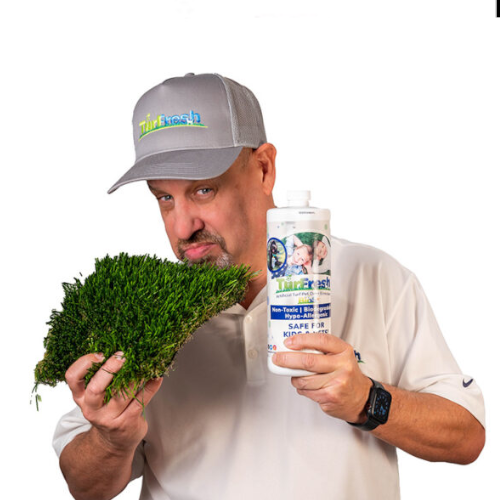

John Pla is the owner of TurFresh and an expert with over 20 years of experience in artificial turf cleaning and maintenance. John’s passion for sustainability, community impact, and innovative solutions has made him a trusted figure in the artificial grass industry and beyond.