Best Artificial Grass Cleaner for Dogs: Enzymatic, Oxygen, or Peroxide?
May 28, 2026 · 14 min read · By John Pla, Founder of TurFresh
Quick Answer: The best artificial grass cleaner for dogs depends on where you live, how many dogs you have, and what kind of odor problem you are dealing with. For most dog owners, an oxygen-based cleaner is the most reliable choice: effective in all climates, safe for kids and pets, and strong enough to sanitize without risking turf damage. Enzymatic cleaners work well in mild climates but lose effectiveness above 95°F ambient temperature, a threshold routinely exceeded on turf surfaces in Arizona, Nevada, and Texas during summer. Peroxide-based cleaners are powerful but risky without professional experience. When in doubt, oxygen-based is the answer.
Skip the trial and error. Let a professional handle it right the first time.
TurFresh has cleaned over 150,000 artificial grass installations. We know exactly which treatment your yard needs, and we bring the right products to do it properly.
Get a Free Cleaning Assessment✔ Pet Safe ✔ Eco Friendly ✔ 20+ Years of Experience ✔ 30-Day Guarantee
Key Takeaways
🔑 There is no single best artificial grass cleaner for dogs. The right choice depends on your climate, the number of dogs you have, and how established the odor problem is. Choosing the wrong type means paying for a product that either fails in your conditions or creates new problems.
🔑 Enzymatic cleaners lose effectiveness above 95°F ambient temperature. Most commercial enzyme formulas begin degrading at 95°F and become largely inactive above 113°F, temperatures that are routinely exceeded on turf surfaces in Phoenix, Las Vegas, and the Inland Empire during summer. If your enzymatic cleaner is not working, heat is almost certainly why.
🔑 Oxygen-based cleaners are the most versatile and are what TurFresh uses. They work across all climates because performance is based on a chemical reaction, not a biological one. Temperature does not affect them. This is the primary choice for the majority of professional cleanings.
🔑 Peroxide-based cleaners are powerful but carry real risk. Incorrect dilution can discolor fibers permanently and degrade backing materials. The margin for error is narrow. Leave these to experienced professionals.
🔑 Application technique matters as much as product choice. Any cleaner applied to the surface blades and rinsed immediately reaches almost nothing. Odor lives in the infill, 3 to 4 inches below the surface. Working the product into the infill with a turf brush and allowing full dwell time is the step most homeowners skip.
Why the Type of Cleaner Matters More Than the Brand
Most homeowners pick an artificial grass cleaner the same way they pick any cleaning product. They read the label, see "pet safe" and "odor eliminator," and assume the job will get done. The problem is that "pet safe" is a safety claim, not a performance claim. It tells you nothing about whether the product will actually work on your specific yard, in your climate, with your dogs.
Over 150,000 turf installations cleaned across California, Nevada, Arizona, Texas, Florida, and other major markets, and the number one reason a yard still smells after cleaning is not the brand of product used. It is the wrong type of product for the conditions.
There are three categories of cleaner used professionally on artificial turf. Each one works through a completely different mechanism. Understanding the difference is what separates a yard that stays clean from a yard that gets cleaned and smells again within a week.
The 3 Types of Artificial Grass Cleaners for Dogs
1. Enzymatic Cleaners
How they work
Enzymatic cleaners use live enzymes and beneficial bacteria that consume the organic compounds causing the smell. Dog urine, feces residue, and other organic waste are broken down at a biological level rather than chemically neutralized. The bacteria in the cleaner eat the bacteria causing the odor problem.
When enzymatic cleaners work well
✅ Mild climates (Pacific Northwest, coastal California, most of the Northeast)
✅ Light to moderate pet use, with one or two smaller dogs
✅ Yards that are cleaned consistently before odor becomes deeply embedded
✅ Homeowners who prefer the most natural, chemical-free approach
The climate limitation most people don't know about
Enzymatic cleaners have a critical weakness: heat kills the live bacteria in the formula. Most commercial enzyme formulas begin losing effectiveness at ambient temperatures above 95°F (35°C) and become largely inactive above 113°F (45°C). Turf surface temperatures in Phoenix, Las Vegas, Dallas, and the Inland Empire routinely exceed 150°F in summer, far above the threshold at which enzyme biology remains viable.
In those climates, you can apply the product correctly and get almost no result because the active ingredients have been neutralized before they reach the infill. This is why yards in hot markets can go through bottle after bottle of enzymatic cleaner without resolving the odor.
💡 Tip
If you use an enzymatic cleaner, apply it in the early morning or evening when surface temperatures are lower. At surface temperatures above 113°F, enzyme activity effectively stops. Ambient temperature matters less than surface temperature at the point of application.
2. Oxygen-Based Cleaners
How they work
Oxygen-based cleaners use activated oxygen to attack and break apart odor molecules and lift bacteria from turf fibers and infill. Unlike enzymatic formulas, the active ingredient is a chemical reaction, not a biological one. Temperature does not affect performance.
When oxygen-based cleaners work well
✅ All climates, including extreme heat
✅ Multi-dog homes with heavy daily use
✅ Yards where odor has been building for weeks or months
✅ Homeowners who want consistent results without adjusting technique by season
✅ Families with children who play directly on the turf
Why this is TurFresh's primary choice
Oxygen-based treatment is what TurFresh uses on the majority of its professional cleanings. The results are consistent across climates, the safety profile for kids and pets is excellent when applied correctly, and it reaches the infill layer where the odor actually originates, not just the surface blades.
The trade-off is that it requires proper application technique to ensure penetration into the infill. Applied to the surface only, oxygen-based cleaners will improve the smell temporarily without solving the root cause.
💡 Tip
After applying an oxygen-based cleaner, use a stiff turf brush to work the solution down into the infill before rinsing. Surface application alone is not enough for persistent odor.
3. Peroxide-Based Cleaners
How they work
Peroxide-based cleaners use stronger oxidizers to kill bacteria and neutralize odors quickly. They are the most powerful of the three categories and can be highly effective in severe contamination cases.
When peroxide-based cleaners might be considered
⚠️ Severe, long-term contamination that milder products have not resolved
⚠️ Commercial installations such as kennels, doggy daycares, and boarding facilities with extreme bacterial loads
⚠️ In the hands of an experienced professional who knows the correct dilution for the specific turf product
The risks that make this the least recommended option
High concentrations or incorrect dilution can discolor turf fibers permanently, degrade certain backing materials, and irritate dog paws if the turf is not thoroughly rinsed and allowed to dry completely before pets return. The results can be excellent, but the margin for error is narrow. Unless you have specific experience with peroxide concentrations on synthetic turf, oxygen-based products achieve comparable results more safely.
⚠️ Warning
If you use a peroxide-based cleaner, keep pets and children off the turf for a full day after application, not just until it dries. Residue can irritate paws even after the surface appears dry.
Enzymatic vs. Oxygen vs. Peroxide: Side-by-Side Comparison
| Factor | Enzymatic | Oxygen-Based | Peroxide |
|---|---|---|---|
| Works in hot climates | ⚠️ Limited (fails above 95°F) | ✅ Yes | ✅ Yes |
| Safe for pets and kids | ✅ Very safe | ✅ Safe when applied correctly | ⚠️ Caution required |
| Risk of turf damage | ✅ None | ✅ None when diluted correctly | ❌ High if misused |
| Reaches infill layer | ✅ Yes | ✅ Yes (with brushing) | ✅ Yes |
| Best for multi-dog homes | ⚠️ In mild climates only | ✅ Yes | ✅ Yes (pro use recommended) |
| DIY friendly | ✅ Yes | ✅ Yes | ❌ Professional recommended |
| TurFresh recommendation | Mild climates, light use | Primary choice | Severe cases, pro only |
The product is not the problem. The application is.
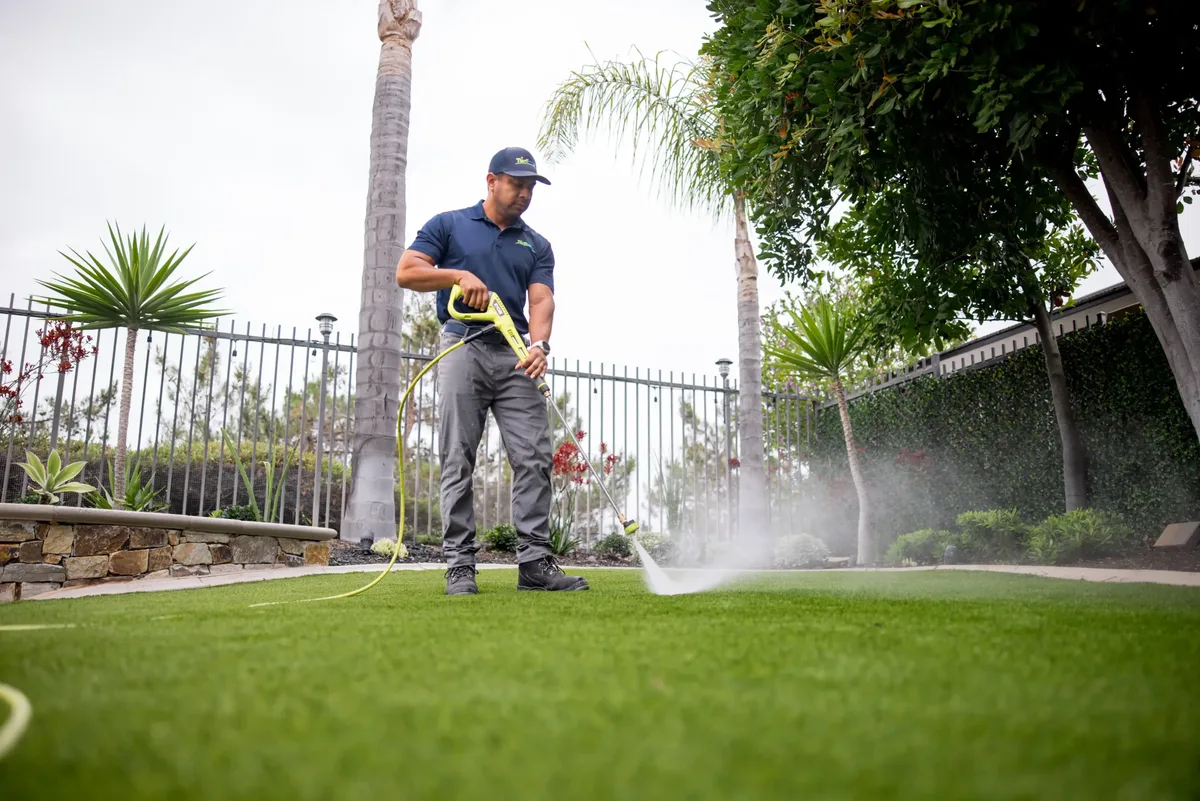
Most persistent odor comes from untreated infill, a layer no surface spray can fully reach. TurFresh uses commercial-grade equipment to clean where the bacteria actually live.
Schedule a Professional Deep Clean✔ Pet Safe ✔ Eco Friendly ✔ 20+ Years of Experience ✔ 30-Day Guarantee
How to Apply Artificial Grass Cleaner for Dogs Correctly
The product is only half the equation. The most common reason a cleaner does not work is incorrect application, specifically, applying it to the surface blades and rinsing before it penetrates the infill.
Dog urine odor does not live on the surface of the turf. It lives in the infill, 3 to 4 inches below where you spray. Any cleaner applied to the blades and rinsed immediately is doing almost nothing for the source of the smell.
Step-by-step application for best results:
➡️ 1. Remove all solid waste and debris first. Applying cleaner over organic material reduces its effectiveness and wastes product.
➡️ 2. Pre-rinse the area with water. A light rinse loosens surface contamination and opens the turf fibers before the cleaner is applied.
➡️ 3. Apply the cleaner evenly to the target area. Do not dilute beyond the label instructions. More water means less active ingredient per square foot.
➡️ 4. Work the solution into the infill with a stiff turf brush. Brush against the grain of the fibers in circular motions. This is the step most people skip, and it is the most important one.
➡️ 5. Allow full dwell time. Enzymatic cleaners need 15 to 30 minutes. Oxygen-based cleaners need 10 to 20 minutes. Do not rinse early.
➡️ 6. Rinse thoroughly from one end of the area to the other. Work in one direction to flush the treated material through the backing rather than spreading it across the surface.
💡 Tip
For yards with persistent odor despite regular cleaning, the infill itself may be saturated beyond what any topical application can reach. At that point, professional cleaning with equipment that penetrates the full depth of the installation is the correct next step.
TurFresh Products: The Best Artificial Grass Cleaner for Dogs at Home
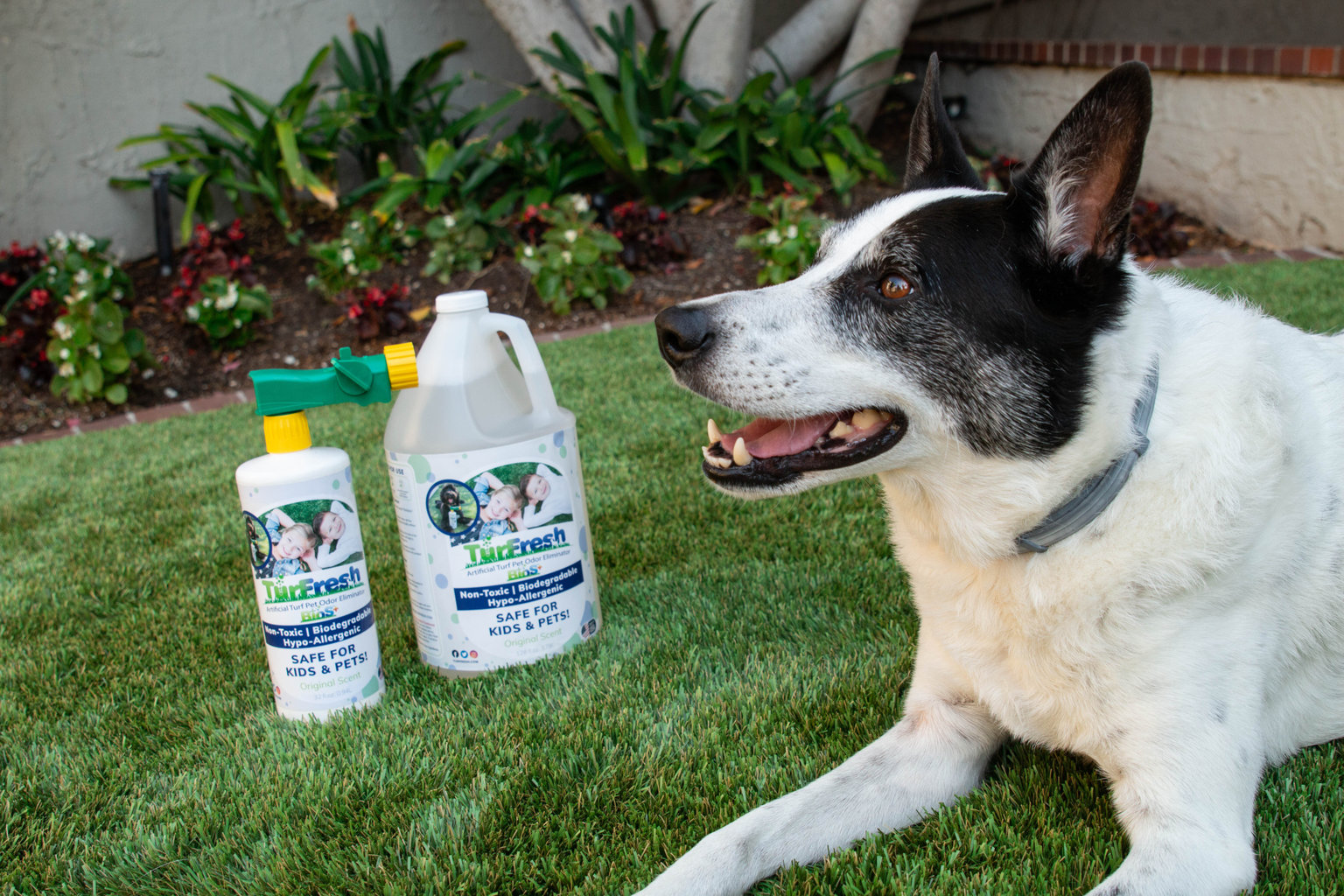
TurFresh BioS+: Enzyme-based deodorizer for weekly maintenance on high-use zones. Fast-acting, family-safe, formulated specifically for synthetic turf fibers and infill. Best for mild climates and regular preventive care.
BioTurf BioS+: Enzyme cleaner for deeper monthly treatment. Breaks down uric acid and ammonia compounds at the infill level. Apply monthly across the full surface in mild climates, weekly for multi-dog homes.
TurFill: Odor-neutralizing infill additive. Used when the infill itself is the odor source. 100% natural, non-toxic, and compatible with all turf types. Adds ongoing odor-neutralizing capacity between cleanings.
💡 Tip
No product eliminates odor permanently without consistent reapplication. The goal is a maintenance schedule that prevents buildup rather than a one-time treatment that fixes everything. Prevention is always cheaper than remediation.
Complete Guide
📖 How to Maintain Artificial Grass When You Have Dogs, the full system for pet households: daily routine, enzyme treatment, multi-dog homes, and when to call a professional.
Frequently Asked Questions
What is the best cleaner for dog urine on artificial grass?
For most climates and household situations, an oxygen-based cleaner is the most reliable choice. It works in all temperatures, is safe for pets and children, and penetrates the infill where odor originates. Enzymatic cleaners are a good alternative in mild climates but lose effectiveness at ambient temperatures above 95°F. Peroxide-based cleaners are best left to professionals due to the risk of turf damage if misapplied.Do enzymatic cleaners work on artificial grass?
Yes, but with an important limitation. Most commercial enzyme formulas begin losing effectiveness at ambient temperatures above 95°F and become largely inactive above 113°F. In hot climates like Arizona, Texas, Florida, and Nevada, turf surface temperatures routinely exceed these thresholds during summer months, significantly reducing effectiveness. If you live in a hot climate and your enzymatic cleaner is not performing, temperature is almost certainly the cause.Is it safe to use cleaning products on artificial grass with dogs?
Yes, when using products formulated for synthetic turf. Enzyme-based and oxygen-based cleaners designed for artificial grass are safe for pets and children when applied as directed and allowed to dry. Avoid bleach, ammonia, and household disinfectants. Peroxide-based products require careful handling and pets should stay off the turf for a full day after application.Why does my artificial grass still smell after using a cleaner?
The most common cause is application technique, not product failure. If the cleaner was applied to the surface and rinsed quickly without being worked into the infill, it did not reach the bacteria causing the odor. Odor lives in the infill layer, 3 to 4 inches below the surface blades. Working the product into the infill with a turf brush and allowing full dwell time before rinsing is what makes the difference. If odor returns within a few days despite correct application, the infill is likely saturated and needs professional deep cleaning.How often should you use cleaner on artificial grass with dogs?
For most households with one or two dogs, a weekly enzyme or oxygen-based treatment on high-use potty zones is sufficient for odor prevention. Multi-dog homes benefit from treating every five to seven days. A professional deep clean every two to three months resets the infill and handles buildup that home applications cannot fully reach.Can I make my own artificial grass cleaner for dog urine?
White vinegar diluted with water is a commonly suggested DIY option and does temporarily neutralize surface odor. However, it does not break down the bacteria in the infill that cause recurring smell. It is useful for light odor management between proper cleanings but is not a substitute for an enzyme or oxygen-based cleaner for consistent odor control.What do professional turf cleaners use on dog yards?
Professional turf cleaning companies primarily use oxygen-based treatments applied with commercial-grade equipment that reaches the full depth of the turf installation, including the infill and backing layer. Some use enzymatic treatments in mild climates. The difference between professional and DIY cleaning is not only the product but the equipment and technique used to get it into the infill.