
Quick Answer: You can pressure wash artificial grass in limited cases, but it is not recommended for most installations. If your turf contains infill (most residential lawns do), high-pressure water displaces the granular material that supports the fibers and causes uneven wear. If you must use a pressure washer, stay under 1,500 PSI, use a wide-angle fan nozzle, keep at least 12 inches from the surface, and never direct the spray straight down. Turf damage from pressure washing is typically not covered by installation warranties.
Professional cleaning is safer than pressure washing and reaches where a hose cannot.
TurFresh TurFlush uses controlled pressure to flush contaminants from the infill layer without displacing it. Safe for all turf systems, backed by a 30-day guarantee.
✔ Pet Safe✔ Eco Friendly✔ 20+ Years Experience✔ 30-Day Guarantee
Key Takeaways
🔑 Most residential artificial turf has infill. High-pressure water displaces infill and causes uneven fiber support, which leads to matting and premature wear
🔑 If pressure washing is unavoidable: under 1,500 PSI, wide-angle fan nozzle, minimum 12 inches from the surface, never spray straight down
🔑 Jet washing, power washing, and pressure washing are the same risk. The issue is not the tool name, it is the PSI and angle used
🔑 Turf damage from pressure washing is typically not covered by installation warranties. Most installer warranty documents explicitly exclude it
🔑 A garden hose with a fan spray setting cleans surface debris effectively without any of these risks. For deep cleaning, professional TurFlush is the appropriate tool
Can You Pressure Wash Artificial Grass?
You can pressure wash artificial grass in limited situations, but it is not recommended for most residential installations. The distinction is whether your turf contains infill.
Turf with infill (most residential and commercial installations): Pressure washing is not recommended. Infill is a loose granular material (typically silica sand, zeolite, or crumb rubber) that fills the space between fibers and supports them in an upright position. High-pressure water displaces this material, creating thin spots, uneven coverage, and fiber loss in high-use areas. Once infill is blown out or redistributed unevenly, the turf loses structural support and wears down faster.
Turf without infill (some balcony installations and hard-base systems): A gentle, low-pressure rinse is lower risk because there is no infill to displace. Even then, high pressure can stress seams and loosen adhesive backing.
Most turf installers explicitly state that damage caused by pressure washing is not covered under the installation warranty. Before using any pressure washing equipment on your turf, check your warranty documentation. The risk is not just to the turf. It is to your warranty coverage.
What Is the Difference Between Pressure Washing, Jet Washing, and Power Washing Artificial Grass?
For practical purposes, these terms describe the same risk. The tool name varies by region and brand, but the issue that matters for artificial turf is pressure (PSI) and spray angle, not which term you use.
Pressure washer: The standard term in North America. Uses a motorized pump to deliver water at high pressure. Residential models typically run 1,200 to 3,000 PSI.
Jet washer: The standard term in the UK and Australia. Same mechanism. A Karcher is the most recognized brand. Same PSI range as a pressure washer.
Power washer: Often used interchangeably with pressure washer in North America, though technically power washers heat the water. Hot water adds additional risk to artificial turf because it can soften polyethylene fiber backing at sustained contact.
The rule for all three: If it generates more than 1,500 PSI at a concentrated angle, it can damage artificial turf infill and fibers. The tool name does not change that.
UK homeowners searching for guidance on jet washing astroturf will find the same answer: the PSI limit and spray angle rules apply regardless of whether the tool is called a jet washer, power washer, or pressure washer.
Why Does Pressure Washing Damage Artificial Turf?
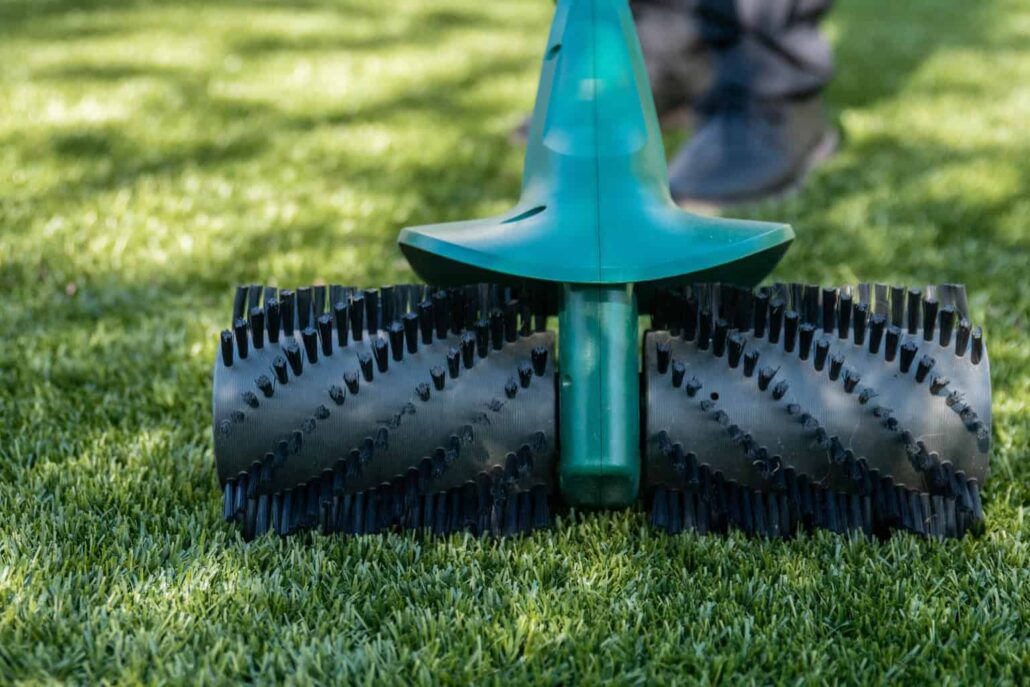
Pressure washing damages artificial turf through three mechanisms, each affecting a different part of the turf system.
Infill displacement
High-pressure water pushes loose infill granules out of their position between fibers, either blowing them to the turf edges or washing them through the backing entirely. Once infill depletes in high-use zones, fibers lose their base support and flatten under foot traffic. Redistributing displaced infill requires either professional service or purchasing and reinstalling replacement material.
Fiber damage
Polyethylene turf fibers are durable under normal use but are not designed to withstand concentrated water jets. A narrow-jet stream at high PSI directed at close range frays fiber tips, causes curling, and accelerates wear at the fiber base where it connects to the backing. Repeated pressure washing in the same zones compounds this damage visibly over seasons.
Seam and backing stress
Most turf installations have seams where panels are joined with adhesive tape. High-pressure water penetrates seam edges and can lift the adhesive, causing panels to separate over time. Hot water from a power washer accelerates this because heat softens the adhesive that holds seams together.
When Is It Safe to Use a Pressure Washer on Artificial Grass?
In limited situations, a pressure washer may be used with strict precautions. According to turf maintenance professionals, the acceptable parameters are:
✅ PSI under 1,500: most residential surface cleaning does not require more than 1,200 PSI. Start at the lowest setting and increase only if needed.
✅ Wide-angle fan nozzle (40 to 65 degrees): a wide spray distributes pressure across a larger surface area. Never use a narrow-jet or zero-degree nozzle on turf.
✅ Minimum 12 inches from the surface: distance reduces the force per square inch at contact. Closer means higher impact, faster infill displacement.
✅ Angled spray, never straight down: spraying at an angle moves debris across the surface rather than forcing it (and infill) directly through the backing.
✅ Cold water only: power washers that heat water add thermal stress to fiber backing. Use cold water only.
✅ Infill inspection after use: check for thin spots and uneven coverage after any pressure washing session and redistribute or top up infill as needed.
Even with all these precautions, pressure washing should be used for occasional light rinsing, not routine maintenance. A garden hose achieves the same surface cleaning result with none of the risk.
What Happens to Infill When You Pressure Wash Turf?
Infill is the most vulnerable component of your turf system during pressure washing. It is lightweight by design, which means any water pressure above what a garden hose delivers can begin displacing it.
When infill displaces unevenly:
⚠️ Fiber support decreases in thin-infill zones: blades have no base support and flatten permanently under foot traffic
⚠️ Drainage performance drops: infill that piles at edges or in low spots blocks water flow through the backing
⚠️ Surface feel becomes inconsistent: hard spots where infill compacted and soft spots where it disappeared
⚠️ Matting accelerates: fibers with no infill support mat 2 to 3 times faster than properly supported fibers
Replacing infill after pressure washing adds time, cost, and effort that makes the cleaning exercise counterproductive for most homeowners.
What Is the Safest Way to Clean Artificial Turf Without Pressure Washing?
According to turf maintenance professionals, routine artificial grass cleaning requires three steps that a garden hose and basic tools handle effectively.
👉 Step 1: Remove surface debris
Use a leaf blower on low setting or a soft-bristle rake. Remove leaves, pet waste, and large debris before any water is applied.
👉 Step 2: Rinse with a garden hose
Use a fan or shower spray setting. Work from one end of the turf to the other so debris flushes in one direction. A standard garden hose delivers approximately 40 to 70 PSI at the nozzle, well within the safe range for infill.
👉 Step 3: Brush to restore fiber stand
Use a soft-bristle turf brush or TurfComb. Brush against the grain to lift fibers and redistribute infill. Rinse once more if needed to flush loosened debris.
For odors, bacteria, and deep infill contamination that surface rinsing cannot address, professional cleaning is the appropriate next step, not a pressure washer.
Why Professional Turf Cleaning Is Safer Than Pressure Washing
Professional turf cleaning equipment achieves deeper cleaning results than pressure washing without the infill displacement risk because it is designed specifically for synthetic turf systems.
TurFresh TurFlush uses a controlled pressure system that flushes contaminants from the infill and backing layer at safe parameters for the turf system. Unlike a consumer pressure washer pointed at the surface, TurFlush is applied by trained technicians who understand infill behavior and can adjust approach based on the specific turf product and installation.
A proper professional cleaning:
✅ Cleans fiber surfaces without damaging them
✅ Flushes the infill and backing without displacing material
✅ Restores and redistributes infill evenly after cleaning
✅ Removes bacteria, pet waste residue, and odor compounds from the infill layer
✅ Restores fiber stand through professional grooming
✅ Protects seams and backing throughout the process
TurFlush cleans deeper than a pressure washer without the damage.
Controlled professional cleaning reaches the infill and backing where surface rinsing stops. No infill displacement. No fiber damage. No warranty risk.
✔ Pet Safe✔ Eco Friendly✔ 20+ Years Experience✔ 30-Day Guarantee
Frequently Asked Questions
Can you pressure wash artificial grass?
You can pressure wash artificial grass in limited situations, but it is not recommended for most residential installations with infill. High water pressure displaces infill granules, damages fiber tips, and stresses seams. If pressure washing is unavoidable, use under 1,500 PSI, a wide-angle fan nozzle, minimum 12-inch distance, cold water, and angled spray. Turf damage from pressure washing is typically not covered by installation warranties.
Can you jet wash artificial grass?
Jet washing artificial grass carries the same risks as pressure washing. The tool name varies by region (jet washer is the common UK term), but the PSI, nozzle angle, and distance rules are identical. Keep PSI under 1,500, use a wide fan nozzle, stay at least 12 inches from the surface, and use cold water only.
Can you power wash artificial turf?
Power washing adds a heat risk that standard pressure washing does not. Power washers heat the water before delivery, and hot water can soften the adhesive that holds turf seams together and stress polyethylene fiber backing. Use cold water only. All other pressure parameters apply: under 1,500 PSI, wide-angle nozzle, minimum 12-inch distance.
What PSI is safe for pressure washing artificial grass?
Under 1,500 PSI is the maximum recommended by turf maintenance professionals. Most routine surface cleaning does not require more than 1,200 PSI. Start at the lowest setting and increase only if needed. Use a wide-angle nozzle (40 to 65 degrees) and keep the nozzle at least 12 inches from the surface.
Does pressure washing damage artificial turf infill?
Yes. Infill is loose granular material that pressure washing displaces into piles at turf edges or washes through the backing entirely. Once infill thins out in high-use zones, fibers lose structural support, mat faster, and require replacement infill to restore performance.
Is pressure washing artificial grass covered by warranty?
Typically no. Most turf installation warranties explicitly exclude damage caused by pressure washing. Before using a pressure washer on your artificial turf, review your warranty documentation. If warranty coverage matters to you, use only a garden hose and professional cleaning services.
What is the safest way to clean artificial turf?
A garden hose with a fan or shower spray setting is the safest DIY cleaning method. It delivers 40 to 70 PSI at the nozzle, well within safe parameters for infill. Remove debris first with a leaf blower or soft rake, rinse from one end to the other, then brush against the grain to restore fiber stand. For deep cleaning that a hose cannot achieve, professional TurFlush service is the appropriate next step.
How do you deep clean artificial turf without a pressure washer?
Professional turf cleaning service is the correct tool for deep cleaning. TurFresh TurFlush uses controlled pressure systems that flush contaminants from the infill and backing layer without displacing infill. This reaches the depth that surface rinsing and consumer pressure washers cannot address safely.
Can you use a Karcher on artificial grass?
A Karcher jet washer can be used on artificial grass with the same precautions as any pressure washer: under 1,500 PSI, wide-angle nozzle, at least 12 inches from the surface, cold water, and angled spray. For most domestic installations with infill, a gentle garden hose setting achieves the same surface result without any infill displacement risk.
Share

John Pla is the owner of TurFresh and an expert with over 20 years of experience in artificial turf cleaning and maintenance. John’s passion for sustainability, community impact, and innovative solutions has made him a trusted figure in the artificial grass industry and beyond.