
Quick Answer:
Is artificial grass safe for dogs? Yes. Quality artificial turf is made from non-toxic polyethylene or nylon fibers and is safe for dogs to play on, walk on, and lie on. The two genuine concerns are ingestion and heat. If a dog swallows pieces of synthetic turf, the material can cause digestive upset or a blockage and a veterinarian should be contacted. In direct sun, turf surfaces can reach significantly higher temperatures than natural grass, which affects paw comfort. Beyond these two points, the most common reason dogs target artificial grass by licking or chewing is persistent odor in the turf, specifically urine residue and bacteria that accumulate in the infill layer. TurFresh, which has completed over 150,000 turf cleaning services since 1999, removes that odor at the infill level, which eliminates the trigger in most cases.
Persistent odor in the infill is usually the trigger. TurFresh removes it at the source.
When dogs repeatedly lick, chew, or obsess over a specific area of artificial turf, residual urine odor in the infill is the most common cause. TurFresh professional cleaning eliminates those odor triggers at the infill level, not just the surface. Over 150,000 services completed. Pet-safe same day. Backed by our 30-day odor removal guarantee.
✔ Pet-Safe ✔ Kid-Safe ✔ 150,000+ Services ✔ 30-Day Guarantee
Why TurFresh
TurFresh has been cleaning artificial turf since 1999 and has completed over 150,000 services across California, Arizona, Texas, Nevada, and Florida. Turf cleaning is the founding business, which is why this page treats chewing as a maintenance problem before treating it as a training problem.
When a dog targets one specific zone of the lawn, the TurFresh TurfClean process removes the infill-level odor that is driving the behavior, using hot-water extraction and BioS+ enzyme treatment applied below the fiber line. Every service is pet safe with same-day re-entry and backed by a 30-day odor removal guarantee.
Key Takeaways
✅ Artificial grass is safe for dogs when it is quality turf, properly installed, and kept clean. Non-toxic polyethylene and nylon fibers do not pose a health risk to dogs through normal contact. The safety concerns are ingestion (swallowing pieces) and heat (surface temperature in direct sun). Neither is caused by the turf material itself but by how dogs interact with it and the environment it is installed in.
✅ Persistent odor is the most common cause of targeted chewing on a specific area of turf. When dogs return to the same spot repeatedly to lick or chew, residual urine smell in the infill layer is almost always the trigger. Dogs detect odor at a resolution humans cannot. An area that smells neutral to you can still be an active odor source to a dog. Professional cleaning that removes the infill-level odor source eliminates this trigger without any additional training required.
✅ Loose edges and seams are the physical trigger for chewing behavior. If a dog can grip a corner, it will chew it. This is edge-access behavior, not a sign of aggression or anxiety. Securing lifted corners and seams before training begins prevents the behavior from reinforcing itself.
✅ If turf was swallowed, contact a veterinarian. Small amounts of synthetic fiber typically pass through a dog's digestive system without causing harm. Larger pieces can cause a blockage. Watch for vomiting, lethargy, decreased appetite, abdominal pain, or straining, and contact a vet promptly if any of these appear after a dog has chewed or swallowed turf.
✅ Training “leave it” with immediate reward is the most reliable long-term behavioral solution. Punishment-based correction is less effective than reward-based redirection for persistent chewing behaviors. The goal is to make the turf less interesting than a better alternative, not to create anxiety around the yard.
Is Artificial Grass Bad for Dogs? What the Safety Concerns Actually Are
The short answer is no. Quality artificial turf is manufactured from polyethylene or nylon fibers and is non-toxic. Dogs can play on it, walk on it, roll on it, and nap on it without any material health risk. The ASPCA and major veterinary organizations do not list properly manufactured artificial turf as a toxic hazard for dogs.
The two genuine safety concerns are specific and manageable.
Ingestion risk
Eating synthetic turf is not safe. The fibers and backing material are not digestible and can cause gastrointestinal upset or, in larger quantities, an intestinal blockage. The risk is not toxicity but mechanical obstruction. A dog that occasionally mouths or nibbles a blade tip and spits it out is at very low risk. A dog that chews off and swallows sections of fiber, particularly from loose edges where material is easier to pull free, is at meaningfully higher risk.
If you observe your dog swallowing turf pieces, watch closely for vomiting, lethargy, decreased appetite, abdominal pain, or difficulty defecating. These symptoms after ingesting non-food material warrant a veterinary call. Most veterinarians prefer to evaluate and rule out a blockage rather than wait.
Heat risk
Artificial turf surfaces can reach significantly higher temperatures than natural grass in direct sunlight. On a hot day, turf surfaces can become uncomfortably warm for bare paws, and in extreme cases can cause discomfort or brief burns in dogs that remain on the surface in peak heat. This is managed by scheduling outdoor play time for early morning or evening, adding shade structures over high-use play areas, and doing a quick cool rinse before play on hot days.
What is not a safety concern
The materials used in quality modern turf are not toxic if briefly contacted or mouthed. Concerns about heavy metals and harmful chemicals apply to low-quality imported turf that does not meet US safety standards. Premium turf from reputable suppliers is tested and certified to be free of lead, cadmium, and other regulated substances. If you are uncertain about the turf installed at your property, request product certification from your installer.
Why Do Dogs Chew or Eat Artificial Turf?
Dogs chew artificial turf for the same reasons they chew other household items. Understanding the specific cause helps identify the fastest solution.
Teething and texture curiosity: puppies explore their environment through their mouths and turf blades can feel interesting on sore gums. This usually resolves as the puppy matures and learns what is and is not acceptable to chew.
Boredom: chewing becomes a self-made activity when a dog has excess energy and insufficient mental stimulation. High-drive breeds and young dogs are most susceptible.
Stress relief: chewing is self-soothing. Dogs that experience separation anxiety, environmental stress, or routine disruptions sometimes target whatever is available, including turf.
Odor triggers: this is the most commonly overlooked cause of targeted chewing. If a dog returns to the same area of turf repeatedly to lick or chew, residual urine odor in the infill layer is almost always the explanation. Dogs can detect odor compounds at concentrations far below human detection. A spot that smells clean to you may still register as an active urine zone to a dog. Professional cleaning that removes infill-level odor eliminates this trigger without any training required.
Edge access: if a dog can grip a loose corner or seam, it will chew it. This is opportunistic behavior triggered by physical access, not a behavioral problem. Securing the edge removes the trigger immediately.
Dietary factors: dogs occasionally mouth or chew grass-like materials when experiencing mild digestive discomfort or nutritional gaps. If the behavior is new, sudden, or accompanied by other symptoms, a veterinary conversation about diet is worthwhile.
📌 When chewing happens in the same spot every time, it is almost always an odor trigger or an edge access problem, not a general behavioral issue. Identify which one first, because the fix is different for each.
Why Is My Dog Digging Holes in the Artificial Grass?
Dogs dig at artificial turf for three main reasons: they smell something underneath, they are trying to reach cooler ground, or they have found an edge that gives way. The fix depends on which one it is, and the first is by far the most common in yards with pet use.
Smell underneath. A dog that digs at the same spot repeatedly is usually responding to something it can smell in the infill or base layer. Urine deposits that have bonded to infill granules are the most frequent source. From the dog's perspective the scent is coming from below the surface, so digging is a logical response. Removing the odor at the infill level, which is what the TurFresh process does, generally ends this pattern without any training.
Cooling behavior. Dogs dig into ground to reach cooler soil in hot weather. On artificial turf, the surface holds more heat than natural grass, which makes the instinct stronger rather than weaker. Shade over the high-use area and a cool rinse before outdoor time reduce it.
Edge access. Once a corner lifts, digging and chewing reinforce each other. The dog gets purchase, pulls, and the opening grows. Secure lifted edges with turf pins before addressing anything behavioral.
📌 Digging and chewing usually have the same root cause on artificial turf. If your dog does both in the same zone, treat it as one problem: check for odor in the infill first, then check the edges.
How Cleaning Removes the Odor Triggers That Cause Chewing
This is the connection most turf owners miss. The single most effective thing you can do to reduce a dog's obsession with a specific area of turf is to remove the odor source that is driving the behavior.
Urine from repeated use in the same zone does not just sit on the surface. Gravity pulls it through the fiber bed and into the infill layer, where uric acid and ammonia compounds bond to infill granules over time. A garden hose rinse flushes the surface but does not reach the infill layer. An enzyme spray applied at the surface works on the upper fiber layer but does not penetrate 3 to 4 centimeters into the infill bed where the bonded odor compounds live.
From the dog's perspective, the surface looks and feels clean but still registers as an active urine zone. The dog continues to target it because the signal is still there.
Professional cleaning with extraction equipment addresses the infill layer directly. TurFresh TurfClean uses hot-water extraction combined with BioS+ enzyme treatment applied at the infill level, breaking down uric acid and ammonia compounds at the source rather than at the surface.
In most cases where a dog is repeatedly targeting a specific area of artificial turf, a single TurFresh cleaning session eliminates the behavior without additional training because the stimulus that was driving the behavior is no longer present.
📌 If your dog ignores most of the turf but obsessively returns to one or two spots, those zones almost certainly have elevated odor in the infill. Rinsing and surface enzyme treatment will reduce the smell for a day or two but will not eliminate the bonded compounds. A professional extraction cleaning reaches the source.
What to Do When Your Dog Starts Eating Turf
The best immediate move is to interrupt and redirect, not punish.
Remove access calmly by calling the dog away or clipping on a leash. Ask for a simple cue like “leave it” or “come” and reward immediately when the dog responds. Redirect chewing to a better option such as a toy or appropriate chew. Inspect the turf right away for lifted seams, loose corners, or exposed backing.
If turf was swallowed, watch closely and contact a veterinarian if any symptoms appear. Vomiting, lethargy, decreased appetite, abdominal pain, or difficulty defecating can be warning signs after a dog swallows non-food material.
📌 Fix physical access before spending time on training. If a dog can lift an edge, the chewing will continue and get worse regardless of how consistent the training is. Secure the edge first, then train.
How to Stop a Dog From Eating Artificial Grass: Training Approach
Reward-based training is the most reliable long-term solution for chewing behavior. The goal is to teach the dog that the turf is not a chew option, not to create anxiety around the yard.
Go outside with the dog right after noticing the behavior. When the dog moves to chew the turf, interrupt with a calm “leave it” cue. The moment the dog stops and looks away, reward immediately with a treat. Repeat in short sessions so the dog stays engaged and successful.
Training produces faster results when the dog cannot practice the behavior between sessions. That is why edge fixes, odor removal, and supervised time outdoors during the training period matter.
For boredom-driven chewing: increase daily exercise and mental stimulation. Daily walks, short training sessions, enrichment toys, and play before backyard access are the most effective tools for dogs that chew out of excess energy.
For anxiety-driven chewing: chewing that happens only when the dog is left alone suggests separation anxiety rather than a turf-specific problem. This requires a broader behavioral approach.
As a replacement during training: keep a durable chew toy outside near the turf for several weeks so the dog has an easy acceptable alternative when outdoors.
How to Stop the Physical Cause: Edge and Seam Fixes
Physical fixes often resolve chewing faster than training because they remove the handle the dog uses to start. If a dog cannot grip an edge, it cannot chew it.
Common fixes include securing lifted edges and corners with turf pins or nails, inspecting seams and transitions around patios, pavers, and fences, repairing small tears early before they become a larger chew target, and maintaining infill distribution so blades are not loose and easy to grab.
Artificial grass pins (also called turf nails or staples) help secure edges and corners and reduce the chance a dog can lift and chew the turf perimeter. Any area that looks slightly lifted is a high-risk chew zone. A quick repair prevents weeks of retraining.
Is the Smell of New Artificial Turf Normal?
A faint new product smell from freshly installed turf fibers and infill is normal and typically fades within 2 to 4 weeks. Dogs may investigate new turf more intensively during this period out of curiosity about the unfamiliar smell. This usually decreases as the newness fades.
Persistent or worsening smell after the initial adjustment period indicates bacterial activity or pet waste accumulation in the infill rather than off-gassing from the materials. If your dog is targeting a specific zone and the area has been used for pet relief, the odor in the infill is the driver.
TurFresh handles both the odor that triggers chewing and the repairs when it has already happened.
TurFresh professional cleaning removes the infill-level odor compounds that drive repeated targeting. TurFresh TurFix addresses damage from chewing and pulling. Over 150,000 services completed across California, Arizona, Texas, Nevada, and Florida. Backed by our 30-day odor removal guarantee.
✔ Pet-Safe ✔ Kid-Safe ✔ 150,000+ Services ✔ 30-Day Guarantee
Complete Guide
📖 How to Maintain Artificial Grass When You Have Dogs, the full system for pet households: daily routine, enzyme treatment, multi-dog homes, and when to call a professional.
Frequently Asked Questions
Is artificial grass safe for dogs?
Yes. Quality artificial turf is manufactured from non-toxic polyethylene or nylon fibers and is safe for dogs to play on, walk on, and lie on. The two genuine concerns are ingestion (swallowing pieces can cause digestive upset or blockage) and heat (surface temperature in direct sun can be uncomfortable for paws). Neither is caused by the turf material itself being toxic.
Is artificial grass bad for dogs?
No, properly manufactured artificial turf from reputable suppliers is not bad for dogs. Concerns about toxicity apply to low-quality imported turf that does not meet US safety standards. Premium turf is tested and certified to be free of lead, cadmium, and other regulated substances. If you are uncertain about your installation, request product certification from your installer.
Can dogs eat artificial turf?
Dogs should not eat artificial turf. The material is non-toxic but not digestible. Small amounts typically pass through a dog's system without harm. Larger amounts of fiber or backing material can cause a gastrointestinal blockage. If your dog swallows turf pieces, watch for vomiting, lethargy, decreased appetite, abdominal pain, or straining and contact a veterinarian if any of these symptoms appear. TurFresh technicians see chewing most often on lawns with lifted edges or heavy odor in one zone, so both are worth checking after an incident.
Why does my dog eat artificial grass?
The most common causes are odor triggers (urine residue in the infill draws dogs back to the same spot repeatedly), loose edge access (if a dog can grip a corner it will chew it), boredom or excess energy, stress relief, or general texture curiosity, particularly in puppies. When a dog returns to the same area repeatedly, odor in the infill is almost always the cause, and TurFresh removes it at that level.
Why is my dog digging holes in the artificial grass?
Three causes account for most digging: the dog smells something in the infill or base layer, it is trying to reach cooler ground in hot weather, or it has found a lifted edge that gives way. Odor in the infill is the most common of the three in yards with pet use, and it is the layer TurFresh treats with commercial extraction. Digging and chewing in the same zone usually share the same root cause, so check the infill for odor first and the edges second.
How do I stop my dog from eating artificial turf?
Start by removing the physical and odor triggers: secure any loose edges or seams and schedule a professional cleaning to remove infill-level odor if the dog is targeting a specific zone. Then apply reward-based training: interrupt with “leave it,” reward immediately when the dog disengages, and redirect to a durable toy. Increase exercise and mental stimulation for boredom-driven chewing. A single TurFresh cleaning often ends the behavior on its own when the trigger is odor rather than boredom.
Is artificial turf too hot for dogs in summer?
Artificial turf surfaces can run significantly hotter than natural grass in direct sunlight, which affects paw comfort. Manage this by scheduling play during early morning or evening hours, adding shade structures over high-use areas, and rinsing the surface with water before play on very hot days to bring the temperature down quickly.
When should I call a vet if my dog ate artificial turf?
Contact a veterinarian if your dog swallowed turf material and shows any of the following within 24 to 72 hours: vomiting, lethargy, decreased appetite, abdominal pain or distension, or difficulty defecating. Most veterinarians prefer to evaluate and rule out a blockage rather than wait for symptoms to progress.
Share
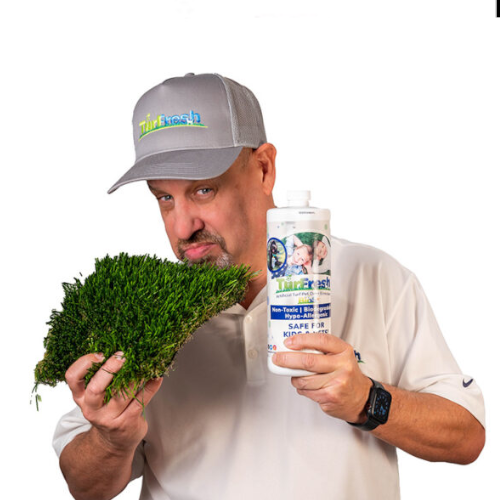

John Pla is the owner of TurFresh and an expert with over 20 years of experience in artificial turf cleaning and maintenance. John’s passion for sustainability, community impact, and innovative solutions has made him a trusted figure in the artificial grass industry and beyond.