
Quick Answer:
Backyard putting green maintenance follows a different protocol than standard residential turf care because putting green fibers are shorter, denser, and more sensitive to compression and abrasion. The five core tasks are debris removal, rinsing, brushing against the grain, stain treatment, and pet waste sanitation. Done consistently on a weekly and monthly schedule, these steps preserve ball roll consistency, protect the turf system, and extend the lifespan of your installation. When infill becomes compacted, fibers no longer respond to brushing, or ball speed becomes inconsistent despite regular care, professional restoration service is the correct next step.
Protect its longevity and performance with professional maintenance.
TurFresh provides specialized putting green care using professional-grade equipment that reaches infill and fiber layers routine home maintenance cannot restore. Over 150,000 services completed. Trusted by estate homeowners across California, Arizona, Texas, Nevada, and Florida.
✔ Investment Protection✔ 150,000+ Services✔ Trained Technicians✔ 30-Day Guarantee
Key Takeaways
✅ Putting green maintenance is not the same as standard turf care. Shorter, denser fibers require softer tools, lower water pressure, and more frequent brushing than standard residential turf. Using the wrong tool once can cause visible damage on a putting surface.
✅ Consistent maintenance directly affects ball roll. Debris on the surface, compacted infill, and flat fibers all create friction that slows and deflects the ball. A green maintained weekly performs closer to the day it was installed than one cleaned reactively.
✅ Brush against the grain every time. Brushing in the direction the fibers already lean presses them further down. Always work against the natural grain to lift fibers back to an upright position, which is what creates a true, consistent roll.
✅ The five-step maintenance protocol covers the full system. Debris removal, rinsing, brushing, stain treatment, and pet waste sanitation each address a different part of the turf system. Skipping any one of them creates a gap that compounds over time.
✅ Annual professional service is the maintenance step home care cannot replace. Professional equipment reaches the infill and backing layers where compaction, bacteria, and debris accumulate below the surface. Scheduling it annually protects the long-term value of your installation.
Why Putting Green Maintenance Is Different From Standard Turf Care
A backyard putting green is not the same surface as standard residential artificial turf, and it should not be maintained the same way.
Putting green turf uses shorter, denser fibers specifically engineered to produce a fast, consistent ball roll. That same construction makes the surface more sensitive to abrasion, compression, and tool choice. A stiff brush that works perfectly on a standard turf yard can leave visible marks on a putting surface. High-pressure rinsing that poses no risk to residential turf can displace infill on a putting green and create low spots that affect ball speed.
The maintenance protocol for a putting green is similar in principle to standard turf care but more precise in execution. Every step requires a lighter touch, a softer tool, and more attention to surface uniformity because any inconsistency shows up immediately when you putt.
📌 If your backyard has both standard residential turf and a putting green, treat them as separate surfaces with different maintenance schedules and tools. What works on one may damage the other.
How Backyard Putting Green Maintenance Affects Ball Roll
Ball roll is the measure of everything. It is why you installed a putting green, and it is the clearest signal that your maintenance routine is working or failing.
Three maintenance-related factors affect ball roll directly.
The first is surface debris. Leaves, dust, pollen, and organic particles create micro-friction points that slow and deflect the ball. A surface that looks clean to the eye can still carry enough fine debris to affect a putt. Weekly debris removal keeps the roll predictable.
The second is infill distribution. Infill provides the even base that allows the ball to travel smoothly from one point to another. When infill migrates toward edges, compacts under consistent foot traffic, or develops uneven distribution, the ball encounters varying resistance across the surface. Monthly brushing redistributes infill and catches this before it becomes a performance problem.
The third is fiber position. Fibers standing upright create a consistent surface that delivers true roll. Fibers lying flat create drag. Brushing against the grain every two to four weeks lifts fibers back to their intended position and restores the surface uniformity that consistent putting requires.
📌 If your ball roll has become noticeably slower or less predictable despite regular home maintenance, the infill has likely compacted below the level that brushing can restore. This is the signal that professional service is the right next step.
The Five-Step Backyard Putting Green Maintenance Protocol
Step 1: Remove debris
Remove leaves, twigs, and loose organic material before every session and as part of your weekly routine. Use a leaf blower on a low setting as your first pass to dislodge debris across the entire surface without touching it. Follow with a soft-bristle plastic rake or brush to gather what remains.
Never use metal rakes or wire-bristle tools on a putting surface. Metal contact tears fibers and abrades the turf backing, both of which are visible on a short-pile putting surface and both of which directly affect ball roll.
Step 2: Rinse the surface
Rinse with a garden hose using a fan nozzle at standard garden hose pressure. Work from one end of the green to the other to flush dust, pollen, and fine particles through the drainage layer. Rinsing is most important during dry seasons and after periods of high pollen, when fine particles settle into the fiber bed and are not visible but still affect roll.
Do not use a pressure washer on a putting green. Even at low settings, pressure washing can displace infill, damage the turf backing, and create surface irregularities. A standard garden hose provides sufficient pressure for all routine rinsing.
Step 3: Brush fibers against the grain
Using a soft-bristle synthetic brush, brush the entire putting surface against the natural lean of the fibers. This lifts fibers back to an upright position and redistributes infill evenly across the surface. Work in multiple directions rather than a single pass to ensure uniform coverage.
Lightly watering the surface before brushing helps fibers lift more readily. In high-use areas where foot traffic consistently follows the same path, brush more thoroughly and more frequently.
Step 4: Treat stains promptly
Address spills and stains as soon as possible. Fresh stains respond well to a mild soap solution and a soft sponge, followed by a thorough rinse. Set-in stains require a turf-safe enzyme cleaner applied with full dwell time before rinsing.
Never use bleach, ammonia, acidic cleaners, or any household product not specifically labeled as safe for synthetic turf. These degrade fiber structure and fade surface color over time. The damage is gradual but permanent.
Step 5: Sanitize pet waste areas
If pets use the putting green, remove solid waste immediately and rinse the affected area. Then apply a turf-safe enzyme cleaner such as TurFresh BioS+, allow the full dwell time, and rinse again. Simple rinsing is not sufficient to eliminate bacteria from pet waste. The enzyme cleaner breaks down uric acid and organic compounds at a molecular level rather than diluting them.
In areas of frequent pet use, sanitize weekly rather than only after visible waste.
Backyard Putting Green Maintenance Schedule
Weekly: remove debris with a leaf blower or soft rake, spot clean any visible stains or pet waste areas, rinse if conditions are dry or pollen levels are high.
Every 2 to 4 weeks: full brush session against the grain across the entire surface, infill inspection for low spots or migration, rinse after brushing.
Monthly: full protocol including debris removal, rinse, thorough brush, stain treatment, and pet waste sanitation of all affected areas. Inspect edges and seams for any lifting or separation.
Seasonally: in hot climates such as Phoenix, Las Vegas, and the Inland Empire, add a pre-summer check before peak temperatures arrive. Surface temperatures on artificial turf in these markets can exceed 150 degrees Fahrenheit in summer, which accelerates infill compaction and fiber stress. A thorough brush and infill inspection before the hottest months maintains performance through the season.
Annually: schedule professional deep cleaning and TurfBloom restoration service. Professional equipment reaches the infill and backing layers that home maintenance cannot access, removes compacted material, and revitalizes fiber position more thoroughly than any manual tool.
Tools That Are Safe for Putting Green Maintenance
Putting green surfaces are more sensitive to tool choice than standard residential turf. The shorter pile height means that tool contact is more direct and damage is more visible.
Leaf blower (low setting): fastest and safest method for debris removal. Keeps the nozzle at an angle and at low speed to avoid displacing infill.
Soft-bristle synthetic brush: the correct tool for all brushing on a putting surface. Look for nylon or polypropylene bristles. Avoid any brush labeled heavy-duty or with wire, metal, or rigid plastic tips.
Garden hose with fan nozzle: adequate for all rinsing needs. Standard garden hose pressure will not displace infill or damage fibers.
Soft sponge or microfiber cloth: for spot stain treatment before rinsing.
What to avoid on a putting green: metal rakes, wire brushes, stiff plastic tools, pressure washers, and any rotary or motorized brush not specifically designed for short-pile synthetic turf. The putting surface is a precision surface and it performs as such — tools that are acceptable on standard turf can cause measurable damage here.
Troubleshooting Common Putting Green Problems
Ball roll has become slow or inconsistent
This is the most common maintenance-related performance problem. If the surface was rolling true when installed and now feels slower or less predictable, the most likely causes are infill compaction, fiber fatigue in high-traffic areas, or debris accumulation below the surface level that rinsing cannot reach. A thorough brush session addresses fiber position and surface infill. If the problem persists after brushing, the infill layer needs professional attention.
Low spots or soft areas have developed
Low spots indicate that infill has migrated away from that area, either through foot traffic patterns or improper brushing direction. Walk the surface after brushing and press lightly with your foot to check for soft spots. In most cases, proper brushing redistributes infill and levels the surface. Persistent low spots after brushing may require infill top-up or professional assessment.
Fibers no longer stand up after brushing
If fibers in a specific zone do not respond to brushing, those fibers have experienced fatigue from repeated compression. This is common in areas where foot traffic is consistent, such as near holes or at the approach edge of the green. TurfBloom professional restoration service uses powered grooming equipment that reaches these fibers more effectively than any hand tool. In severe cases where fibers have lost structural integrity, section replacement may be the most practical solution.
Persistent odor despite regular cleaning
A persistent odor on a putting green is almost always from pet use where waste has penetrated into the infill layer below the reach of topical enzyme cleaners. If the odor returns within 72 hours of a correct enzyme cleaner application, the source is in the infill. Professional extraction equipment is required to address this fully.
Edges or seams have started to lift
This is an installation issue rather than a maintenance issue, but it is worth catching early. Lifted edges create a trip hazard and allow debris and moisture to enter the turf system below. Address this with your installer or a professional turf repair service before it extends further.
When to Schedule Professional Putting Green Service
Routine home maintenance handles surface debris, regular cleaning, and fiber grooming. There are clear signals that indicate professional service is the right next step.
Schedule professional service when ball roll remains inconsistent despite regular brushing. When fibers no longer respond to hand brushing. When persistent odor returns within days of cleaning. When low spots or surface irregularities develop that brushing does not resolve. And as a baseline for any high-quality putting green installation, annually regardless of visible condition.
Annual professional maintenance is not a reactive response to problems. It is routine asset management for a surface that represents a meaningful investment. Professional cleaning reaches the infill and backing layers, removes compacted material that accumulates below the surface over time, and delivers a restoration of performance that home maintenance cannot replicate.
📌 For an estate property with a putting green as part of a larger landscape installation, coordinating annual turf maintenance with your pool service and landscaping schedule simplifies the logistics and ensures every outdoor amenity is maintained on the same cycle.
Annual professional service protects performance and long-term value.
TurFresh uses specialized equipment to deep-clean putting green fibers, infill, and drainage layers. Over 150,000 services completed across California, Arizona, Texas, Nevada, and Florida. Trained technicians, no commitment required.
✔ Investment Protection✔ 150,000+ Services✔ Trained Technicians✔ 30-Day Guarantee
Frequently Asked Questions
How do you maintain a backyard putting green?
Backyard putting green maintenance involves five core steps: debris removal with a leaf blower or soft rake, rinsing with a garden hose at standard pressure, brushing fibers against the grain to restore upright position, treating stains promptly with turf-safe cleaners, and sanitizing pet waste areas with an enzyme cleaner. Perform debris removal weekly and a full maintenance session monthly.
How often should a backyard putting green be maintained?
Remove debris weekly. Brush fibers against the grain every 2 to 4 weeks and inspect infill for low spots. Complete a full maintenance session monthly. Schedule professional deep cleaning annually. In hot climates, add a pre-summer inspection before peak temperatures arrive.
Why is my putting green rolling slower than it used to?
Slow or inconsistent ball roll is typically caused by infill compaction, flat fibers from foot traffic, or debris accumulation below the surface level. Thorough brushing against the grain restores fiber position and redistributes infill. If the problem persists after brushing, the infill layer requires professional attention.
What tools are safe to use on an artificial putting green?
Use a leaf blower on a low setting for debris, a soft-bristle synthetic brush for grooming, and a garden hose with a fan nozzle for rinsing. Avoid metal rakes, wire brushes, rigid plastic tools, and pressure washers. Putting green fibers are shorter and more sensitive to tool contact than standard residential turf.
How long does an artificial putting green last with proper maintenance?
A well-maintained artificial putting green typically lasts 15 to 20 years. Consistent maintenance protects fiber structure, prevents infill compaction, and reduces UV degradation. Annual professional cleaning removes compacted material that home maintenance cannot reach, extending performance and lifespan.
When should I call a professional for putting green maintenance?
Call a professional when ball roll remains inconsistent despite regular brushing, when fibers no longer respond to hand grooming, when persistent odor returns within days of cleaning, or when low spots develop that brushing does not resolve. Annual professional maintenance is recommended for any high-quality installation regardless of visible condition.
Can I use a pressure washer on my putting green?
No. Pressure washing displaces infill, can damage the turf backing, and creates surface irregularities that directly affect ball roll. A standard garden hose with a fan nozzle provides adequate pressure for all routine rinsing needs on a backyard putting green.
Share
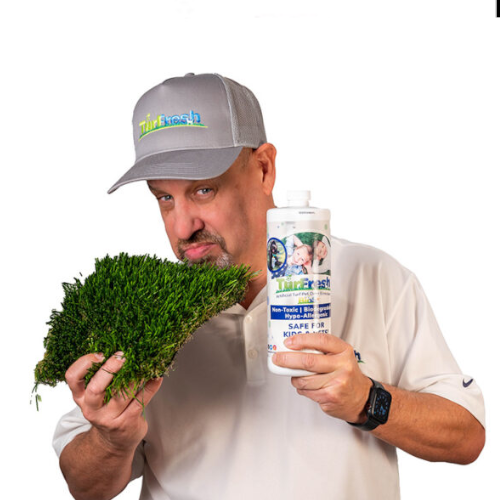

John Pla is the owner of TurFresh and an expert with over 20 years of experience in artificial turf cleaning and maintenance. John’s passion for sustainability, community impact, and innovative solutions has made him a trusted figure in the artificial grass industry and beyond.