Artificial Grass Flattened? How to Fix It and When It Cannot Be Fixed
May 14, 2025 · 14 min read · By John Pla, Founder of TurFresh
Quick Answer: Artificial grass flattened by traffic, furniture, or pets falls into two categories: temporary compression that responds to brushing, and fiber fatigue that does not. New turf that looks flat after installation is almost always temporary and fully reversible with one brushing session. Turf that has been under heavy use for years in the same zones has experienced fiber fatigue, meaning the synthetic material has lost its ability to rebound. Brushing improves the appearance temporarily but does not restore original fiber resilience. Professional TurfBloom service uses powered grooming equipment that delivers more consistent results than manual brushing, but even this does not create a permanent fix on heavily fatigued fibers.
Don't replace it before trying professional restoration.
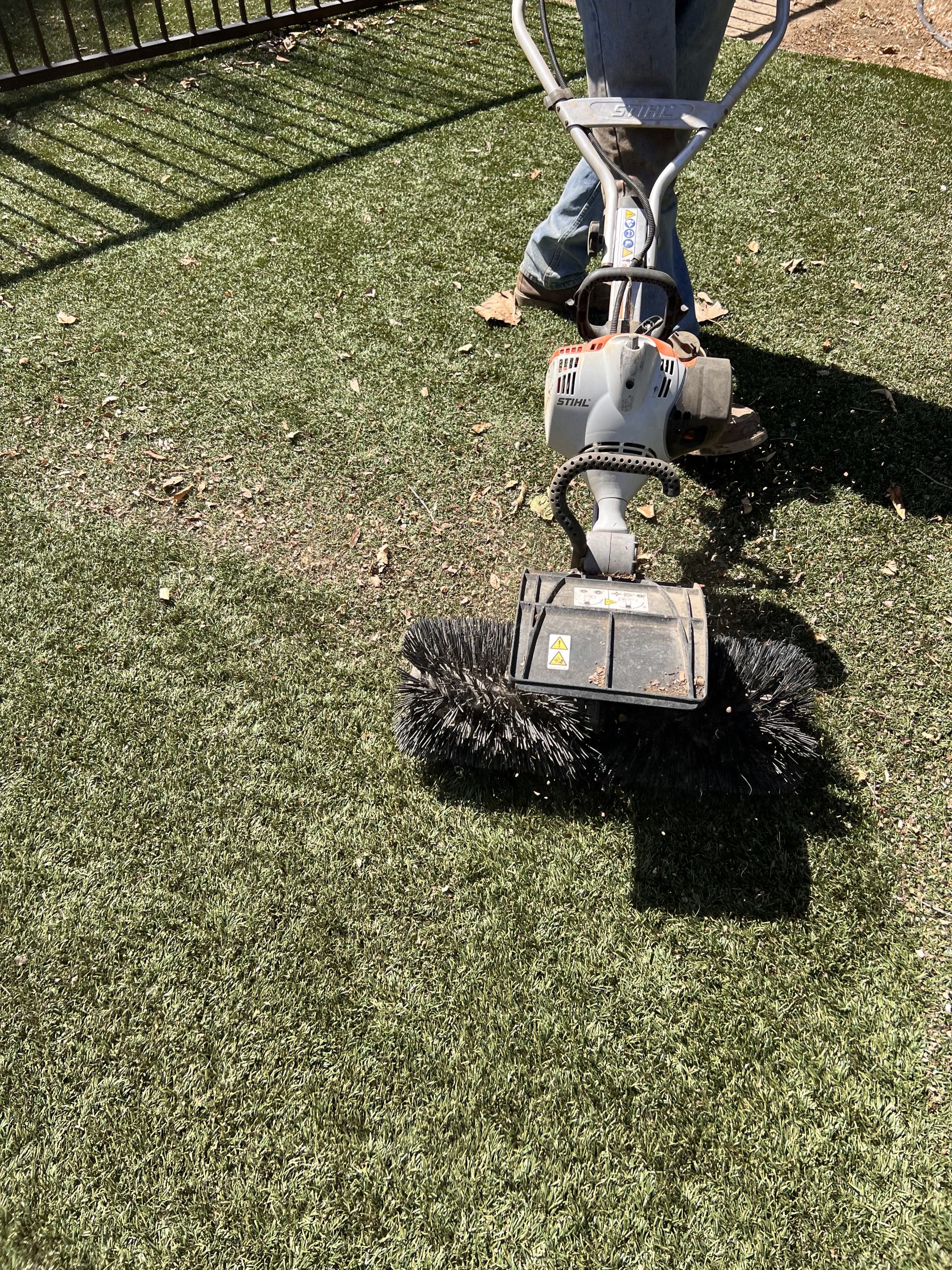
TurFresh TurfBloom uses powered grooming equipment to lift compressed fibers and restore turf appearance more effectively than any manual method. Over 150,000 services completed. Backed by our 30-day guarantee.
See If TurfBloom Can Help✔ Pet-Safe✔ Kid-Safe✔ 150,000+ Services✔ 30-Day Guarantee
Key Takeaways
✅ Not all flat artificial grass is the same problem. Temporary compression from objects, new installation, or short periods of heavy use is reversible with brushing. Fiber fatigue from years of traffic is not fully reversible by any method.
✅ New turf that looks flat is almost always normal. Fibers compressed during shipping and rolling flatten during transit and storage. One thorough brushing session after installation restores upright position in most cases.
✅ Brushing is maintenance, not repair. Brushing against the grain of the fibers lifts them temporarily and redistributes infill. In high-traffic zones with fatigued fibers, the effect is cosmetic and short-lived.
✅ Infill alone does not fix flat blades in modern turf systems. Modern turf designs use a built-in thatch layer to support fibers, not infill depth. Adding more infill to a flat turf will not restore blade height.
✅ TurfBloom outperforms DIY brushing on moderate compaction. Professional powered grooming equipment reaches fibers more consistently than hand tools and delivers visible improvement, especially when performed regularly as part of a maintenance schedule.
New Artificial Grass Looks Flat? That Is Normal
If your turf was recently installed and the blades are lying flat, this is almost certainly not a product defect or an installation problem.
Artificial grass is manufactured, measured, and shipped in tightly wound rolls. During transit and storage, the fibers are compressed under their own weight for days or weeks. When the turf is unrolled and installed, many blades have a temporary memory of that compressed position and need time or manual help to stand upright.
The fix is straightforward: brush the entire surface against the natural lean of the fibers using a stiff-bristle synthetic brush or power broom. One session is usually enough to lift most fibers. In areas where the roll was particularly tight, a second pass the following week may help.
This type of flattening has nothing to do with fiber fatigue or long-term wear. The fibers are new, flexible, and fully capable of standing upright once the compression from shipping is cleared.
📌 If a pool, trampoline, or heavy furniture was placed on new turf shortly after installation, the same principle applies. Remove the object, brush thoroughly, and the surface will recover.
Temporary vs. Permanent Flattening: How to Tell the Difference
This is the distinction that most articles about flat artificial grass miss, and it changes what you should do about the problem.
Temporary flattening
Temporary flattening occurs when fibers are compressed by an object or weight for a limited period. The fibers themselves are not damaged. They have simply been pushed down and can return to an upright position once the pressure is removed and brushing restores their natural position.
Common causes: new installation, seasonal pool left in place, furniture moved after extended placement, trampoline or play equipment removed after summer.
How to identify it: the flattened area is relatively uniform, the fibers look intact (not frayed, broken, or discolored), and the problem appeared after a specific event rather than gradually.
What to do: brush against the grain using a stiff synthetic-bristle brush, working in multiple directions. Water the surface lightly before brushing to help fibers lift. One to two sessions over a week resolves most temporary flattening.
Permanent flattening
Permanent flattening occurs when synthetic fibers have been compressed and released repeatedly over a long period of time. Like any flexible material under cyclic stress, the fibers eventually lose their elastic memory and can no longer return to an upright position on their own or through brushing.
Common causes: consistent foot traffic along the same path over years, pets using the same area as a daily route, high-use zones in yards where children play or dogs run repeatedly.
How to identify it: the flattened areas follow traffic patterns (pathways, entry points, dog runs), developed gradually over months or years, the fibers look slightly frayed or have lost their original color at the tips, and brushing produces only temporary improvement that reverses within days.
What to do: brushing still helps maintain appearance temporarily. Professional TurfBloom service delivers better results than hand brushing. In areas where the damage is severe and the turf is older, replacement of that section may be the most cost-effective long-term option.
What Causes Artificial Grass Blades to Flatten?
Understanding the cause helps determine the right response.
Foot traffic: the most common cause in residential settings. Every footstep applies downward pressure that synthetic fibers absorb. In low-traffic zones, fibers recover between uses. In high-traffic zones, the recovery time is shorter than the compression frequency, and gradual fatigue sets in over months and years.
Pets: dogs running the same path daily create concentrated traffic patterns that accelerate flattening. Small yards with multiple dogs show this most quickly, typically in the route from the back door to the most used area of the yard.
Furniture and equipment: patio furniture, trampolines, play equipment, and storage items left in place for extended periods create localized compression. The longer the object stays, the harder it is for fibers to recover. Objects with small footprints (chair legs) create more concentrated pressure than those with distributed weight (flat-based furniture).
Heat: in Phoenix, Las Vegas, and other Sun Belt markets, surface temperatures on artificial turf can exceed 150 degrees Fahrenheit in summer. Sustained high heat softens synthetic fibers and accelerates the compression cycle, making flattening develop faster in hot climates than in cooler ones.
UV exposure: prolonged UV exposure degrades synthetic polymer structure over time, reducing the fiber's ability to return to an upright position after compression. This is a slow process and typically noticeable only in turf older than 8-10 years.
Does Brushing Artificial Turf Actually Work?
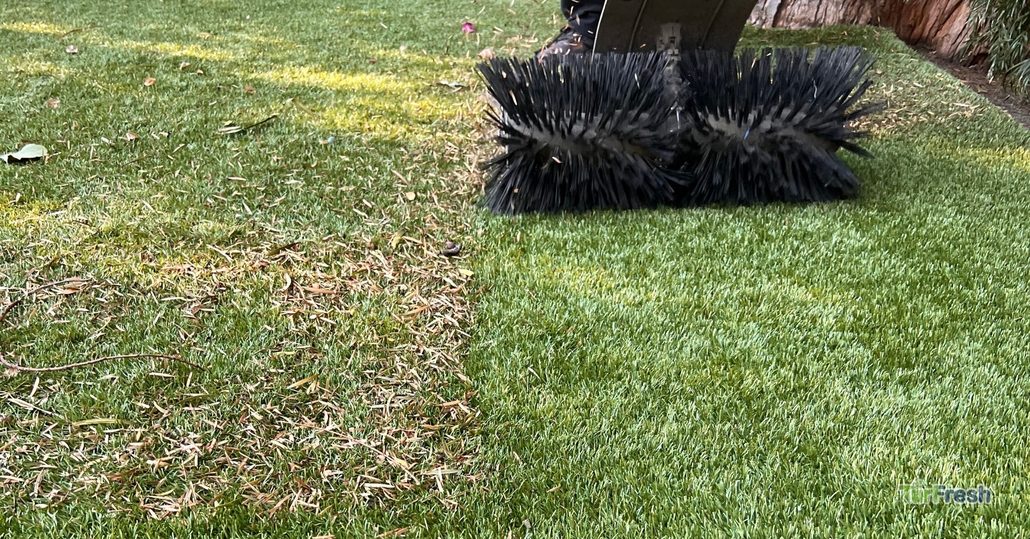
Yes, brushing works. The question is how long the results last and whether the underlying cause allows for lasting improvement.
Brushing lifts compressed fibers and redistributes infill, making the surface look fresher and more upright. In areas with temporary flattening, brushing produces lasting results because the fibers are still capable of holding an upright position.
In areas with fiber fatigue, brushing produces visible improvement that typically reverses within days to weeks of normal use. The fibers respond to the brushing but lack the structural resilience to maintain the position under continued traffic.
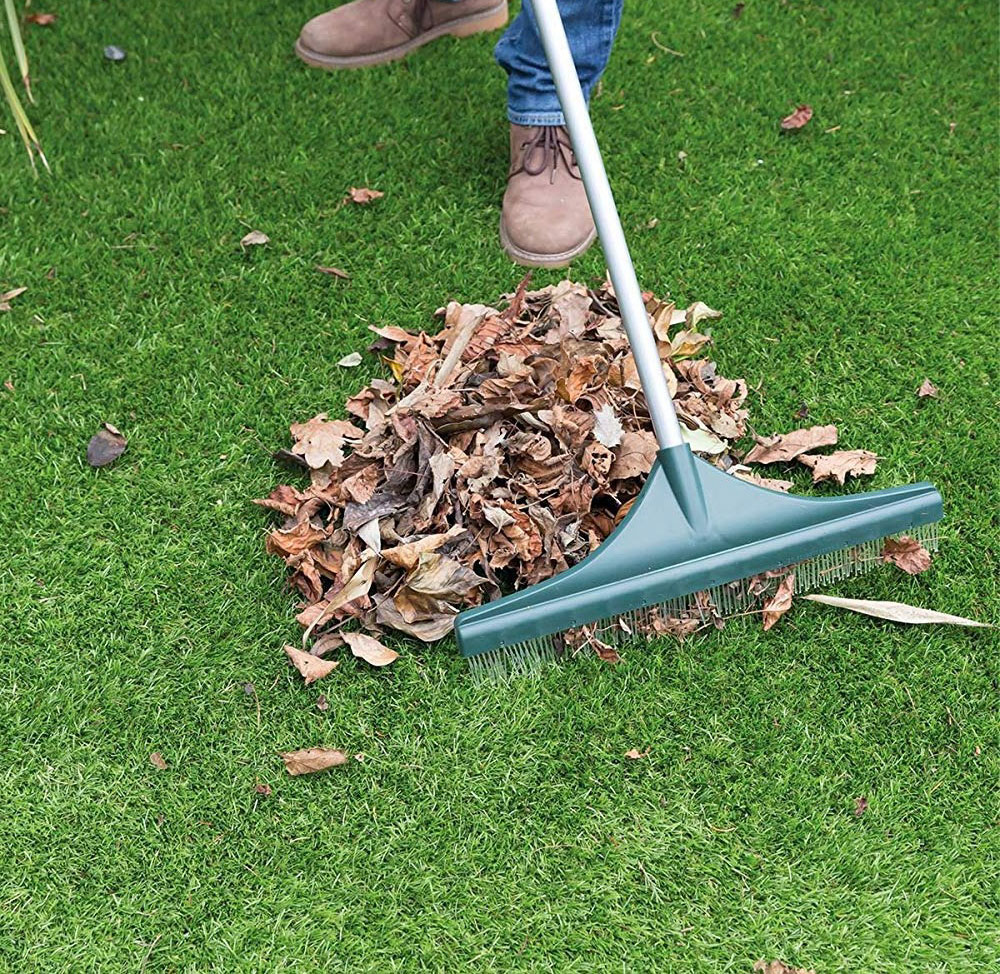
How to brush correctly: use a brush with stiff synthetic bristles, never metal or wire. Brush against the natural lean of the fibers, not with it. Work in multiple directions across the affected area. Lightly watering the surface before brushing helps fibers lift more readily. In high-traffic zones, monthly brushing as part of a routine maintenance schedule manages appearance even when permanent restoration is not possible.
Tools that work: synthetic-bristle stiff brush for small areas, power broom or turf groomer for larger areas or deeper compaction. The Grandi Groom rake is a specialized option used in both carpet cleaning and turf maintenance that can lift fibers in moderately compressed areas.
What to avoid: metal rakes, wire brushes, and rigid plastic tools that can tear fiber tips and damage turf backing.
What Is Infill and Why Adding More Does Not Fix Flat Blades
Infill is the granular material spread between turf fibers to provide weight distribution, UV protection for the backing, moisture management, and system stability. Common types include silica sand, zeolite, and crumb rubber.
In older turf systems, particularly slit-film designs common in athletic fields, heavy infill was also used to keep fibers upright. These systems sometimes used several pounds of rubber infill per square foot, and adding more infill did help blades stand taller because the design relied on infill for blade support.
Modern residential turf systems are built differently. They incorporate a thatch layer: a bed of shorter, curled fibers woven among the longer upright blades at the base of the turf. This thatch supports the fibers naturally from below, reducing the structural role of infill. In these systems, adding more infill does not restore blade height because the blades are not being held up by infill in the first place.
This is why many homeowners find that topping up infill has no visible effect on flat-looking turf. The support system is the thatch, and the issue is fiber fatigue, not infill depth.
📌 If your turf was installed in the last 5 to 8 years, it almost certainly uses a thatch-based design. Replenishing infill will not correct flat blades, but it does still serve its other functions in the system.
When TurfBloom Helps and When It Does Not
TurfBloom is TurFresh's professional fiber restoration service. It involves powered grooming equipment that agitates and lifts turf fibers more thoroughly than any hand tool, combined with cleaning and infill redistribution.
TurfBloom delivers noticeable improvement when the flattening is moderate: fibers that have been compressed but retain enough structural resilience to respond to powered grooming. Most customers in this situation report visible improvement and are satisfied with the results.
TurfBloom has limited effect when fibers have reached advanced fatigue: blades that are severely flattened, frayed at the tips, or discolored from UV degradation have lost the structural capacity to hold an upright position even after powered grooming. In these cases, TurfBloom can improve appearance temporarily but cannot reverse the underlying material degradation.
Factors that predict a better TurfBloom outcome: turf that is less than 8 years old, flattening that developed within the last 1 to 2 years, areas where flattening is moderate rather than severe, and turf that has been maintained regularly rather than neglected for extended periods.
📌 If you are unsure whether TurfBloom is the right service for your situation, TurFresh can assess the turf condition before scheduling. This prevents paying for a service that will not deliver the result you are looking for.
How to Reduce Flattening Over Time
You cannot prevent flattening entirely in high-use areas, but you can slow the rate at which it develops and maintain a better appearance through consistent upkeep.
Rotate furniture and equipment regularly. Moving chairs, tables, and play items every few weeks distributes compression across more of the surface rather than concentrating it in one spot.
Use stepping stones or pathways in heavy-traffic zones. Installing stepping stones along the most frequently used routes takes foot pressure off the turf fibers entirely in those areas.
Brush monthly in high-use zones. Consistent brushing against the grain maintains fiber position and slows the rate of fatigue progression in areas that cannot avoid traffic.
Schedule professional TurfBloom annually. Regular professional grooming catches moderate compaction before it progresses to fiber fatigue and delivers results that manual brushing cannot match.
Choose the right turf system for your use case. If you are considering installation or replacement, turf products designed with stronger thatch layers and higher-denier fibers are more resistant to flattening in high-traffic conditions. Ask your installer about fiber denier and pile height for heavy-use applications.
When Replacement Makes More Sense Than Restoration
Restoration services like TurfBloom are the right answer for most cases of artificial grass flattening. There are situations where replacement of a section or the entire surface is the more practical decision.
Replacement makes sense when the turf is over 10 years old and showing widespread fiber fatigue and UV degradation across the entire surface. At this age, restoration delivers diminishing returns because the material itself is reaching the end of its designed lifespan.
Replacement also makes sense when a specific zone is severely damaged beyond recovery: a heavily used dog run with torn or broken fibers, a section that has been discolored by chemical damage, or an area where the backing has been compromised. In these cases, replacing that section while maintaining the rest of the surface is often the most cost-effective approach.
For most homeowners with turf under 8 to 10 years old where flattening is the primary concern, restoration is the right first step. Replacing turf that can be meaningfully improved through professional grooming is an unnecessary expense.
Professional TurfBloom restoration may be all you need.
TurFresh TurfBloom uses powered grooming equipment to lift compressed fibers and restore turf appearance. Over 150,000 services completed across California, Arizona, Texas, Nevada, and Florida. Backed by our 30-day guarantee.
Schedule a TurfBloom Assessment✔ Pet-Safe✔ Kid-Safe✔ 150,000+ Services✔ 30-Day Guarantee
Frequently Asked Questions
Why is my artificial grass flattened?
Artificial grass flattens from repeated compression by foot traffic, pets, furniture, and heavy objects. In new turf, it is usually temporary compression from shipping and can be reversed with brushing. In older turf with high-use zones, it is fiber fatigue from years of repeated compression and is not fully reversible.Can flat artificial grass be fixed?
It depends on the cause. Temporary flattening from objects or new installation is fully reversible with brushing. Fiber fatigue from years of heavy traffic can be improved temporarily through brushing or professional TurfBloom service, but the improvement does not last indefinitely because the underlying fiber structure has been affected.My new artificial grass looks flat. Is that normal?
Yes. Turf compressed during shipping and storage often looks flat after installation. One thorough brushing session against the natural lean of the fibers resolves this in most cases. This is not a product defect.Will adding more infill fix flat artificial grass blades?
Not in most modern turf systems. Modern residential turf uses a built-in thatch layer to support fiber position, not infill depth. Adding infill has other benefits for the turf system, but it will not restore blade height in a thatch-based design.How often should I brush artificial grass to prevent flattening?
Monthly brushing in high-traffic and pet zones is a practical schedule for most homeowners. In very heavy-use areas, brushing every 2 to 3 weeks delivers better appearance maintenance. Always brush against the natural grain of the fibers with a synthetic-bristle brush.What is TurfBloom and is it worth it for flat turf?
TurfBloom is TurFresh's professional fiber restoration service using powered grooming equipment. It outperforms manual brushing for moderate compaction and is worth it when fibers retain enough resilience to respond to grooming. It is less effective on severely fatigued or degraded fibers where the material itself has lost structural integrity.When should I replace artificial grass instead of trying to restore it?
Consider replacement when the turf is over 10 years old with widespread fiber degradation, when specific sections have torn or broken fibers beyond recovery, or when UV discoloration or chemical damage has affected large areas. For most turf under 8 to 10 years old, restoration is the right first step before committing to replacement.