
How to stop artificial grass from smelling is one of the most searched questions among dog owners who have already tried rinsing, vinegar, and store-bought sprays without much to show for it. If the smell keeps coming back despite a routine you are actually keeping, the problem is not the routine. It is that surface treatments cannot reach where the odor lives. This guide covers what fails and why, what works, and the point where buildup has gone past what any home product will fix.
Quick Answer:
Artificial grass smells because uric acid crystals from pet urine settle into the infill and backing layer where surface cleaning cannot reach. Water does not remove uric acid, because uric acid is not water-soluble. Enzyme cleaners break it down at the molecular level when given full dwell time, which is the part most people skip. Raw sand infill makes the problem considerably worse by trapping urine instead of draining it. To stop artificial grass from smelling: remove waste immediately, rinse pet zones regularly, and apply an enzyme cleaner monthly with full dwell time. For odor that has been building for months or years, professional deep cleaning is the only reliable reset, which is what TurFresh has done across more than 150,000 turf cleaning services since 1999.
The odor source is in the infill. Surface cleaning cannot reach it.
TurFresh reaches the infill and backing layer where uric acid accumulates. Most yards are back to fresh the same day. Over 150,000 services completed. Pet safe immediately after service.
✔ Pet Safe ✔ Eco Friendly ✔ 150,000+ Services ✔ 30-Day Guarantee
Why TurFresh
TurFresh has been cleaning artificial turf since 1999 and has completed over 150,000 services across California, Nevada, Arizona, Texas, and Florida. Turf cleaning is the founding business, not a service added to a landscaping menu.
Most of the advice on this page is what to do yourself, because for most yards that is enough. The TurFresh TurfClean process exists for the case this page ends on: infill that has passed the point where any surface product can reset it. Every service is pet safe with same-day re-entry and backed by a 30-day odor removal guarantee.
Key Takeaways
🔑 Uric acid is not water-soluble, and that single fact explains everything. Rinsing flushes fresh urine. It cannot dissolve what has already bonded to infill granules. This is why people who rinse religiously still have a yard that smells.
🔑 Enzyme cleaners are the only home product that removes the source instead of covering it. They digest uric acid at a molecular level. Everything else on the shelf either masks the smell or attacks the wrong thing.
🔑 Dwell time is where most people lose the result. Spray and immediately rinse and you have wasted the product. The enzymes need contact time to finish the reaction.
🔑 Raw sand infill traps urine instead of draining it. If your turf was installed on standard sand and you have dogs, the infill may be contributing more to the smell than your cleaning schedule ever did.
🔑 Past a certain point, artificial grass odor removal stops being a DIY job. Six months or more of dogs on the same area without professional cleaning means the infill baseline is too high for surface products to reset, and a TurFresh deep clean is the reliable way back.
Why does my artificial grass smell?
The smell comes from uric acid crystals that settle into the infill and backing layer after dog urine drains through the fibers. Here is the detail that almost every guide leaves out: uric acid is not water-soluble.
Rinsing dilutes fresh urine and flushes some residue through. It does not dissolve uric acid that has already bonded to infill granules below the surface. You can rinse that yard every day for a year and the deposits stay exactly where they are.
As uric acid accumulates, bacteria feed on it and produce ammonia. That is the smell. Heat and moisture reactivate the crystals, which is why a yard that seems fine in the morning is unbearable at four in the afternoon. Cleaning the surface helps for a day. The source is still down there.
The pattern that confirms infill buildup: if the smell fades after cleaning but returns within 24 to 48 hours, or spikes on hot afternoons, the odor source is below the turf fibers. Surface products will not solve it.
Why does my turf smell like dog pee?
If the smell is specifically urine rather than musty or stale, you are smelling ammonia being released from uric acid deposits in the infill. That is a different problem from a turf that smells damp or dirty, and it has a different fix.
Dog urine is roughly 95% water. The other 5% is where the trouble is: uric acid, urea, ammonia, proteins, and mineral salts. The water drains through the backing within minutes. The rest stays behind, and uric acid in particular crystallizes as the surface dries, bonding to the infill granules it lands on.
How to tell urine odor apart from the other kinds:
➧ Sharp, ammonia-like, worse in the afternoon: uric acid in the infill. The classic dog pee smell.
➧ Musty, damp, like a wet basement: moisture trapped in the base layer. That is drainage, not urine.
➧ Stale and general, no strong ammonia note: accumulated organic debris and compacted infill.
➧ Concentrated in one corner: a dog with a favorite spot. The whole yard does not need treating, that zone does.
The urine case is the most common and the most responsive to treatment, because enzyme cleaners target exactly those compounds. It is also the one that gets worse fastest if left alone, since every accident adds to a deposit that never breaks down on its own.
Worth knowing: the same yard can have two of these at once. A poorly drained potty zone smells of both urine and damp, and treating only the urine leaves half the problem in place.
What does not work, and why
Before we get to how to get smell out of artificial grass for good, it helps to know what fails. That knowledge saves you the money and the two months of trying it.
Water and rinsing alone. Flushes fresh urine well. Cannot dissolve uric acid already bonded to infill. Essential as a first step, useless as the whole plan.
Vinegar. Neutralizes some alkaline surface compounds temporarily. Does not break down uric acid crystals. Worse, the acidic smell can encourage dogs to re-mark the same spot, so you may end up with more of the problem than you started with.
Masking sprays and fragrance deodorizers. Cover the smell for a few hours. In hot weather, sometimes less. The odor comes back the moment the fragrance fades because nothing was removed.
Bleach. Damages turf fibers and backing, reacts with the ammonia in urine to produce toxic fumes, and still does not eliminate the source. Never put it on artificial grass.
Pressure washing with no enzyme treatment. Often drives urine residue deeper into the infill instead of lifting it out. This is the one that regularly makes things worse rather than better.
Artificial grass odor removal that actually works
Step 1. Remove waste and rinse first
Pick up solid waste immediately. Rinse urine zones with a garden hose to flush fresh residue through the backing before it bonds to the infill. Skipping this step means your enzyme cleaner spends itself on surface debris instead of the compounds you bought it for.
Step 2. Apply an enzyme cleaner and let it sit
This is how to deodorize artificial turf properly, and it is the step everything else depends on. Enzyme cleaners are the only at-home product that breaks uric acid and ammonia down at a molecular level rather than covering them.
The whole thing hinges on dwell time. Spray it and rinse it off two minutes later and you have accomplished nothing except spending money. The enzymes need contact time to finish the reaction.
TurFresh BioS+ is an enzymatic cleaner built for synthetic turf and pet odor. Apply, allow the full dwell time on the label, then rinse.
TurFresh BioX is an oxygenated cleaner for odor that keeps coming back, and for hot climates where the surface dries before an enzyme product finishes working. More consistent in California, Nevada, Arizona, and Texas conditions.
Step 3. Treat at dawn or dusk in hot climates
Apply when it is cool. In a Phoenix summer, a mid-afternoon application evaporates before the enzymes get anywhere. Dawn or dusk gives them the working time they need, and in dry climates this one change makes a visible difference on its own.
Step 4. Brush once the surface is dry
Brush with a synthetic-bristle broom against the grain to lift fibers and redistribute infill. Better airflow, better drainage, and the surface dries more evenly between treatments.
Is your infill making the smell worse?
The infill under your turf has more influence on odor than most people realize. Raw sand infill traps urine instead of letting it drain, which concentrates ammonia in the infill layer rather than moving it through.
If your turf went in with standard sand infill and you have dogs, the infill may be doing more damage than your cleaning frequency ever could. No schedule fixes a material problem.
Antimicrobial infill made for pet turf, like TurFresh TurFill, neutralizes urine compounds before they accumulate. For chronic odor that does not respond to enzyme treatment, topping up or replacing with antimicrobial infill treats the cause instead of the symptom.
New smell or old smell? The answer changes
If it started in the last few weeks:
✔ Rinse pet zones daily until the odor is back under control
✔ Apply enzyme cleaner now, before the residue bonds to infill
✔ Check whether it is localized. One concentrated spot means one dog with a favorite corner, and you can focus everything there
If it has been months or years:
⚠️ Home cleaning alone probably will not resolve it. Uric acid accumulated over months has bonded deep into the granules
⚠️ Enzyme cleaners will help but may not finish the job. The infill baseline is simply too high for a surface product to reset
✔ Professional deep cleaning is the reliable reset. It reaches the infill and backing, removes accumulated buildup, and puts the baseline back where your maintenance products can work
✔ Enzyme maintenance afterward keeps it from returning. Once the baseline is reset, how to stop artificial grass smelling becomes a matter of staying on schedule rather than fighting a backlog
Honest assessment: if dogs have been using the same area for more than six months with no professional cleaning, the infill holds more uric acid than home products can address. At that point professional cleaning is not an upgrade. It is the only thing that resets the system.
A professional clean before summer removes the buildup that heat activates.
TurFresh reaches the infill and backing layer where uric acid accumulates. One service resets the system so your maintenance routine starts working again. Over 150,000 services completed.
✔ Pet Safe ✔ Eco Friendly ✔ 150,000+ Services ✔ 30-Day Guarantee
How to keep turf from smelling: the maintenance schedule
Keeping turf from smelling is a question of frequency, not products. Once the baseline is clean, staying ahead of it costs a few minutes a week. Falling behind costs a professional visit.
The schedule below scales with how many dogs you have and how concentrated their use is. A single dog with a large yard is a different problem from three dogs sharing a small run.
One dog, average yard:
• Daily: solid waste removal
• Weekly: rinse pet zones
• Monthly: enzyme treatment with full dwell time
• Annually: professional deep clean
Two to three dogs, or a small yard with concentrated use:
• Daily: waste removal and rinse of potty zones
• Every 2 to 3 weeks: enzyme treatment
• Every 6 months: professional deep clean
Three or more dogs, kennel, or doggy daycare:
• Daily: waste removal and full rinse
• Weekly: enzyme treatment
• Every 3 to 4 months: professional deep clean
The test that tells you the schedule is wrong: if odor is detectable within 24 hours of a correct enzyme treatment, the interval is too long for your level of use. Move up one tier rather than switching products.
Does artificial grass smell more in hot weather?
Yes, and it is not a new problem arriving with summer. Heat accelerates the release of ammonia from uric acid deposits that were already sitting in the infill. Turf that seems manageable in February becomes hard to ignore in July.
Which means the fix is seasonal timing, not seasonal effort. Reduce the buildup before the heat arrives. A TurFresh clean in late spring gives you a fresh baseline going into the months when the smell would otherwise be at its worst.
Related Guides
📖 Artificial Turf Smell After Rain covers why rain triggers odor and how to tell drainage problems apart from infill buildup.
📖 Here Is Why Your Turf Is Starting to Smell covers the other causes, including the chemical smell of a brand new installation.
Frequently Asked Questions
How do I stop my artificial grass from smelling?
Remove waste immediately, rinse pet zones regularly, and apply an enzyme cleaner monthly with full dwell time. For chronic odor that has built up over months, a TurFresh professional deep clean resets the infill baseline so home maintenance works effectively again. Surface cleaning alone cannot reach uric acid deposits already bonded to infill granules.
Why does my turf smell like dog pee?
A sharp ammonia smell means uric acid deposits in the infill are releasing ammonia as bacteria feed on them. Dog urine is about 95% water, which drains through the backing in minutes. The remaining 5%, including uric acid and mineral salts, crystallizes as the surface dries and bonds to the infill. Enzyme cleaners target exactly those compounds, which is why they work where rinsing does not.
How do I keep turf from smelling long term?
Match the frequency to the use. One dog on an average yard needs daily waste removal, weekly rinsing, monthly enzyme treatment, and an annual professional clean. Two or three dogs need daily rinsing, enzyme treatment every two to three weeks, and a professional clean every six months. If odor returns within 24 hours of a correct treatment, move up a tier rather than changing products.
Why does my artificial grass smell after cleaning?
Because uric acid from dog urine is not water-soluble and bonds to infill granules below the turf surface. Rinsing and surface sprays remove fresh residue but cannot dissolve what has already accumulated in the infill. Enzyme cleaners break down uric acid at a molecular level and are the only at-home product that addresses the source rather than masking it.
What does artificial grass odor removal actually involve?
Three layers. Waste removal and rinsing handle what is fresh on the surface. Enzyme cleaners with full dwell time break down uric acid that has bonded to infill granules. Professional extraction removes accumulated buildup from the infill and backing when home treatment can no longer reach it. Skipping the enzyme step or cutting the dwell time short is where most home attempts fail.
Does artificial grass smell more in hot weather?
Yes. Heat activates uric acid deposits already in the infill, releasing ammonia more strongly. Turf that seems manageable in cooler months often smells significantly worse in summer. The fix is reducing infill buildup before hot weather arrives, ideally with a professional deep clean in late spring.
Is my infill causing the smell?
Possibly. Raw sand infill traps urine instead of allowing it to drain, which concentrates ammonia in the infill layer over time. If your turf has standard sand infill and persistent odor despite regular cleaning, replacing or topping up with antimicrobial infill designed for pet turf addresses the root cause.
Can professional turf cleaning remove years of built-up odor?
Yes. TurFresh uses equipment that reaches the infill and backing layer where years of uric acid buildup accumulates. The process removes the odor source rather than masking it, and restores drainage function so the turf performs as intended. One service typically resets the baseline significantly, and the result is backed by a 30-day odor removal guarantee.
What is the best cleaner for smelly artificial grass?
An enzyme cleaner designed specifically for synthetic turf is the most effective at-home option. TurFresh BioS+ is formulated for routine pet turf maintenance. For persistent odors in hot climates or high-use yards, TurFresh BioX delivers more consistent results because it acts faster and depends less on the surface staying wet. For chronic buildup that home products cannot fully address, professional cleaning is the reliable solution.
Share
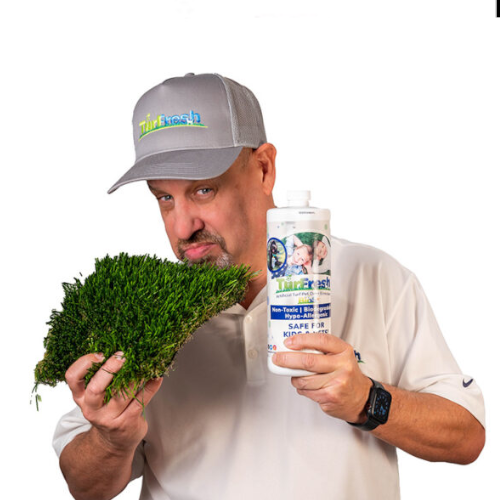

John Pla is the owner of TurFresh and an expert with over 20 years of experience in artificial turf cleaning and maintenance. John’s passion for sustainability, community impact, and innovative solutions has made him a trusted figure in the artificial grass industry and beyond.