
Quick Answer: Turf infill is the granular material spread between artificial grass blades to keep fibers upright, add cushion, stabilize the surface, and support drainage. Most residential installations start at 1 to 2 pounds of infill per square foot. Without adequate infill, fibers flatten faster, the surface feels harder, and pet odors are harder to control. Top-up frequency depends on use level and climate, not a fixed calendar.
Low infill is the most common cause of flat turf and persistent odor.
TurFresh professional cleaning reaches the infill layer where odor and bacteria accumulate. One visit restores what surface rinsing cannot fix.
✔ All Natural✔ Pet Safe✔ Enzymatic Odor Control✔ 30-Day Guarantee
Key Takeaways
🔑 Turf infill is a structural component, not an optional add-on. Blades without adequate infill support flatten permanently under normal foot traffic
🔑 Most residential installations need 1 to 2 pounds of infill per square foot at installation. Top-ups replace only the depleted zones, not the entire yard
🔑 Pet zones lose infill faster than any other area. Check depth seasonally, not just when problems become visible
🔑 For pets, choose an infill that neutralizes ammonia at the source. Sand absorbs moisture; zeolite-based infill like TurFill breaks down odor compounds enzymatically
🔑 The turf infill calculator approach is simple: measure the thin area in square feet, multiply by the depth needed in pounds per sqft, then buy that weight in bags
What Is Infill for Artificial Turf
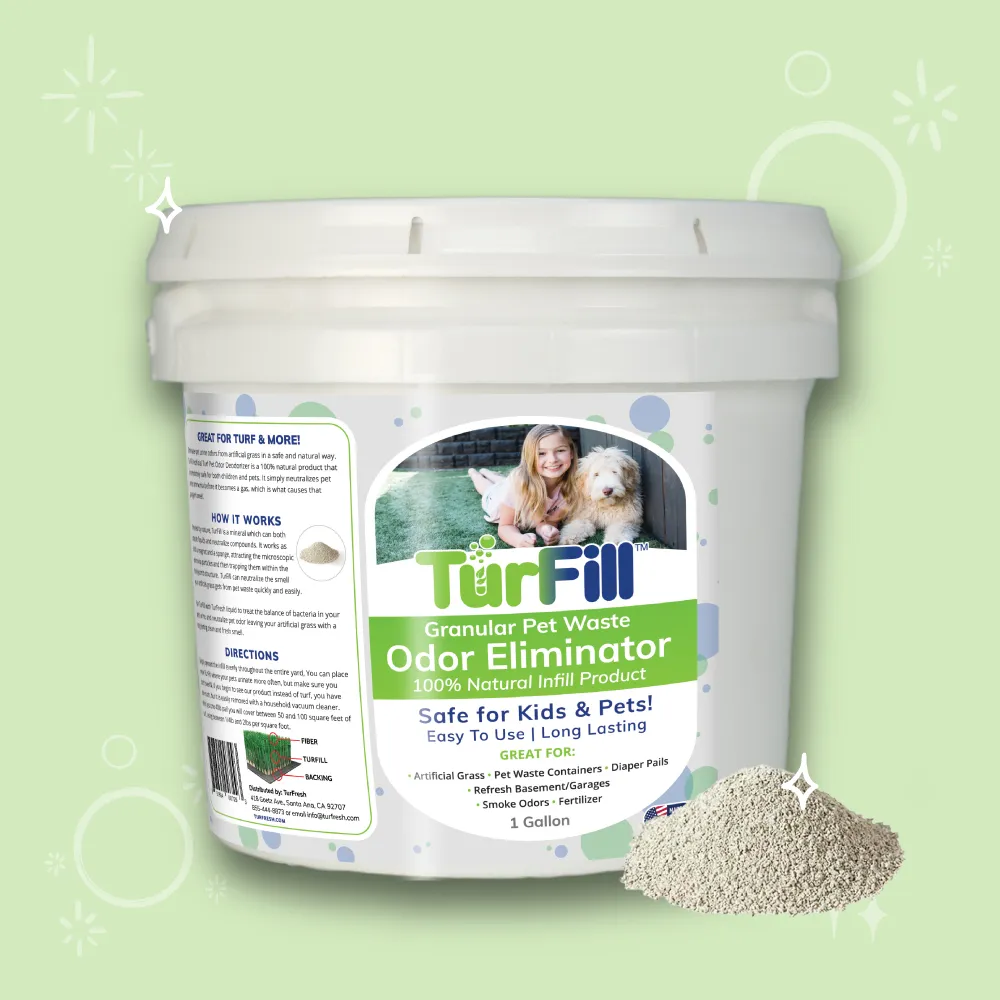
Turf infill is the granular material placed between the blades of an artificial grass installation to fill the open space at the fiber base. It is a structural component of the turf system, not a surface treatment. Most residential and commercial installations include infill at installation, and it requires monitoring and occasional replenishment as part of routine turf maintenance.
Infill serves four primary functions:
✔ Blade support: Holds fibers upright so they maintain a natural standing position rather than lying flat
✔ Cushioning: Adds impact absorption so the surface feels more like natural grass underfoot rather than a hard mat
✔ Ballast: Adds weight that stabilizes the turf system and reduces wrinkling, buckling, and surface shifting
✔ Backing protection: Reduces UV exposure to the turf backing over time, extending the life of the overall installation
What Does Infill Do for Turf Maintenance?
Infill makes turf easier to maintain because healthy infill levels prevent the compaction and fiber collapse that create the most common maintenance problems: matting, odor buildup, and drainage slowdown.
When infill levels are adequate, fibers stand upright after brushing and foot traffic. When infill depletes below the functional threshold, fibers lose their base support and problems compound. Brushing no longer restores the appearance. Pet urine sits closer to the surface instead of draining through. Odors develop faster and are harder to control with surface treatment alone.
According to turf installation professionals, infill is the component most homeowners underestimate after installation. Most visible turf problems that appear years after installation trace back to infill depletion rather than fiber degradation.
What healthy infill levels deliver in practice:
➡️ Less matting: Blades have a base to return to after compression from foot traffic or furniture
➡️ More consistent feel: The surface cushions evenly rather than feeling hard in high-use zones
➡️ Better drainage: Infill at correct depth allows liquid to pass through rather than pooling at the base
➡️ Odor control: With the right infill type, urine compounds are neutralized at the infill level between cleaning visits
How Much Infill Per Square Foot Do You Need for Artificial Grass?
The standard starting amount for most residential installations is 1 to 2 pounds of infill per square foot. The specific amount depends on the turf pile height and product specifications from the turf manufacturer. Longer pile height turf typically requires more infill to reach the functional support level.
The infill target range:
➡️ Too little infill: Fibers are unsupported and flatten faster. Surface feels harder. Drainage slows. Odor is harder to control in pet areas.
➡️ Correct infill level: Fibers stand upright, surface feels cushioned, drainage flows freely. Infill sits below the blade tips but fills the base layer adequately.
➡️ Too much infill: Infill becomes visible above the fiber base and the lawn looks dusty or granular rather than natural.
How Much Will a 50-Pound Bag Cover?
👍 At 1 pound per square foot: a 50-pound bag covers approximately 50 square feet
👍 At 2 pounds per square foot: a 50-pound bag covers approximately 25 square feet
👍 For top-ups: measure only the thinned zones, not the full yard
Turf Infill Calculator: How to Estimate What You Need
For top-up purchases, the calculation replaces depleted infill in specific zones rather than filling the full installation.
Step 1: Measure the area of thinned zones in square feet (length x width for each zone)
Step 2: Estimate the depth shortfall. If blades are lying flat, assume approximately 0.5 to 1 pound per square foot is needed to restore support
Step 3: Multiply area (sqft) by estimated depth need (lbs/sqft) to get total pounds needed
Step 4: Divide by 50 to get the number of 50-pound bags to purchase
Example: A 200 sqft pet run zone thinning at approximately 0.75 lbs/sqft shortfall = 150 lbs needed = 3 bags of 50-pound TurFill.
For top-ups, always buy slightly more than your estimate. Infill settles after application and a second light pass often reveals areas that need additional product before reaching the correct depth.
How Often Do You Need to Add Infill to Artificial Grass?
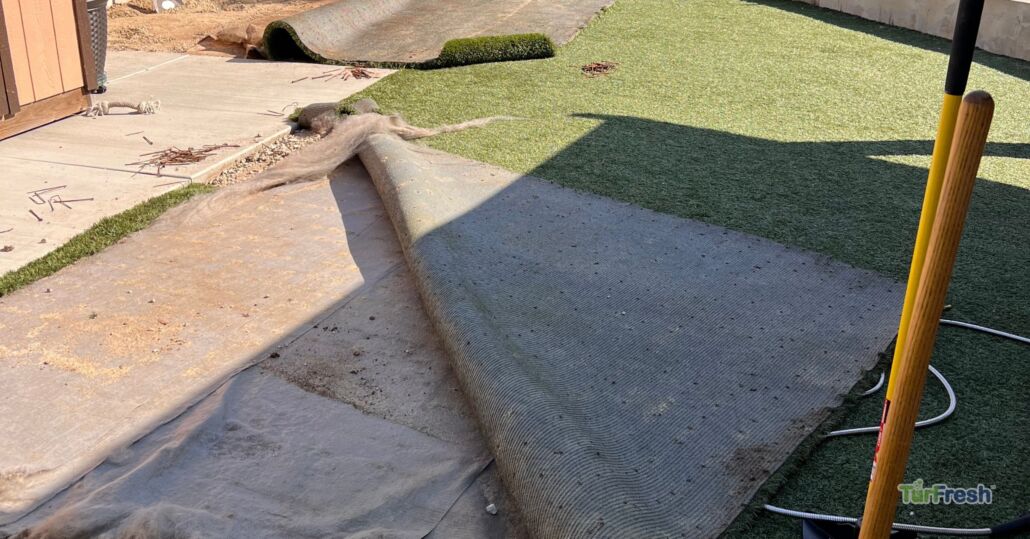
Most homeowners do well by inspecting infill levels at least once per year and topping up only the areas where thinning is visible, typically high-traffic lanes and pet zones. Industry maintenance guides suggest a 12 to 18 month inspection rhythm as a baseline, but actual top-up frequency depends on use level, climate, and whether the yard has pets.
Hot, dry climates like Phoenix and Las Vegas can accelerate infill settling and compaction. Heavy pet use in a concentrated zone depletes infill faster than distributed foot traffic across a large area.
Signs you likely need an infill top-up:
➡️ Blades look flat shortly after brushing and do not recover
➡️ Backing becomes more visible in worn areas or traffic lanes
➡️ Surface feels noticeably harder in certain zones compared to the rest of the lawn
➡️ High-traffic lanes look distinctly more compressed than surrounding areas
➡️ Pet areas are holding odor longer than usual even after enzyme treatment and rinsing
Top up high-traffic hot spots first: pet runs, play areas, gate entry points, and main walkways. Those are the zones where infill drops fastest and where the functional impact is greatest.
How Do You Put Infill in Turf Without Making a Mess?
The safest application method uses light layers brushed in between passes, which allows the infill to settle evenly below the blade tips rather than sitting visibly on top.
Step-by-step: how to add infill to artificial grass
👉 1. Remove all debris first. Infill applied over leaves or pet hair will trap organic material in the turf base
👉 2. Brush the turf to lift blades and open the fiber canopy. This creates space for infill to settle between fibers rather than sitting on top of them
👉 3. Apply infill in light passes. Use a drop spreader for even distribution or apply carefully by hand in smaller zones
👉 4. Brush again after each pass. Work infill down between blades using a stiff-bristle turf broom or power brush on larger areas
👉 5. Inspect depth and repeat if needed. Infill should sit below blade tips with fibers remaining the most visible part of the surface
👉 6. Rinse lightly after application. A light rinse helps infill settle to the base level and flushes any surface dust
Stop adding infill before it becomes visible at the surface. The correct appearance is fibers standing upright with no granular material visible above the blade base.
What Is the Best Infill for Artificial Grass If You Have Pets?
For pet households, the best infill is one that addresses odor at the source rather than absorbing moisture and masking smell. Standard silica sand performs well structurally but does not neutralize ammonia from pet urine. Zeolite-based infills absorb ammonia. Enzymatic infills like TurFill break down the ammonia and protein compounds that cause odor rather than simply absorbing them.
Infill Type Comparison for Pet Owners
Silica sand: Most common, lowest cost, good structural support and drainage. Does not address odor. Best for low-pet-use areas.
Zeolite: Absorbs ammonia from pet urine, reducing odor. Performance degrades as absorption capacity fills over time and requires periodic replacement.
Crumb rubber: Common in sports field installations. Not recommended for residential pet areas. Heat retention increases odor release in warm climates.
TPE (thermoplastic elastomer): Softer than crumb rubber, better heat profile. Good cushioning. Neutral effect on pet odor.
TurFill (enzymatic zeolite blend): All-natural, non-toxic, biodegradable. Uses the same enzymatic technology as BioS+ to break down ammonia and urine proteins at the infill level rather than absorbing and holding them. Safe for children and pets immediately after application.
Pet zones are the first areas to show infill depletion. If one zone consistently smells worse than the rest despite regular rinsing and treatment, check infill depth there first. Low infill means urine is concentrating closer to the backing rather than dispersing through the infill layer.
When Should You Hire Professional Artificial Turf Maintenance?
Professional turf maintenance is appropriate when infill has compacted over multiple seasons, when odors return quickly after home treatment, or when infill redistribution and deep cleaning need to be done together.
TurFresh's 10-point cleaning process includes infill assessment and redistribution as part of the service. For yards where infill has depleted across multiple zones, combining professional deep cleaning with a TurFill top-up in the same service visit delivers better results than either step alone.
Signs that professional service is the right call:
⚠️ Infill levels appear low across multiple zones rather than one isolated hot spot
⚠️ Brushing and top-up have been done but odors return within days
⚠️ The turf has not had professional cleaning in over 12 months with regular pet use
⚠️ Surface feels hard and uneven despite recent infill application
The problem is in the infill. TurFresh gets it out.
TurFresh deep cleaning removes bacterial buildup from the infill and backing layer where surface treatment stops. Pet safe and kid safe the same day.
✔ All Natural✔ Pet Safe✔ Enzymatic Formula✔ 30-Day Guarantee
Frequently Asked Questions
What is turf infill?
Turf infill is the granular material placed between artificial grass blades to keep fibers upright, add cushioning, stabilize the surface, and support drainage. It is a structural component installed at the base of the fiber layer. Most residential installations use 1 to 2 pounds of infill per square foot, with top-ups needed over time in high-traffic and pet areas.
Is infill necessary for artificial grass?
Yes, for most turf systems. Infill keeps fibers standing upright, adds cushion, and stabilizes the backing against shifting and wrinkling. For residential lawns with pets or children, infill is a functional requirement for performance and hygiene.
How much infill do I need for turf?
New installations typically require 1 to 2 pounds per square foot depending on pile height. For top-ups, measure only the thinned zones and estimate the depth shortfall at 0.5 to 1 pound per square foot. A 50-pound bag covers 25 to 50 square feet depending on depth needed.
How do I calculate how much infill I need?
Measure the thinned zone area in square feet. Multiply by the estimated depth shortfall (0.5 to 1 lb/sqft for top-ups). Divide by 50 to get the number of 50-pound bags needed. Always buy slightly more than the estimate since infill settles after application.
How much infill for artificial turf in high-traffic areas?
High-traffic areas need closer monitoring and more frequent top-ups because infill compacts and displaces faster under repeated use. Inspect entry points, pet paths, and seating areas seasonally. Signs include visible backing, hard surface feel, and blade flattening that does not respond to brushing.
How often do you need to add infill to artificial grass?
Inspect at least once per year and top up only thinned zones. High-pet-use yards in hot climates may need seasonal inspection and annual top-ups. Base frequency on visible signs rather than a fixed calendar.
What is the best infill for artificial grass with dogs?
Zeolite-based or enzymatic infill like TurFill is the best choice for pet areas because it neutralizes ammonia and urine proteins at the infill level. Standard silica sand provides structural support but does not address odor compounds.
How do you get rid of wrinkles in artificial grass?
Adequate infill helps reduce surface wrinkling by adding ballast weight that stabilizes the turf backing. If wrinkling persists after infill is restored, the issue is likely in the installation base or seaming and requires professional assessment.
What is synthetic pitch infill top-up?
Sports fields and synthetic pitches follow different infill specifications than residential lawns, typically using higher volumes at regulated depths set by governing bodies like FIFA or World Rugby. Residential top-ups are simpler and do not require equipment or compliance testing.
Share

John Pla is the owner of TurFresh and an expert with over 20 years of experience in artificial turf cleaning and maintenance. John’s passion for sustainability, community impact, and innovative solutions has made him a trusted figure in the artificial grass industry and beyond.