Quick Answer:
How to choose an artificial turf cleaning company comes down to three criteria: specialized experience with synthetic turf systems (not general lawn care), equipment designed to reach the infill layer where odor and bacteria accumulate, and a clearly defined guarantee with specific terms. The most important question to ask any prospective vendor is what their cleaning process does below the fiber surface. A company that cleans only the surface with brushing and rinsing is not performing deep cleaning regardless of how it is marketed. A company using hot-water extraction equipment reaches the infill layer where urine compounds and bacteria actually live. Ask that question first. Everything else follows from the answer.
Use the 8 questions in this guide on us. We will answer every one of them.
TurFresh uses hot-water extraction equipment that reaches the infill layer, non-toxic BioS+ and BioX formulas with no waiting period after service, and backs every cleaning with a 30-day odor removal guarantee with specific terms. Over 150,000 services completed across California, Arizona, Texas, Nevada, and Florida.
✔ Pet-Safe✔ No Waiting Period✔ 150,000+ Services✔ 30-Day Guarantee
Key Takeaways
✅ The single most important question: does your process clean below the fiber surface? Any company can rinse and brush turf. Only a company with extraction equipment designed for synthetic turf infill can remove the urine compounds and bacteria that cause persistent odor. If the answer to this question is vague, the company is not performing deep cleaning regardless of what they call it.
✅ A guarantee with no specific terms is not a guarantee. A 30-day odor removal guarantee is meaningless if it does not define what “odor removal” means, what voids the guarantee, and what the company will do if odor returns within the window. Ask for the guarantee terms in writing before booking.
✅ Re-entry time is a reliable proxy for product safety. If a company asks you to keep pets off the turf for 4 to 6 hours after service, the cleaning formula contains chemicals that require off-gassing before the surface is safe. A genuinely non-toxic formula requires no waiting period. Dogs can return as soon as the surface dries, typically 1 to 2 hours after service. Ask specifically: “when can my pets return to the turf after cleaning?”
✅ Pressure washing alone is not a substitute for professional turf cleaning. Pressure washing at high settings can displace infill, damage fiber backing, and reduce the cushioning that protects the installation. A legitimate turf cleaning company uses low-pressure or controlled extraction methods, not standard pressure washing. This is one of the clearest ways to distinguish a specialist from a general lawn care service that added turf cleaning to their menu.
✅ Years in business matters less than years specifically in turf cleaning. A landscaping company with 20 years of experience that added turf cleaning two years ago is not a specialist. Ask specifically how long the company has been performing artificial turf cleaning, how many services they have completed, and whether turf cleaning is their primary business or a secondary service.
Why Choosing the Right Artificial Turf Cleaning Company Matters
Artificial turf is a significant installation investment. A 500 square foot residential installation typically costs $5,000 to $15,000 depending on turf grade, market, and installer. The rated lifespan of premium synthetic turf is 15 to 20 years with proper maintenance. The wrong cleaning company can shorten that lifespan by damaging fiber backing with inappropriate chemicals, displacing infill with high-pressure washing, or providing surface-level cleaning that leaves bacterial contamination in the infill to degrade the system over time.
The difference between a specialist and a generalist in this category is not always visible from a company's website or initial quote. It becomes visible in the questions you ask and the specificity of the answers you receive.
This guide gives you the eight questions that reveal whether a turf cleaning company is a genuine specialist or a general service provider who added synthetic turf to their menu.
The 8 Questions to Ask Before Hiring a Turf Cleaning Company
Question 1: Does your process clean below the fiber surface into the infill?
This is the most important question. The infill layer is where urine compounds, bacteria, and fine organic debris accumulate over months of use. It is also where persistent odor originates. A surface rinse, brushing, or standard pressure wash does not reach it.
A specialist's answer will reference specific equipment designed for infill-level extraction: hot-water extraction machines, powered grooming equipment with infill decompaction capability, or a multi-step process that explicitly includes infill treatment. If the answer describes rinsing and brushing without mentioning what happens below the fiber line, the service is surface-level cleaning.
TurFresh answer: TurFresh TurfClean uses hot-water extraction equipment that reaches the infill layer, combined with BioX bacterial treatment applied at the infill level during the service.
Question 2: What cleaning products do you use and are they specifically safe for synthetic turf?
Bleach, ammonia-based cleaners, solvent-based products, and oxidizing agents damage synthetic turf materials. Bleach degrades backing adhesives and fades fiber pigments. Ammonia-based products worsen urine odor because ammonia is already a component of the problem.
Ask for the product name, the formulation type (enzyme-based, chemical disinfectant, oxidizing agent), and whether it is specifically tested as safe for synthetic turf fibers and backing. If the company cannot name the specific product they use, that is a red flag.
TurFresh answer: TurFresh uses BioS+ (enzyme cleaner for odor treatment) and BioX (bacterial disinfectant), both formulated specifically for synthetic turf surfaces and certified safe for pets and children with no waiting period required after application.
Question 3: How long before my pets can return to the turf after cleaning?
Re-entry time is a direct indicator of product toxicity. A formula that requires 4 to 6 hours of off-gassing before pets can safely return to the surface contains chemicals that are not genuinely pet-safe during application. A non-toxic, biodegradable enzyme formula requires only the time for the surface to dry.
If the company says pets need to stay off the turf for several hours after service, ask specifically why. The answer reveals whether the cleaning formula is appropriate for a household with pets and children.
TurFresh answer: Dogs and children can return to TurFresh-cleaned turf as soon as the surface dries, typically 1 to 2 hours after service depending on conditions. No extended waiting period is required.
Question 4: How long have you been specifically cleaning artificial turf?
Synthetic turf cleaning is a specialized service category distinct from general lawn care, carpet cleaning, or pressure washing. A company that entered the category recently lacks the accumulated experience with different turf systems, infill types, fiber backings, and installation conditions that a specialist develops over years.
Ask how many artificial turf cleaning services the company has completed, not how long the company has been in business overall. A landscaping company with 15 years of experience that added turf cleaning 18 months ago has 18 months of relevant experience.
TurFresh answer: TurFresh has completed over 150,000 artificial turf cleaning services across California, Arizona, Texas, Nevada, and Florida. Turf cleaning is TurFresh's primary business, not an add-on service.
Question 5: What does your guarantee cover and what are the specific terms?
A guarantee mentioned on a website without specific terms is a marketing statement, not a service commitment. Before booking, ask: what specifically does the guarantee cover? How long is the guarantee period? What voids the guarantee? What does the company do if the issue returns within the guarantee window?
The answers reveal whether the guarantee is a genuine commitment or a phrase designed to reduce sales objections.
TurFresh answer: TurFresh backs every service with a 30-day odor removal guarantee. If odor returns within 30 days of a correctly performed service, TurFresh will return to address it. The guarantee applies to odor that develops from the pre-existing infill contamination addressed in the service, not to new pet use after the service is complete.
Question 6: Do you use pressure washing as part of your process?
High-pressure washing can displace infill from the fiber bed, damage fiber backing at connection points, and reduce the cushioning function that protects the installation and provides impact absorption. A specialist uses controlled pressure methods or extraction equipment, not standard pressure washing.
Some companies use pressure washing as an add-on option for severe surface contamination. Ask whether it is a standard part of the process and at what pressure setting it is applied. Anything above 1,500 PSI on residential turf carries a risk of infill displacement and backing damage.
TurFresh answer: TurFresh does not use standard pressure washing as a primary cleaning method. The TurfClean process uses hot-water extraction and controlled application methods designed to clean the infill layer without damaging fiber backing or displacing infill.
Question 7: Do you provide documentation of the service?
A professional turf cleaning company should provide written confirmation of the service performed, including the date, the products used, the areas treated, and any observations about the turf condition. This documentation is valuable for three reasons: it creates a maintenance record that helps with scheduling future services, it provides evidence of professional maintenance if a warranty claim is ever made against the turf installation, and it satisfies compliance requirements for commercial properties, schools, and HOAs that maintain facility maintenance logs.
If a company cannot provide a written service record, that is a signal of informal operations that may also affect the consistency of the cleaning process itself.
TurFresh answer: TurFresh provides written service documentation for every visit, which clients can use for maintenance records, HOA compliance, or installer warranty purposes.
Question 8: Is turf cleaning your primary business or an add-on service?
This question is not about the company's history. It is about where their operational investment is focused. A company whose primary business is turf cleaning has invested in specialized extraction equipment, trained technicians specifically in synthetic turf systems, and developed protocols for different turf types and contamination scenarios. A company for which turf cleaning is a secondary service added to their main offering (landscaping, pressure washing, carpet cleaning) has typically not made that level of investment.
The answer to this question correlates directly with the quality and consistency of the service delivered.
TurFresh answer: Artificial turf cleaning is TurFresh's primary and founding business. John Pla founded TurFresh specifically to address the gap in specialized synthetic turf maintenance services for residential and commercial pet owners.
Red Flags: 5 Signs a Turf Cleaning Company May Damage Your Turf
Beyond the eight questions above, these signals during an initial conversation or quote process indicate higher risk of a poor service outcome.
Red flag 1: Cannot name the specific cleaning products they use. A professional using products specifically designed for synthetic turf knows those products by name. A company that describes their cleaning method as “safe and eco-friendly” without being able to name the formula is likely using generic cleaning products not designed for synthetic turf.
Red flag 2: Quotes multiple sessions before the problem can be resolved. Reputable turf cleaning companies can assess whether a single service will address the contamination level based on a brief diagnostic conversation. A company that quotes three or four sessions before your turf can smell clean as a default position may be managing revenue rather than genuinely diagnosing the problem. A standard professional TurfClean service addresses infill contamination in a single visit for most residential installations.
Red flag 3: Does not ask about your turf installation age, type, or current condition. A specialist begins every service conversation with diagnostic questions about the turf system. A generalist quotes based on square footage without regard for the turf's specific situation. If the company does not ask about your pets, the turf's age, the primary problem you are experiencing, and whether you have tried any DIY treatments, they are not diagnosing. They are booking.
Red flag 4: Cannot explain what their process does differently from rinsing with a garden hose. If the answer to “what does professional cleaning do that I cannot do myself with a hose?” is vague or describes only surface-level brushing and rinsing, the service is not substantively different from what you can do yourself. A legitimate professional service can clearly articulate what their equipment reaches and how that differs from surface maintenance.
Red flag 5: Requires payment in full before the service is performed without any guarantee terms. Full payment before service without a written guarantee is a risk for the customer. A company confident in their service quality offers guarantee terms before booking and does not require full payment before demonstrating results.
Cleaning Methods Compared: What Each Type Actually Does
The practical implication: a company offering only surface cleaning methods cannot resolve persistent pet odor in an infill-saturated yard. If your primary concern is odor that has persisted through multiple DIY attempts, the only cleaning method that addresses the source is infill-level extraction.
What the Guarantee Should Cover
A guarantee from a turf cleaning company should specify four things to be meaningful:
The specific outcome it covers. “Odor removal” is more specific than “satisfaction.” “30-day odor removal guarantee” is more specific than “we stand behind our work.”
The duration of the coverage window. 30 days is the industry standard for residential pet odor treatment. Shorter windows (7 to 14 days) are inadequate for infill-level odor removal because infill contamination can take 2 to 4 weeks to fully manifest after partial treatment.
What voids the guarantee. New pet use after the service is complete does not indicate treatment failure. The guarantee should cover the contamination that existed at the time of service, not new inputs. A legitimate guarantee clearly distinguishes between treatment failure and new contamination.
What the company does if the issue returns within the window. A company that offers a return visit at no charge is demonstrating confidence in their work. A company that offers only a partial refund without returning to address the problem has limited commitment to the outcome.
TurFresh's 30-day odor removal guarantee covers return to address any odor that returns from pre-existing infill contamination addressed in the original service. It does not cover odor from new pet use after the service is complete.
What Professional Artificial Turf Cleaning Should Cost
Pricing transparency is itself a criterion. A company that provides clear per-square-foot pricing or straightforward service package pricing is operating professionally. A company that provides only vague “starting at” pricing with extensive add-on fees is creating conditions for post-service billing surprises.
General pricing ranges for residential turf cleaning services:
Basic service (surface cleaning, light debris removal, surface rinse): $75 to $150 for a typical residential yard of 300 to 500 square feet.
Standard professional cleaning (extraction, enzyme treatment, fiber brushing): $150 to $400 for 300 to 500 square feet depending on condition and location.
Full restoration service (extraction, infill decompaction, TurfBloom fiber restoration, enzyme treatment): $250 to $600 for 300 to 500 square feet.
When comparing quotes, the relevant comparison is not the price per service but the price relative to what the service actually does. A $150 surface cleaning and a $350 extraction service are not alternatives for the same problem. For a yard with persistent pet odor, the surface cleaning does not address the source and the cost difference represents the difference between a temporary result and a lasting one.
The replacement cost of a 500 square foot turf installation is $5,000 to $15,000. Regular professional cleaning that extends the installation's effective life by 3 to 5 years has a direct financial return that substantially exceeds the service cost.
TurFresh is a specialist. Turf cleaning is all we do. We can prove it.
150,000+ services completed. Non-toxic BioS+ and BioX formulas with no waiting period after service. Hot-water extraction that reaches the infill layer. 30-day odor removal guarantee with specific terms. Service documentation provided for every visit. Available across California, Arizona, Texas, Nevada, and Florida.
✔ Specialist, Not a Generalist✔ 30-Day Guarantee✔ 150,000+ Services✔ No Waiting Period
Frequently Asked Questions
How do I choose an artificial turf cleaning company?
Choose based on three criteria: specialized experience in synthetic turf (not general lawn care), equipment that cleans below the fiber surface into the infill layer where odor and bacteria accumulate, and a clearly defined guarantee with specific terms. The single most important question to ask is whether their process reaches the infill layer and how. A company that can answer that question specifically is a specialist. A company that gives a vague answer about rinsing and brushing is a generalist.
What questions should I ask a turf cleaning company before hiring?
Ask: Does your process clean below the fiber surface into the infill? What specific products do you use and are they tested safe for synthetic turf? How long before pets can return after service? How long have you specifically been cleaning artificial turf? What does your guarantee cover in specific terms? Do you use pressure washing and at what settings? Do you provide written service documentation? Is turf cleaning your primary business or an add-on service?
What are the red flags when hiring a turf cleaning company?
Red flags include: inability to name the specific products they use, quoting multiple sessions as a default before assessing the problem, not asking diagnostic questions about your turf before quoting, vague descriptions of what their process does differently from a garden hose, and requiring full payment before service without written guarantee terms.
Is pressure washing bad for artificial turf?
High-pressure washing above approximately 1,500 PSI can displace infill from the fiber bed, damage fiber backing at connection points, and reduce the cushioning the turf system provides. A specialist uses controlled extraction methods or low-pressure application designed for synthetic turf, not standard pressure washing. If a company uses pressure washing as a primary cleaning method, ask specifically at what pressure setting and whether it is appropriate for your turf type.
How long should a turf cleaning guarantee last?
A 30-day odor removal guarantee is the industry standard for residential pet odor treatment. Shorter windows of 7 to 14 days are inadequate because infill contamination can take 2 to 4 weeks to fully manifest after partial treatment. The guarantee should also specify what it covers (pre-existing contamination, not new pet use), what voids it, and what the company will do if the issue returns within the window.
How much does professional artificial turf cleaning cost?
Standard professional cleaning with extraction, enzyme treatment, and fiber brushing typically ranges from $150 to $400 for a 300 to 500 square foot residential yard. Basic surface cleaning is $75 to $150 for the same area. Full restoration services including infill decompaction and fiber restoration range from $250 to $600. When comparing quotes, ensure you are comparing equivalent service types. A surface cleaning and an extraction service are not alternatives for the same problem in a pet-intensive yard.
Share
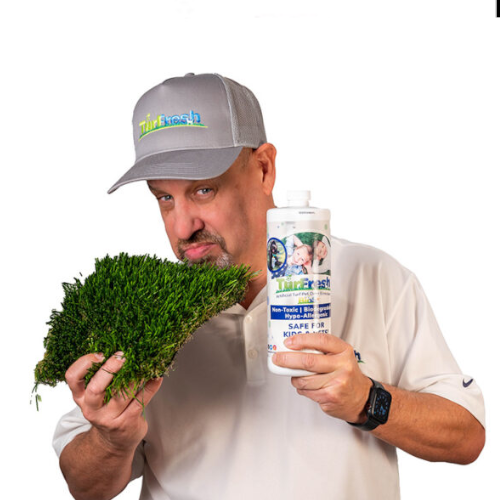

John Pla is the owner of TurFresh and an expert with over 20 years of experience in artificial turf cleaning and maintenance. John’s passion for sustainability, community impact, and innovative solutions has made him a trusted figure in the artificial grass industry and beyond.