
Quick Answer:
How to prevent artificial grass from matting comes down to three consistent habits: brushing fibers against the grain every 2 to 4 weeks, using the right tool for your yard size and use level, and catching compaction early before it becomes permanent fiber fatigue. In pet households or high-traffic yards, weekly brushing in the most-used zones is more effective than monthly brushing across the whole surface. When fibers no longer respond to brushing after two sessions, the compaction has reached the infill layer and requires professional restoration equipment to reverse.
Stop managing the matting. Start protecting your investment.
TurFresh TurfBloom uses professional-grade grooming equipment to restore fiber height and prevent permanent compaction, going deeper than any home tool can reach. Over 150,000 services completed. Pet-safe. Backed by our 30-day guarantee.
✔ Pet-Safe✔ Kid-Safe✔ 150,000+ Services✔ 30-Day Guarantee
Key Takeaways
✅ Brush against the grain every time. Brushing in the direction fibers already lean pushes them further down. Always work in the opposite direction to lift fibers back to an upright position. This is the single most important technique in preventing matting.
✅ Frequency matters more than intensity. Two short brushing sessions per month prevent more matting than one aggressive session every three months. Consistent light maintenance stops compaction from building up to the point where brushing alone cannot reverse it.
✅ The right tool depends on yard size and use level. A stiff synthetic-bristle hand brush with 4 to 5 inch bristles works well for small yards and light use. A power broom covers larger areas faster and reaches deeper into the fiber bed. Professional grooming equipment goes further than either.
✅ Protective mats and furniture rotation prevent the most stubborn matting. Fibers under static weight for weeks or months develop compression memory that brushing struggles to reverse. Moving furniture every few weeks and placing protective mats under heavy items prevents the problem before it starts.
✅ When brushing stops working, the problem is in the infill. If fibers in a specific zone do not lift after two proper brushing sessions, compaction has reached below the surface level. This requires professional extraction equipment, not more brushing.
Why Artificial Grass Mats Down
Artificial grass mats when synthetic fibers are compressed repeatedly without being lifted back to an upright position between uses. The fibers themselves are flexible and resilient when new, but repeated compression in the same direction gradually reduces their ability to rebound.
The most common causes are foot traffic along consistent paths, pets running the same routes daily, outdoor furniture left in one position for extended periods, and play equipment with small footprints that concentrate weight. In hot climates like Phoenix and Las Vegas, sustained high surface temperatures soften the synthetic polymer structure and accelerate the compression cycle, making matting develop faster than in cooler markets.
The critical variable is not whether compression happens (it always will in any used yard) but whether fibers are restored to an upright position between compression events. A yard that is brushed regularly shows dramatically less permanent matting than one with the same use level but no brushing routine.
📌 Matting that develops gradually over months is harder to reverse than matting that develops after a specific event like a party or a summer of heavy use. Consistent prevention is always more effective than periodic restoration.
How Often Should You Brush Artificial Grass?
Brushing frequency should match use intensity, not a fixed calendar schedule.
For a low-traffic residential yard with no pets, brushing every 4 to 6 weeks maintains fiber position without requiring frequent effort. Time per session for a 500 square foot yard: approximately 20 to 30 minutes with a hand brush, 10 to 15 minutes with a power broom.
For a moderate-traffic yard with one dog, brush every 2 to 3 weeks. Focus extra attention on the routes your dog uses most consistently, typically the path from the door to the back of the yard and any favorite resting spots.
For a high-traffic yard with multiple dogs or children, brush the highest-use zones weekly and the rest of the surface every 2 weeks. Pet traffic concentrates in specific areas and those zones fatigue significantly faster than the surrounding lawn.
For commercial installations, dog runs, and kennels, weekly brushing across the entire surface is the minimum effective schedule. High-volume use compresses fibers faster than any home-use scenario and requires more frequent intervention to prevent permanent damage.
📌 A quick way to assess whether brushing is needed: drag your hand across the surface in a high-traffic area. If fibers are leaning flat and do not spring back when touched, a brushing session is overdue.
What Tools Should You Use to Brush Artificial Grass?
The right tool depends on yard size, use level, and how much time you want to spend.
Stiff synthetic-bristle hand brush
The correct choice for small yards (under 300 square feet), spot treatment of specific matted areas, and maintenance brushing between professional sessions. Look for bristles made from nylon or polypropylene, approximately 4 to 5 inches in length. Shorter bristles do not penetrate deeply enough to redistribute infill. Longer bristles can be too flexible to lift compressed fibers effectively.
Never use metal bristles, wire brushes, or rigid plastic tools. These tear synthetic fibers, abrade the turf backing, and cause damage that accumulates invisibly over time and shortens the lifespan of the surface.
Power broom
A power broom uses rotating synthetic bristles to lift fibers and redistribute infill more thoroughly than hand brushing. It covers large areas significantly faster and is more effective on moderate compaction where hand brushing produces only partial improvement.
For residential yards over 500 square feet, a power broom is the more practical tool for routine maintenance. Any power broom with synthetic bristle heads works on artificial turf. It does not need to be marketed specifically for synthetic grass as long as the bristle material is not metal.
The TurFresh TurfGroomer Plus is a purpose-built power broom with polypropylene bristles calibrated for synthetic turf fiber height. It picks up debris including pet hair as it brushes, combining two maintenance tasks in one pass.
TurfComb
The TurFresh TurfComb is a manual tool designed specifically for artificial grass. Its polypropylene bristles are strong enough to penetrate the fiber bed and redistribute infill while being gentle enough to avoid fiber damage. It also removes pet hair embedded in the surface during the brushing pass. Useful as a detail tool for high-use zones between power broom sessions.
What not to use
Metal rakes, wire brushes, garden rakes with metal tines, and stiff-bristle push brooms with plastic tips should not be used on artificial grass. Each contact with these tools causes micro-damage to fiber tips and backing material that accumulates over time. The damage is not immediately visible but reduces fiber resilience and shortens the effective lifespan of the surface.
How to Brush Artificial Grass Correctly
The technique matters as much as the frequency.
Always brush against the natural lean of the fibers. After installation or extended use, synthetic grass fibers develop a directional lean. Brushing with that lean presses them further down. Brushing against it lifts them back toward vertical.
Work in multiple directions rather than a single linear pass. A cross-brushing pattern covers the fiber bed more thoroughly than brushing in one direction only. Start with a north-south pass, then follow with an east-west pass across the same area.
Lightly watering the surface before brushing helps fibers lift more readily, especially in dry climates where static buildup can cause fibers to cling together. This is most effective in Phoenix, Las Vegas, and other arid markets during summer.
Focus extra attention on high-traffic zones: entry points from the house, paths your pets use daily, and areas under or near play equipment. These zones compress faster and need more frequent brushing than the surrounding surface.
After brushing, walk the surface and check for any areas that still feel hard or flat underfoot. Repeat the pass in those specific zones rather than re-brushing the entire surface.
Other Habits That Prevent Matting
Brushing is the primary prevention tool, but three additional habits meaningfully reduce how quickly matting develops.
Rotate furniture and equipment regularly. Move patio chairs, tables, and play equipment every 2 to 4 weeks. Static weight in one position creates localized compression that is harder to reverse than the distributed compression from foot traffic. Furniture with small contact points like chair legs creates more concentrated pressure than flat-based items.
Use protective mats under heavy objects. Placing rubber or foam pads under furniture legs and play equipment distributes weight across a larger surface area and significantly reduces fiber compression at the contact point. This is especially useful for permanent or semi-permanent installations like outdoor dining sets that move infrequently.
Manage traffic patterns in high-use zones. Installing stepping stones along the most heavily used paths removes foot pressure from the turf fibers entirely in those areas. In yards where dogs follow the same route every day, redirecting that route slightly every few months distributes wear across more of the surface.
How to Tell If Your Matting Is Still Reversible
Not all matting responds to brushing the same way. Understanding where your turf is in the compression cycle helps you choose the right response.
Temporary compression occurs after a specific event: a party, a trampoline that sat in one spot, or a period of neglected brushing. The fibers are still structurally intact but lying flat from sustained pressure. One to two thorough brushing sessions typically restores 80 to 90 percent of fiber height. This type responds well to DIY maintenance.
Moderate compaction occurs in high-use zones after months of consistent traffic without adequate brushing. Fibers respond partially to hand brushing but do not fully return to their original height. A power broom session delivers significantly better results than a hand brush in this state. Professional TurfBloom grooming with powered equipment restores fibers more thoroughly than any home tool at this stage.
Permanent fiber fatigue occurs when fibers have been compressed repeatedly over a long period and have lost their structural resilience. Brushing produces visible improvement that reverses within days of normal use. At this stage, no maintenance service creates a permanent fix. The options are scheduled TurfBloom service to maintain acceptable appearance or, in severely affected sections, replacement of that zone.
📌 The simplest diagnostic test: brush a matted area thoroughly and check it again 48 hours after normal use. If fibers return to a flat position within two days, the compaction has progressed to a level where professional grooming is the appropriate intervention.
When to Schedule Professional Turf Grooming
Professional grooming is the right next step in three situations.
The first is when brushing produces only temporary improvement. If you brush a zone thoroughly and fibers flatten again within a week of normal use, the compaction source is in the infill layer below the surface. Professional equipment reaches that layer; home tools do not.
The second is when a large area requires restoration at once. Manually brushing a heavily matted 1,000 square foot yard is impractical and inconsistent. Professional equipment covers the entire surface uniformly in a fraction of the time.
The third is as a scheduled annual maintenance investment regardless of visible condition. Annual TurfBloom service removes compacted infill, restores fiber position, and cleans the full turf system before problems become visible. For yards with multiple dogs or heavy use, scheduling every 6 months delivers consistently better long-term results than waiting for matting to become noticeable.
Professional TurfBloom reaches where home tools cannot.
TurFresh TurfBloom uses powered grooming equipment to restore fiber height, redistribute compacted infill, and clean the full turf system. Over 150,000 services completed across California, Arizona, Texas, Nevada, and Florida. No commitment required.
✔ Pet-Safe✔ Kid-Safe✔ 150,000+ Services✔ 30-Day Guarantee
Frequently Asked Questions
How do you prevent artificial grass from matting?
Prevent artificial grass from matting by brushing fibers against the grain every 2 to 4 weeks, using a stiff synthetic-bristle brush or power broom depending on yard size, rotating furniture and using protective mats under heavy objects, and scheduling professional grooming annually or when home brushing stops producing lasting results.
How often should you brush artificial grass?
Brush every 4 to 6 weeks for low-traffic yards without pets. Every 2 to 3 weeks for yards with one dog. Weekly in the highest-use zones for multi-dog households or heavy-traffic areas. Frequency should match use intensity rather than a fixed calendar.
What is the best brush for artificial grass?
A stiff synthetic-bristle brush with 4 to 5 inch nylon or polypropylene bristles works well for small areas and routine maintenance. For larger yards or deeper compaction, a power broom with synthetic bristle heads delivers faster and more thorough results. The TurFresh TurfComb is a purpose-built option that also removes pet hair during the brushing pass.
Is a power broom better than a hand brush for artificial grass?
Yes, for larger areas and moderate-to-heavy compaction. A power broom covers ground faster, penetrates the fiber bed more consistently, and redistributes infill more thoroughly than hand brushing. For small yards or spot treatment, a hand brush is sufficient. Many homeowners use both for different zones.
What causes artificial grass to mat permanently?
Permanent matting is caused by fiber fatigue from years of repeated compression without adequate restoration between use cycles. Heat accelerates the process in Sun Belt markets. Once fibers have lost structural resilience, no maintenance service creates a permanent fix, though regular professional grooming maintains acceptable appearance.
Can you fix matted artificial grass yourself?
Temporary and moderate compaction responds well to DIY brushing. Use a stiff synthetic-bristle brush or power broom and work against the grain in multiple directions. If fibers do not hold an upright position for more than a week after a thorough session, the compaction has reached a level that requires professional grooming equipment.
How long does it take to brush artificial grass?
Approximately 20 to 30 minutes per 500 square feet with a hand brush, and 10 to 15 minutes with a power broom. Focus extra time on high-traffic zones and pet paths rather than spending equal time across the entire surface.
Share
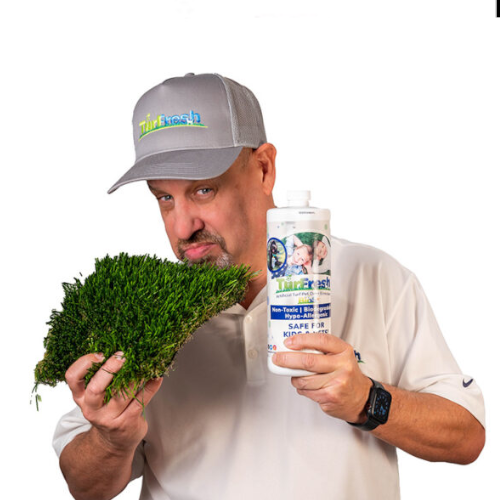

John Pla is the owner of TurFresh and an expert with over 20 years of experience in artificial turf cleaning and maintenance. John’s passion for sustainability, community impact, and innovative solutions has made him a trusted figure in the artificial grass industry and beyond.