Artificial Grass Maintenance Mistakes That Shorten Your Turf's Lifespan
Jun 20, 2026 · 15 min read · By John Pla, Founder of TurFresh
Quick Answer: The most common artificial grass maintenance mistakes fall into two categories: those that cause immediate damage and those that cause gradual degradation you will not notice until the problem is expensive to fix. Immediate damage comes from vacuuming the turf (which removes infill and tears fibers), using bleach or harsh chemical cleaners (which degrade backing adhesives and fade fiber color), and brushing with metal tools (which abrades the turf surface). Gradual degradation comes from neglecting infill levels, skipping professional cleaning, and brushing in the wrong direction. Of these, skipping professional cleaning is the most costly long-term mistake. Without periodic deep extraction of the infill layer, urine compounds and bacteria accumulate to levels that surface treatments cannot reverse, shortening a 15 to 20 year installation to 8 to 10 years.
Most long-time owners are surprised by how much has built up. One professional cleaning shows you the difference.
TurFresh professional cleaning reaches the infill layer where years of pet use, organic debris, and urine compounds accumulate beyond the reach of any surface maintenance. Over 150,000 services completed. Pet-safe same day. Backed by our 30-day odor removal guarantee.
Book Your First Professional Cleaning✔ Pet-Safe✔ Kid-Safe✔ 150,000+ Services✔ 30-Day Guarantee
Key Takeaways
✅ Vacuuming artificial turf removes infill and damages fibers. Artificial turf is not carpet. Standard household vacuums are not designed for turf systems and will pull infill out of the fiber bed, flatten blades, and can fray or tear synthetic fibers. Use a leaf blower, plastic rake, or power broom instead.
✅ Bleach and harsh chemical cleaners cause permanent damage. High-alkalinity cleaners, bleach, and solvent-based products degrade the latex backing adhesive over time and can permanently fade or discolor synthetic fibers. Damage from repeated chemical misuse is not reversible. Only enzyme-based, pH-neutral turf-safe cleaners should be used.
✅ Brushing with metal tools abrades turf fibers with every pass. Metal rakes and wire brushes cause micro-abrasions on synthetic fibers that accumulate invisibly over months. Always use synthetic-bristle brushes, plastic rakes, or purpose-built turf combs. Brushing direction also matters: always brush against the natural lean of the fibers, not with it.
✅ Neglecting infill causes matting and drainage failure. Infill is displaced by foot traffic, pets, and weather continuously. When infill drops below the fiber line in high-use zones, blades lose their upright support, drainage efficiency drops, and urine begins to pool at the base rather than drain through. Check infill levels every few months and top up as needed.
✅ Skipping professional cleaning is the most expensive maintenance mistake. Surface rinsing and enzyme treatments handle what is visible. Professional extraction handles what has accumulated in the infill layer over months of use. Without periodic deep cleaning, urine compounds crystallize in the infill and cannot be reversed by any surface treatment, shortening a 15 to 20 year installation to 8 to 10 years.
Mistake 1: Vacuuming Artificial Turf
What happens
Artificial turf looks and feels similar to indoor carpet in some ways, which leads many homeowners to reach for a vacuum when the surface looks dirty or carries pet hair. This causes two immediate problems.
First, the suction draws infill out of the fiber bed. Infill is the granular material between the blades that keeps fibers upright, provides cushioning, and manages drainage. Removing it from high-use zones creates soft spots where blades collapse and drainage becomes uneven.
Second, vacuum nozzle and rotating brush attachments are not designed for synthetic fiber geometry. Contact with turf fibers causes fraying at the fiber tip, which accelerates matting in the affected zone. In severe cases, fibers can be pulled partially free from the backing.
What to do instead
For routine debris removal, a leaf blower on a low setting removes loose material without contacting fibers or displacing infill. A plastic rake or purpose-built turf comb handles debris the blower does not clear. For pet hair embedded in the fiber bed, the TurFresh TurfComb is designed to lift and remove pet hair in the same pass without affecting infill.
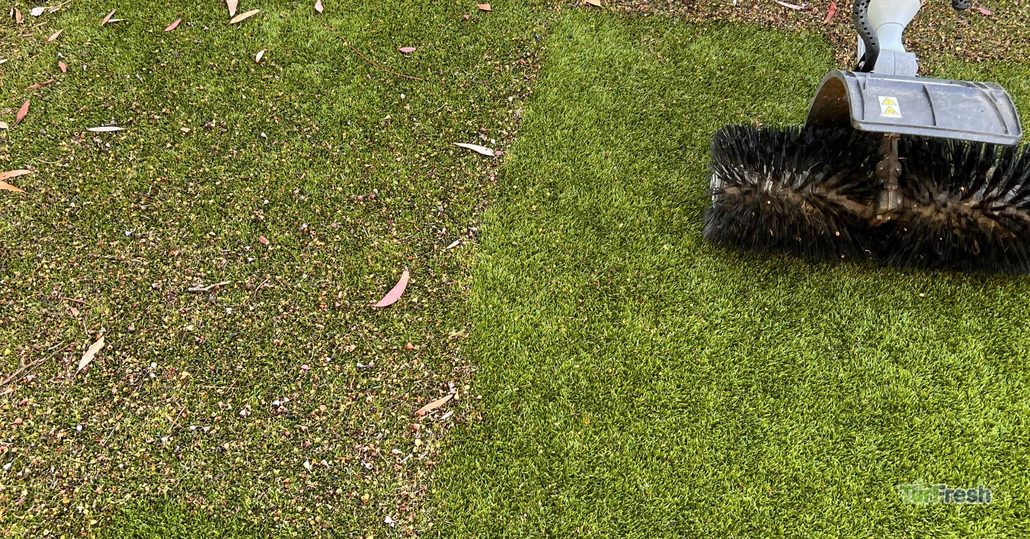
For deep fiber cleaning, a professional power broom is the correct tool. It uses rotating synthetic bristles to agitate the fiber bed, redistribute infill, and remove material embedded between blades without the suction that damages infill distribution.
📌 If you have already vacuumed your turf and noticed areas that feel softer or have lower fiber density, a TurFill infill top-up combined with a professional TurfBloom fiber restoration session typically restores normal function to the affected zones.
Mistake 2: Using Bleach or Harsh Chemical Cleaners
What happens
Pet urine odor creates strong motivation to use the most powerful cleaning product available. Bleach and other high-alkalinity cleaners feel like the logical response to a persistent smell. In practice, they create two separate problems.
The first is chemical degradation. Bleach and solvent-based cleaners break down the latex adhesive that bonds turf fibers to the backing material. With repeated applications, this adhesive weakens progressively. Fibers begin to detach from the backing in affected areas, and the structural integrity of the installation declines years ahead of its rated lifespan.
The second problem is color damage. Bleach and oxidizing agents fade synthetic fiber pigments, particularly in UV-exposed outdoor installations. This fading is permanent and irreversible. Discolored patches cannot be restored through any cleaning or treatment.
What to do instead
Enzyme-based cleaners like TurFresh BioS+ are the correct solution for pet odor. They work by introducing beneficial bacteria and enzymes that break down uric acid and ammonia compounds at a molecular level rather than masking them with fragrance or attempting to oxidize them chemically. They are effective at the temperatures found on outdoor turf in warm climates, safe for pets and children immediately after application, and do not degrade backing adhesives or fiber pigments with repeated use.
For surface disinfection after illness or pathogen exposure, TurFresh BioX provides antibacterial and antiviral action in a formula that is safe for synthetic turf materials.
If odors return within 48 to 72 hours of a correct enzyme treatment session with full dwell time, the contamination source is in the infill layer below the surface. No topical application, however strong, reaches that layer. Professional extraction is the appropriate next step.
Mistake 3: Brushing With Metal Tools or in the Wrong Direction
What happens
Two brushing mistakes are common, and both cause damage that accumulates invisibly until the surface begins looking permanently worn.
The first is using metal tools. Metal rakes, wire brushes, and any tool with metal tines or bristles cause micro-abrasions on synthetic fiber surfaces with every pass. These abrasions are not visible after a single use but accumulate with repeated application. Over months, the fiber surface becomes rougher, less reflective, and more prone to attracting debris. In severe cases, metal tools can tear fibers from the backing or puncture the backing material itself.
The second is brushing in the wrong direction. Turf fibers have a natural lean direction from installation. Brushing with that lean pushes fibers further down rather than lifting them. Always identify the natural lean direction by looking across the surface at a low angle and brush in the opposite direction. This technique, called cross-brushing, lifts compressed fibers back toward a vertical position and redistributes infill that has settled in high-traffic zones.
Complete Guide
📖 5 Maintenance Tips to Extend the Life of Your Artificial Turf — the complete care schedule: debris, brushing, pet waste, infill, and professional cleaning frequency.
What to do instead
Use a brush with stiff synthetic (nylon or polypropylene) bristles, a plastic rake, or the TurFresh TurfComb. Brush against the natural grain in multiple passes, then follow with a pass at 90 degrees to the first. Focus extra attention on high-traffic zones where compression develops fastest. Monthly brushing maintains fiber position between professional services and significantly slows the matting that makes turf look aged and worn.
📌 Overbrushing is also a real mistake. Aggressive, repeated brushing in the same session can stress fiber attachment points and cause premature fiber fatigue. For routine maintenance, one to two thorough passes is sufficient. Power broom services from TurFresh are calibrated for the correct pressure and speed for each turf type.
Mistake 4: Neglecting Infill Levels
What happens
Infill is the material between turf fibers that performs three critical functions: keeping fibers upright, providing cushioning underfoot, and managing how liquids including pet urine move through the turf system. Most homeowners do not think about infill after installation, which means it depletes without anyone noticing until the visible signs become obvious.
Infill is displaced continuously by foot traffic, pet activity, wind, and rainfall. In high-use zones like pet paths and children's play areas, infill can drop below the fiber line within months of installation. When this happens, blades in that zone collapse because they have lost their support structure. The surface feels different underfoot and begins to look flat and artificial rather than upright and natural. Drainage in depleted zones also decreases because the infill layer that channels liquid downward is no longer functioning at the correct density.
For pet households, depleted infill also means that urine is not being channeled efficiently through the drainage system. Instead, it pools at the base layer where it concentrates and creates the bacterial environment that generates persistent urine smell.
What to do instead
Check infill levels by pressing down on the surface in high-use areas. If it feels hard and rocky with no give, or if the backing is visible between fibers in any zone, infill has depleted in that area and needs to be topped up. Use the same infill material as the original installation. If you are unsure what was used, your installer will have that information.
TurFresh TurFill is a deodorizing infill that provides ongoing odor control in addition to the structural functions of standard infill, making it particularly effective for pet zones.
Mistake 5: Skipping Professional Cleaning
What happens
This is the most expensive maintenance mistake in cumulative terms, and it is the one most homeowners do not recognize until the consequences are already advanced.
Surface maintenance including rinsing, brushing, and enzyme treatment addresses what is visible on the fiber surface and in the upper fiber bed. It does not reach the infill layer. Over months of use, particularly in pet households, urine compounds, fine organic debris, and bacteria accumulate in the infill layer through a process that surface maintenance can slow but not stop.
Once uric acid crystals form in the infill at sufficient concentration, the odor source becomes self-sustaining. Heat activates the crystals to release ammonia gas. Surface enzyme treatments applied after this point react with the surface material and never reach the crystallized source below. The smell that returns within days of a DIY cleaning session, even a correct one with proper dwell time, is the signal that this threshold has been reached.
Without professional extraction that reaches the infill layer, the crystallized uric acid continues to degrade the infill material, reduces its ability to neutralize new urine inputs, and progressively damages the backing of the installation. The result is a turf surface that smells regardless of how often it is treated and ages years ahead of its rated lifespan.
What to do instead
Schedule professional cleaning on a schedule matched to actual use level. For a yard with no pets: once or twice per year. For a single dog: every 3 to 6 months. For two or more dogs or large breeds: every 6 to 12 weeks. For multiple large dogs: every 3 to 4 weeks during warm months.
TurFresh TurfClean service uses hot-water extraction equipment that reaches the infill layer, combined with BioX bacterial treatment that eliminates urine compounds at the molecular level rather than masking them. The result is a surface that is genuinely clean rather than deodorized, safe for pets and children immediately after service, and reset to a clean baseline that extends the effective interval before the next service is needed.
📌 If you have owned artificial turf for more than 2 years and have never had a professional cleaning, scheduling your first service produces a visible and noticeable improvement that most homeowners describe as seeing the turf restored to close to its installed condition.
How to Clean Indoor Artificial Turf Without Making These Mistakes
Indoor artificial turf follows the same mistake-avoidance rules as outdoor turf, with two additional considerations.
First, indoor installations lack the natural rinse cycle that outdoor turf receives from rain. This means organic debris and urine compounds accumulate on the surface faster between cleaning sessions and require more frequent enzyme treatment applications rather than the more passive approach that outdoor turf can rely on.
Second, indoor turf typically lacks the drainage system of outdoor installations. This means product application must be more targeted and conservative. Over-saturating an indoor turf surface with enzyme cleaner or water leads to moisture accumulation under the installation that outdoor drainage systems prevent. Apply BioS+ with a pump sprayer rather than a hose-end sprayer for indoor use, targeting specific affected zones rather than saturating the full surface.
For high-use indoor spaces such as gyms, training facilities, or school play areas, professional cleaning is especially important because the absence of weather rinsing means organic accumulation progresses faster than in comparable outdoor installations.
The source is in the infill. That is where professional cleaning starts.
TurFresh professional cleaning reaches what surface maintenance stops at: the infill layer where urine compounds crystallize and bacteria accumulate over months of use. Over 150,000 services completed across California, Arizona, Texas, Nevada, and Florida. Backed by our 30-day odor removal guarantee.
Schedule Your Cleaning✔ Pet-Safe✔ Kid-Safe✔ 150,000+ Services✔ 30-Day Guarantee
Frequently Asked Questions
What are the most common artificial grass maintenance mistakes?
The most damaging artificial grass maintenance mistakes are vacuuming the turf, using bleach or harsh chemical cleaners, brushing with metal tools or in the wrong direction, neglecting infill levels, and skipping professional cleaning. Vacuuming causes immediate infill loss and fiber damage. Bleach causes permanent backing degradation and fiber discoloration. Skipping professional cleaning is the most expensive long-term mistake because it allows urine compounds to crystallize in the infill layer beyond the reach of any surface treatment.Can you vacuum artificial grass?
No. Household vacuums remove infill from the fiber bed, which causes blades to collapse and drainage to decline in affected zones. Vacuum nozzles also fray and tear synthetic fibers on contact. Use a leaf blower for debris removal, a plastic rake for heavier material, and a power broom for deep fiber cleaning.What cleaning products should you avoid on artificial grass?
Avoid bleach, ammonia-based cleaners, solvent-based products, strong acids, acetone, and any product not specifically labeled as safe for synthetic turf. These products degrade backing adhesives, fade fiber pigments permanently, and do not effectively eliminate pet odor at the bacterial source. Use enzyme-based, pH-neutral turf-safe cleaners instead.How often does artificial turf need professional cleaning?
Frequency depends on use intensity. Yards without pets need professional cleaning once or twice per year. Single-dog households need it every 3 to 6 months. Multi-dog households need it every 6 to 12 weeks. The signal that frequency is too low: pet odor returns within 48 to 72 hours of a correct DIY enzyme treatment session.What happens if you neglect infill on artificial turf?
Depleted infill causes fibers to flatten and collapse because they lose their support structure. Drainage efficiency drops, causing urine to pool at the base rather than drain through. In pet zones, pooling urine concentrates the bacterial load that generates persistent odor. Check infill levels every few months by pressing on high-use areas. If the surface feels hard with no give or backing is visible between fibers, the zone needs infill replenishment.How should you brush artificial grass correctly?
Always brush against the natural lean of the fibers, not with it. Identify the lean direction by looking across the surface at a low angle. Use a synthetic-bristle brush, plastic rake, or TurfComb. Never use metal tools of any kind. Cross-brush in two directions for thorough fiber lifting. Monthly brushing in high-use zones maintains fiber position between professional services.What is the most expensive artificial grass maintenance mistake?
Skipping professional cleaning is the most expensive long-term mistake. Without periodic deep extraction of the infill layer, urine compounds from pet use crystallize into the infill and cannot be reversed by any surface treatment. This progressive degradation shortens a 15 to 20 year installation to 8 to 10 years, representing thousands of dollars in early replacement costs that consistent professional cleaning prevents.