How Much Hotter Does Artificial Turf Get Than the Air?
Apr 6, 2026 · 13 min read · By John Pla, Founder of TurFresh
Quick Answer How much hotter does artificial turf get than the air? Turf routinely runs 60°F to 90°F hotter than the surrounding air temperature on a hot day, with surfaces reaching 150°F to 200°F, far exceeding the 130°F threshold at which polyethylene fibers begin to soften and flatten. Once fibers lose their upright shape and elasticity, they will not recover without mechanical intervention. Heat-damaged turf shows as matting, discoloration, increased hardness, and accelerated odor retention. Professional turf restoration services like TurfBloom™ can reverse fiber compaction caused by heat and restore performance without replacing the entire field or lawn.
TurfBloom™ reverses heat-related fiber compaction in a single visit.
If your turf backing is still intact, restoration is almost always more cost-effective than replacement. TurFresh technicians assess the damage and recommend the right service before you spend on a full swap.
Book a TurfBloom™ Assessment✔ Pet Safe✔ Kid Safe✔ 150,000+ Services✔ 30-Day Guarantee
Key Takeaways
🌡️ Artificial turf runs 60°F to 90°F hotter than the surrounding air on a hot day. University research (Penn State, UNLV/Desert Research Institute) has measured turf surfaces reaching 200°F when air temperatures were only 98°F.
⚠️ Fiber damage begins at 130°F for polypropylene and 140 to 150°F for polyethylene. Most turf in direct summer sun exceeds both thresholds regularly, which is why repeated heat cycles compound stress over a season.
🔧 Once fibers lose their upright memory, they do not recover on their own. Brushing helps with light matting, but moderate to severe flattening requires professional mechanical decompaction to reverse.
✅ Most heat damage is restorable if the backing, seams, and drainage are intact. Full replacement is only necessary when there is structural failure, not simple matting or fading.
💧 A quick hose-down drops surface temperature 30°F to 50°F within minutes. It is both a comfort measure and a safety one on days when surfaces exceed 150°F.
If your artificial turf looks dull, feels harder underfoot, or has developed a persistent odor this summer, heat damage may be the cause, not just normal wear. Artificial turf surfaces can reach temperatures between 150°F and 200°F on a hot day in direct sunlight, depending on turf color, infill type, and geographic location.
This guide explains exactly how extreme heat affects synthetic turf fibers, how to identify permanent damage, and what your realistic options are, from DIY cooling methods to professional TurfBloom™ fiber restoration.
How Much Hotter Does Artificial Turf Get Than the Air Temperature?
Artificial turf typically runs 60°F to 90°F hotter than the surrounding air temperature on a hot, sunny day. Research from the University of Nevada, Las Vegas and the Desert Research Institute measured turf surfaces running as much as 62°F hotter than the air above them, and up to 69°F hotter than nearby irrigated natural grass. Separate research from Pennsylvania State University recorded turf surface temperatures near 200°F when the surrounding air was only 98°F, a gap of roughly 90 to 100 degrees.
The gap is not fixed. It widens with direct sun exposure, dark fiber or infill color, and still air, and narrows with cloud cover, shade, and wind. That is why two locations reporting the same air temperature can have turf surfaces 30 to 50 degrees apart.
📌 The reason the gap is so large comes down to physics, not product quality. Natural grass cools itself through transpiration, releasing moisture the way sweat cools skin. Synthetic fibers have no equivalent cooling mechanism, so solar energy just accumulates at the surface until the sun goes down or the surface is cooled manually.
How Hot Does Artificial Turf Actually Get in Summer?
Artificial turf surfaces routinely reach 150°F to 200°F (65°C to 93°C) in direct summer sunlight, significantly hotter than the surrounding air temperature. Research from institutions including Pennsylvania State University and the University of Nevada has measured synthetic turf surface temperatures up to 200°F (93°C) when ambient air temperatures were around 98°F.
This heat build-up occurs because synthetic fibers, typically made from polyethylene or polypropylene, absorb and retain solar radiation rather than dissipating it the way natural soil and grass do. Dark-colored infill materials amplify the effect further.
Surface Temperature vs. Air Temperature: What's the Real Difference?
The air temperature forecast has almost no bearing on how hot your turf surface will be. A 95°F day with full sun and low humidity can push turf surface temperatures past 175°F, while a 95°F day with heavy cloud cover may keep surfaces closer to 110°F to 120°F.
Variables that affect artificial turf surface temperature include:
⚠️ Direct sun exposure and duration of peak sunlight
⚠️ Turf fiber color (lighter colors reflect more heat)
⚠️ Infill material type (crumb rubber retains significantly more heat than sand or organic infill)
⚠️ Proximity to reflective surfaces such as glass windows, aluminum fencing, or white walls
⚠️ Ambient wind speed and air circulation
🔑 Key Insight Crumb rubber infill, still common in older installations, can increase turf surface temperature by an additional 20°F to 30°F compared to sand or organic infill. If your turf uses crumb rubber, heat damage risk is meaningfully higher.
Can Extreme Heat Permanently Damage Artificial Turf Fibers?
Yes, extreme heat can cause permanent structural damage to artificial turf fibers. The severity depends on fiber material, heat duration, and whether the turf receives any recovery period between heat events.
Artificial turf fibers are thermoplastic polymers. They have a memory shape that gives them their upright, blade-like appearance. When exposed to high sustained temperatures, these fibers soften, flatten, and lose their structural memory. Once that memory is lost, the fiber does not spring back on its own.
What Types of Synthetic Turf Fibers Are Most Vulnerable to Heat?
Polypropylene fibers are more heat-vulnerable than polyethylene fibers, but both materials can suffer damage under sustained extreme heat conditions.
➡️ Polypropylene (PP): Softens at lower temperatures (~130°F / 54°C); more prone to permanent flattening and color degradation. Common in older or lower-cost installations.
➡️ Polyethylene (PE): More heat-resistant and UV-stable, the standard in modern residential and sports turf. Begins to soften around 140°F to 150°F (60°C to 65°C).
➡️ Nylon: Most heat-resistant of the three; rarely used in residential applications due to cost.
At What Temperature Does Artificial Turf Fiber Degradation Begin?
Fiber degradation typically begins at surface temperatures above 130°F (54°C) for polypropylene and above 140°F to 150°F (60°C to 65°C) for polyethylene. Most artificial turf surfaces in direct summer sun exceed both thresholds regularly.
A single heat event rarely causes catastrophic damage. However, repeated daily heat cycles, common in summer in states like Arizona, California, Texas, Nevada, and Florida, compound fiber stress over time. The result is progressive flattening, brittleness, and eventual fiber cracking or splitting.
What Are the Warning Signs of Heat-Damaged Artificial Turf?
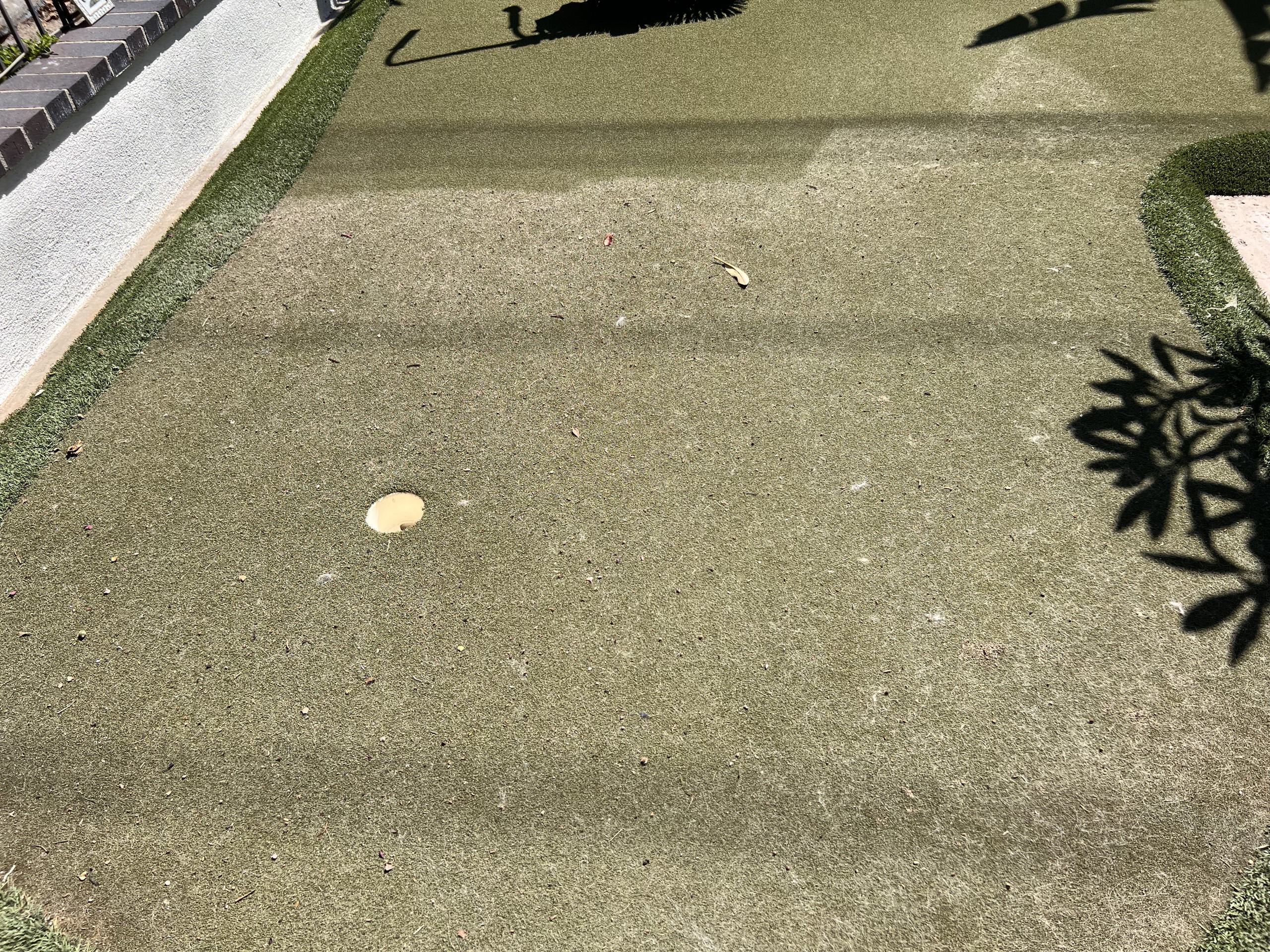
The most visible signs of heat-damaged artificial turf are persistent fiber matting, a hardened surface texture, and uneven or faded coloring, particularly in areas that receive the most direct sun exposure.
Warning signs to look for:
⚠️ Fibers lying flat that do not bounce back after foot traffic
⚠️ Visible color fading or bleaching, especially in the center of the lawn or field
⚠️ Surface feels noticeably harder or more abrasive than it used to
⚠️ Increased odor retention even after cleaning, since heat accelerates bacterial growth in infill
⚠️ Fibers appear brittle, cracked, or frayed at the tips when examined closely
⚠️ Seams becoming more visible, indicating infill displacement from thermal expansion
💡 Pro Tip Run your hand firmly across the turf surface. Heat-damaged fibers will feel coarse and stiff rather than soft and flexible. If fibers snap back slowly, or not at all, that is a reliable indicator of thermal fiber stress that warrants professional evaluation.
Does Turf Heat Damage Reverse on Its Own, or Is It Permanent?
Minor heat stress can partially resolve with cooler temperatures, but moderate to severe fiber flattening is permanent without mechanical intervention. Turf fibers that have lost their upright memory do not self-correct.
Light cosmetic changes, such as a slight color shift after one intense heat event, may stabilize over time. However, once fibers have structurally flattened, compacted infill has hardened, or cracking has begun, the damage is progressive rather than self-healing.
This is where professional intervention makes a meaningful difference. TurFresh's TurfBloom™ service combines mechanical fiber grooming and infill decompaction with organic treatment formulas to restore fiber stand, drainage performance, and surface resilience, without the cost of full replacement.
How Can You Protect Artificial Turf from Extreme Heat?
You can reduce heat-related damage by managing sun exposure, cooling the surface, and maintaining clean, decompacted infill throughout the warm-weather season.
Practical heat protection steps:
👍 Water the turf surface in the early morning or late afternoon on peak heat days. Even a light watering can temporarily reduce surface temperature by 30°F to 50°F.
👍 Install shade structures such as pergolas, shade sails, or strategically placed trees to block peak midday sun.
👍 Choose lighter-colored turf and infill materials when installing or replacing. Lighter tones absorb less solar radiation.
👍 Avoid placing reflective materials near turf edges. Glass, mirrors, and metal fencing can intensify heat to damaging levels.
👍 Schedule professional turf cleaning and infill decompaction service before summer. Compacted infill holds more heat and traps more odor.
👍 Brush or groom fibers regularly to prevent early matting before heat makes it irreversible.
💡 Pro Tip A simple garden hose can drop turf surface temperature by 50°F within minutes. On days when surface temperatures exceed 150°F, watering the turf before outdoor use is also a safety measure, not just a maintenance one.
When Is Heat-Damaged Turf Restorable vs. When Does It Need Replacement?
Most heat-damaged artificial turf can be professionally restored if the backing, seams, and drainage infrastructure remain intact. Full replacement is only necessary when structural failure occurs.
Fiber matting or flattening: Restorable. TurfBloom™ mechanical grooming and fiber revival.
Color fading (UV or heat): Partially restorable. TurfBloom™ treatment plus seasonal maintenance.
Infill compaction or hardening: Restorable. TurfBloom™ infill decompaction service.
Fiber brittleness or tip cracking: Partially restorable, depending on severity. Professional inspection; TurfBloom™ may slow progression.
Backing cracking or separation: Not restorable. Full turf replacement required.
Seam failure or lifting: Not restorable through TurfBloom™. Structural repair or replacement.
Complete drainage failure: Not restorable. Full turf replacement required.
The TurFresh rule of thumb: if your turf is structurally sound, with no cracked backing, no seam separation, and no drainage failure, restoration is almost always the more practical and cost-effective path before committing to full replacement, which averages $8 to $14 per square foot installed.
How Does TurFresh Restore Heat-Stressed Artificial Turf?
TurFresh's TurfBloom™ service is specifically designed to address the compaction, fiber depression, and infill degradation that heat accelerates over time.
The TurfBloom™ process combines three core elements:
👉 Mechanical fiber grooming: lifts flattened fibers back to their upright position using specialized grooming equipment.
👉 Infill decompaction: loosens and redistributes hardened infill granules to restore cushioning, drainage, and proper fiber support.
👉 Organic treatment with BioS+: TurFresh's non-toxic, biodegradable formula neutralizes bacteria and odor compounds that accumulate in heat-stressed infill. Safe for kids and pets immediately after application.
Before a TurfBloom™ service, TurFresh technicians apply TurfClean™ to deep-clean the turf surface, removing the bacterial biofilm that heat and sun exposure accelerate. This ensures the restoration treatment works on a clean foundation.
TurFresh has completed over 150,000 services with a 30-day satisfaction guarantee. For heat-damaged turf that is structurally sound, TurfBloom™ is typically the first, and often the last, step needed before considering a costly replacement.
Get an honest assessment before you consider full replacement.
TurFresh technicians identify whether your turf is a restoration or replacement candidate, and every TurfBloom™ service is backed by a 30-day satisfaction guarantee.
Schedule Your Assessment✔ Pet Safe✔ Kid Safe✔ 150,000+ Services✔ 30-Day Guarantee
Frequently Asked Questions
Can artificial turf melt in the heat?
Artificial turf fibers do not typically melt into liquid under normal summer conditions, but they can soften and deform permanently when surface temperatures exceed 140°F to 160°F for extended periods. Polypropylene fibers are especially vulnerable. Reflected heat from nearby glass or metal surfaces can create concentrated hot spots capable of causing visible melting or scorching.Is it safe to let kids and pets play on hot artificial turf?
No. Extremely hot turf poses a burn risk and heat stress hazard for children and pets. When surface temperatures exceed 120°F, the risk of skin burns from direct contact increases significantly. Before allowing play on hot days, water the surface to bring temperatures down, and test with your palm. If the surface is uncomfortable to hold your hand against for 5 seconds, it is too hot for safe use.How long does artificial turf take to cool down after a hot day?
Without active cooling, artificial turf retains heat well into the evening. In high-heat climates, surface temperatures can remain above 100°F even after sunset. Lightly watering the surface is the fastest way to bring temperatures down; surface temps can drop by 30°F to 50°F within minutes of watering.Does heat damage affect how artificial turf smells?
Yes. Heat accelerates bacterial growth in turf infill, which intensifies odor, particularly in pet-use areas where urine compounds are already present. Hot infill acts as an incubator for odor-producing bacteria. Regular professional cleaning with TurFresh's BioS+ formula neutralizes odor at the source and is especially important in summer months.Can I restore heat-damaged turf myself?
DIY options such as brushing fibers with a stiff broom can temporarily lift light matting, but they do not address infill compaction or fiber structural changes. For moderate to severe heat damage, professional equipment is needed to properly groom fibers, decompact infill, and apply treatment formulas. DIY efforts on severely damaged turf risk further fiber breakage.How much does artificial turf heat damage restoration cost vs. full replacement?
Professional turf restoration through TurfBloom™ is a fraction of replacement cost. Full turf replacement averages $8 to $14 per square foot installed, while professional restoration services typically cost significantly less. For structurally sound turf showing heat-related matting, compaction, or odor, restoration is almost always the most economical first step.