
Quick Answer: The best tools for artificial grass maintenance are a soft-bristle turf groomer or TurfComb for weekly brushing, an enzymatic deodorizer like BioS+ for pet areas, quality infill to keep blades supported, and access to a professional cleaning service for deep resets. According to Artificial Turf Supply, regular brushing with the right tools extends artificial turf lifespan by up to 25 percent and prevents 90 percent of drainage issues. Manual tools handle routine upkeep. Power tools handle seasonal deep grooming. Professional equipment handles what neither can reach.
The right tools get you halfway. TurFresh gets the rest.
TurFresh professional cleaning reaches the infill and backing layer where home tools stop. Shop maintenance products or book a service visit.
✔ Pet Safe✔ Eco Friendly✔ 20+ Years Experience✔ 30-Day Guarantee
Key Takeaways
🔑 Regular brushing with the right tools extends artificial turf lifespan by up to 25 percent and prevents 90 percent of drainage issues, according to Artificial Turf Supply
🔑 Never use metal-tined rakes on synthetic turf. They damage polyethylene fibers and shorten turf lifespan
🔑 A turf deodorizer is not optional for pet owners. Synthetic fibers retain ammonia odor between cleanings. Enzyme-based treatment breaks it down at the source
🔑 Manual tools handle weekly maintenance. Power tools handle seasonal deep grooming. Professional equipment handles infill compaction and deep bacterial buildup that neither can reach
🔑 If brushing does not restore the look, the problem is infill compaction or bacterial buildup below the surface, not the tool you are using
Why Does Artificial Grass Still Need Maintenance Tools?
Artificial grass needs regular maintenance because foot traffic, pets, weather, and debris all affect surface performance in ways that passive care cannot address. Unlike natural grass that partially self-repairs, synthetic turf fibers do not recover on their own once flattened, and infill does not redistribute itself once compacted.
The good news is that the tools required are simple, affordable, and take minutes per week to use effectively. A complete home maintenance kit covers three functions: grooming, odor control, and infill management. For what those tools cannot reach (deep infill compaction, bacterial buildup in the backing layer), professional cleaning is the appropriate next step.
Natural grass demands daily effort in extreme heat and often struggles despite it. Artificial turf requires only consistent light maintenance with the right tools to stay looking its best year round.
What Is the Best Tool for Cleaning Artificial Grass?
The best all-around tool for cleaning artificial grass is a soft-bristle turf groomer or turf comb with synthetic tines. It lifts flattened fibers, loosens and redistributes infill, removes pet hair and fine debris, and restores a natural upright appearance in a single pass.
The key specification is bristle type. Soft, synthetic tines flex against the fiber without snagging or tearing. Metal tines are too rigid and catch on polyethylene fibers, shortening turf lifespan with repeated use.
TurFresh TurfComb is designed specifically for this purpose. Its 18-inch polypropylene comb head penetrates to the infill level to remove embedded debris and pet hair while remaining gentle on fiber backing.
How to use a turf groomer correctly:
👉 Brush against the grain of the fibers using firm, steady strokes
👉 Cross-brush in multiple directions to lift fibers from all angles
👉 Focus time on high-traffic zones: entry points, pet paths, seating areas
👉 Follow with a light rinse to flush loosened debris through the backing
If your turf looks flat or tired, brush first before assuming you need a deep clean. Brushing alone restores appearance in most cases of light to moderate matting. If fibers stay flat after brushing, the problem is infill compaction or deep debris and requires a different approach.
Manual Tools vs. Power Tools vs. Professional Equipment: What Do You Actually Need?
Choosing the right tool depends on your yard size, use level, and what problem you are trying to solve. There are three tiers of artificial grass maintenance equipment, each suited to a different task.
Manual Tools: Weekly Routine Maintenance
Manual tools are the foundation of any home maintenance routine. They are affordable, effective for routine use, and require no power source.
✅ Soft-bristle turf groomer or TurfComb: Best for weekly brushing, fiber lifting, and pet hair removal
✅ Plastic or rubber leaf rake: Best for dry leaf removal and surface debris clearance. Never use metal tines.
✅ Standard garden hose with fan spray: Best for weekly rinsing to flush dust, pollen, and light contamination. Avoid high pressure.
✅ Stiff-bristle push broom: Best for brushing large flat areas quickly and redistributing surface infill
Use manual tools for: weekly brushing, leaf removal, light debris, routine rinsing
Power Tools: Seasonal Deep Grooming
Power tools deliver faster, deeper grooming results over larger areas. Worth the investment for yards over 500 square feet or with heavy pet use.
✅ Cordless power broom with synthetic bristles: Counter-rotating brushes lift compacted fibers and redistribute infill more effectively than manual brushing alone. Use 2 to 4 times per year for a deep groom.
✅ Leaf blower: Excellent for dry leaf removal on large areas. Use on a low setting to avoid displacing infill. Not effective on wet debris or pet hair.
✅ TurFresh TurfGroomer: Motorized power groomer designed specifically for synthetic turf. Combines debris removal and fiber reblooming in a single pass.
Use power tools for: end-of-season deep grooms, post-event restoration, large yards, pre-listing preparation
Professional Equipment: What Home Tools Cannot Reach
Professional turf maintenance equipment operates at a different level of penetration and cleaning power. It is not available for consumer purchase and is operated by trained technicians.
Professional power grooming rigs use counter-rotating brushes at controlled speeds to decompact infill at depths a consumer power broom cannot reach without risking fiber damage.
TurFlush pressure systems flush contaminants from the infill layer and backing using controlled pressure that removes pet hair, bacterial residue, and organic buildup that surface tools leave behind.
Professional enzyme treatment equipment applies turf-safe antimicrobial solutions evenly across large surfaces with precise dwell time control.
Use professional equipment for: infill decompaction, deep bacterial buildup, odor that returns after rinsing, full surface restoration after heavy seasonal use
Professional turf maintenance equipment typically costs $30,000 to $140,000. For most homeowners, one or two professional service visits per year cost less than owning and maintaining this equipment, and deliver results a consumer power broom cannot replicate.
What Turf Deodorizer Works Best for Pet Odors on Synthetic Grass?
The best turf deodorizer for pet areas is an enzymatic formula that breaks down ammonia and uric acid compounds at the molecular level rather than masking them with fragrance. Pet urine odor on synthetic grass is not a surface problem. The odor-causing compounds accumulate in the infill layer where rinsing and fragrance sprays cannot reach.
TurFresh BioS+ is an enzymatic deodorizer specifically formulated for synthetic turf. It binds to and breaks down proteins and ammonia in pet urine, eliminating odors at the source rather than masking them. BioS+ is non-toxic, safe for children and pets immediately after application, and can be used on hardscapes and other yard surfaces as needed.
How to use a turf deodorizer effectively:
👉 Apply as soon as possible after pet use for easiest odor control
👉 Allow full dwell time per product instructions before rinsing
👉 Treat a wider area than the visible spot, as urine spreads beyond the surface contact zone
👉 In hot climates, apply in early morning or evening so heat does not evaporate the product before it can work
A turf deodorizer is not a substitute for professional cleaning in heavily used pet areas. It is maintenance between professional visits. If odor returns within days of application, bacterial buildup has penetrated the infill and backing layer and requires professional enzyme treatment to address.
Why Is Infill an Ongoing Maintenance Tool, Not Just an Installation Component?
Infill is a structural component that degrades over time under use and requires periodic monitoring and top-up to maintain performance. Most homeowners treat infill as a one-time installation step. In practice, infill levels drop through normal use, pet activity, high-pressure rinsing, and wind displacement. When infill drops below the optimal depth, fibers lose support, the surface feels harder, drainage slows, and odor becomes harder to control.
TurFresh TurFill is an all-natural, biodegradable infill designed specifically for pet areas. Unlike standard silica sand, TurFill uses the same enzymatic technology as BioS+ to neutralize ammonia and urine proteins at the infill level, providing ongoing odor control between professional cleaning visits.
Signs your infill needs attention:
⚠️ Fibers stay flat after brushing: base support is insufficient
⚠️ Surface feels harder or less cushioned than it used to
⚠️ Visible backing in high-traffic lanes
⚠️ Odor in pet zones becoming harder to control despite regular rinsing
⚠️ Drainage noticeably slower than when turf was new
How Often Should You Use Each Artificial Grass Maintenance Tool?
According to Pioneer Athletics and turf manufacturer guidelines, maintenance frequency should match actual usage rather than a fixed calendar schedule. High-use yards need more frequent attention than low-traffic decorative installations.
Manual groomer or TurfComb:
➧ Weekly for yards with pets or regular foot traffic
➧ Every 2 weeks for moderate-use yards without pets
➧ Monthly for decorative or low-traffic installations
Leaf rake or debris removal:
➧ After each significant wind event or leaf fall
➧ Weekly during autumn in tree-heavy areas
Garden hose rinse:
➧ Weekly for pet areas to flush urine residue
➧ After each use in high-traffic zones
➧ Immediately after pool splash or irrigation overspray in hard water markets
Turf deodorizer:
➧ As needed after pet use. Treat early for easiest odor control
➧ Monthly full-surface treatment in multi-dog households
Infill top-up:
➧ Seasonally for high-use pet areas
➧ Annually for moderate residential use
Professional deep cleaning:
➧ Once or twice per year for most residential installations
➧ 2 to 3 times per year for heavy pet use or post-event restoration
When Should You Call a Professional Turf Cleaning Service?
Call a professional when home tools stop solving the visible problem. Routine maintenance with manual and power tools addresses surface-level debris, fiber stand, and light odor. What it cannot address is bacterial accumulation in the infill, deep organic compaction, and infill decompaction that has developed over multiple seasons.
Signs it is time for professional service:
⚠️ Odor returns within days of deodorizer application
⚠️ Fibers stay flat after brushing even in zones with adequate infill
⚠️ Drainage has visibly slowed in pet areas or high-traffic zones
⚠️ The turf has not had professional cleaning in over 12 months with regular use
⚠️ Preparing the yard for listing, an event, or seasonal reset
TurFresh TurfClean and TurfBloom are designed for exactly this use case: deep infill decompaction, bacterial elimination at the backing level, and full fiber restoration in a single professional visit.
Home tools maintain the surface. TurFresh restores the whole system.
Shop TurfComb, BioS+, and TurFill for your home maintenance routine, or book a TurfClean or TurfBloom service for a professional-grade reset.
Shop Products or Book a Service
✔ Pet Safe✔ Eco Friendly✔ 20+ Years Experience✔ 30-Day Guarantee
Frequently Asked Questions
What are the best tools for artificial grass maintenance?
The four essential tools for artificial grass maintenance are a soft-bristle turf groomer or TurfComb for weekly brushing, an enzymatic deodorizer like BioS+ for pet odor control, quality infill for ongoing blade support, and access to a professional cleaning service for deep infill decompaction and bacterial treatment. According to Artificial Turf Supply, using the right tools regularly extends artificial turf lifespan by up to 25 percent.
What is the best tool for cleaning artificial grass?
A soft-bristle turf groomer or turf comb with synthetic tines is the best all-around cleaning tool for artificial grass. It lifts flattened fibers, removes pet hair and embedded debris, and redistributes infill in a single pass. Avoid metal-tined rakes, which damage polyethylene fibers with repeated use.
Can you use a power broom on artificial grass?
Yes. A cordless power broom with synthetic bristles is effective for seasonal deep grooming on artificial grass. Counter-rotating brushes lift compacted fibers and redistribute infill more thoroughly than manual brushing. Use 2 to 4 times per year for best results. Avoid power brooms with metal or stiff wire bristles.
What should you never use on artificial turf?
Never use metal-tined rakes, stiff wire brushes, or high-pressure washers on artificial turf. Metal tines damage polyethylene fibers. High pressure displaces infill and can damage fiber backing. Avoid bleach, strong chemical cleaners not rated for synthetic turf, and abrasive scrubbing pads.
How often should you brush artificial grass?
Brush artificial grass weekly for yards with pets or regular foot traffic. For moderate-use yards without pets, every two weeks is sufficient. Decorative or low-traffic installations can be groomed monthly. Focus extra brushing time on high-traffic zones like entry points, pet paths, and seating areas.
What is the difference between a turf groomer and a regular rake for artificial grass?
A regular plastic or rubber leaf rake moves surface debris but does not penetrate deep enough to lift matted fibers or remove embedded pet hair. A turf-specific groomer or TurfComb is designed to reach the infill level, pulling out fine debris and lifting fibers from the base. For pet areas and high-traffic zones, a turf comb delivers significantly better results than a standard rake.
Do you need special equipment to maintain artificial grass?
For routine home maintenance, no specialized equipment is required. A soft-bristle turf groomer, garden hose, enzymatic deodorizer, and infill top-up product cover the full home maintenance routine. Specialized professional equipment becomes necessary when infill is deeply compacted, bacterial accumulation has reached the backing layer, or the surface needs a full restoration that home tools cannot achieve.
What equipment do professional turf cleaners use?
Professional turf cleaning services use counter-rotating power grooming rigs for deep infill decompaction, controlled-pressure flushing systems like TurFlush to remove contaminants from the infill and backing layer, and professional enzyme treatment equipment for precise antimicrobial application. This equipment typically costs $30,000 to $140,000 and operates at penetration depths that consumer power brooms cannot safely replicate.
Is a leaf blower good for artificial grass maintenance?
Yes, for dry leaf and debris removal on large areas. Use on a low setting to avoid displacing infill. A leaf blower is not effective on wet leaves, pet hair, or debris mixed into the fiber layer. For those situations, a turf comb or grooming rake is needed.
When should you replace your artificial grass maintenance tools?
Replace a turf groomer when bristles are bent, worn flat, or no longer flex properly against the fiber. Worn bristles do not lift fibers effectively and can scratch the backing with the rigid base of the tool. Inspect your grooming tool seasonally and replace when performance visibly drops.
Share
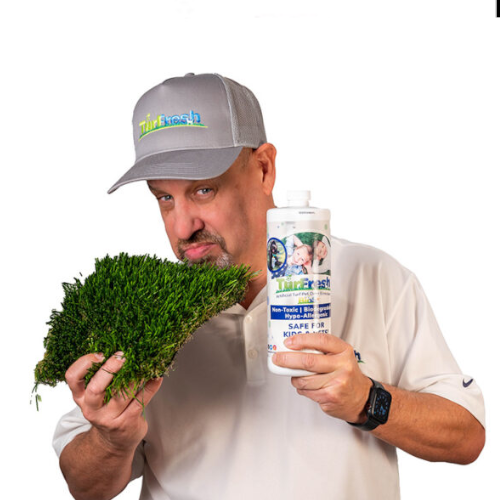

John Pla is the owner of TurFresh and an expert with over 20 years of experience in artificial turf cleaning and maintenance. John’s passion for sustainability, community impact, and innovative solutions has made him a trusted figure in the artificial grass industry and beyond.