Quick Answer
UV damage to artificial turf in Arizona and Nevada is one of the leading causes of premature fiber failure in desert climates. Arizona and Nevada record UV Index readings between 10 and 13, meaning turf in these states absorbs 30 to 50 percent more cumulative UV radiation annually than the national average. That accelerates photodegradation of polyethylene fibers, causing fading, brittleness, and a lifespan reduction of 20 to 30 percent without proactive maintenance. Surface temperatures on uncleaned turf reach 140 to 180°F on peak summer days, compounding UV-driven fiber breakdown by accelerating oxidation at the fiber base. Early-stage UV damage is largely reversible through professional fiber restoration; late-stage structural failure is not.
Protect your turf investment before UV damage becomes irreversible.
TurfBloom™ fiber restoration and TurfClean™ deep cleaning are specifically formulated for desert-climate turf. Book a TurFresh assessment before early-stage UV impact becomes late-stage.
Schedule Your TurFresh Assessment
✔ Pet Safe✔ Kid Safe✔ 150,000+ Services✔ 30-Day Guarantee
Key Takeaways
☀️ Arizona and Nevada turf absorbs 30 to 50 percent more UV than the national average, cutting expected lifespan by 20 to 30 percent without maintenance. A turf rated for 15 years under standard conditions may realistically perform for 10 to 12 years in Phoenix or Las Vegas without annual professional care.
🌡️ Surface temperature compounds the UV problem. Uncleaned turf reaches 140 to 180°F on peak summer days in Arizona. Organic buildup from debris and pet use retains that heat at the fiber base, accelerating oxidative breakdown from below. Cleaning is not just about hygiene — it is a direct UV protection measure.
⚠️ Fading and brittleness are early warning signs, not end-of-life signals. Caught in years 3 to 6 in high-UV climates, UV damage is largely reversible through TurfBloom fiber restoration. Caught in years 8 to 12 with backing compromise, full replacement is the only option.
🧹 Annual professional cleaning is one of the highest-impact UV protection strategies available. TurfClean removes the organic layer that retains heat at the fiber base, reduces peak surface temperatures, and slows the oxidative chain reactions that UV exposure triggers. Competitors do not offer or mention this connection.
📅 The earlier you act, the more options you have. Early-stage UV damage costs a fraction to address compared to late-stage. TurFresh recommends annual professional assessment for all Arizona and Nevada installations from year three onward.
What Does UV Exposure Do to Artificial Turf Fibers?
UV radiation causes a chemical process called photodegradation: the breakdown of polymer bonds inside synthetic fibers when they absorb ultraviolet light. Most residential artificial turf is made from polyethylene, a polymer that offers excellent flexibility and a natural blade appearance, but is vulnerable to sustained UV bombardment at the wavelengths emitted most intensely in desert climates.
How UV Rays Attack Polyethylene Fibers
When UV photons strike polyethylene fibers, they provide enough energy to break the carbon-carbon and carbon-hydrogen bonds that give the material its strength and flexibility.
Over time, this causes:
⚠️ Chain scission: Polymer chains fragment into shorter, weaker segments.
⚠️ Oxidation: Oxygen molecules react with broken bonds, forming carbonyl groups that cause yellowing and brittleness.
⚠️ Cross-linking degradation: Structural connections between polymer chains weaken, reducing tensile strength.
⚠️ Pigment fading: UV radiation attacks the colorants bonded to the fiber surface, causing the characteristic bleached or yellowed appearance.
📌 High-quality turf manufacturers incorporate UV stabilizers and antioxidants into the fiber during production to slow this process. But no additive fully stops UV degradation — it only delays it. In Arizona and Nevada, that delay is significantly shorter than in moderate-UV markets.
Why Arizona and Nevada Are the Hardest States for UV Turf Damage
Arizona and Nevada experience some of the highest UV Index readings in the United States, driven by a combination of high altitude, low humidity, minimal cloud cover, and intense solar angles during summer months.
Location: Phoenix, AZ
Average Summer UV Index: 10 to 12 (Very High)
Annual Peak UV Index: 13+ (Extreme)
Cloud Cover: approximately 85 percent sunny days
Location: Las Vegas, NV
Average Summer UV Index: 10 to 11 (Very High)
Annual Peak UV Index: 12 to 13 (Extreme)
Cloud Cover: approximately 85 percent sunny days
Phoenix and Las Vegas average more than 300 sunny days per year. For homeowners with artificial turf, that means 300 days of uninterrupted UV exposure with virtually no cloud-cover relief. Compared to the national average, desert turf absorbs 30 to 50 percent more cumulative UV radiation annually.
🔑 Key Insight
UV intensity increases with every 1,000 feet of elevation gain. Flagstaff, AZ sits at 6,900 feet, nearly 4,000 feet higher than Phoenix, meaning turf at elevation faces even more aggressive UV exposure than the valley floor. If your turf is in a high-elevation Arizona location, your maintenance frequency should increase, not decrease.
Warning Signs Your Turf Has UV Damage
UV damage follows a predictable progression. Catching it early gives you more restoration options; missing it until the late stages often means the only solution is full replacement.
⚠️ Fading and Discoloration
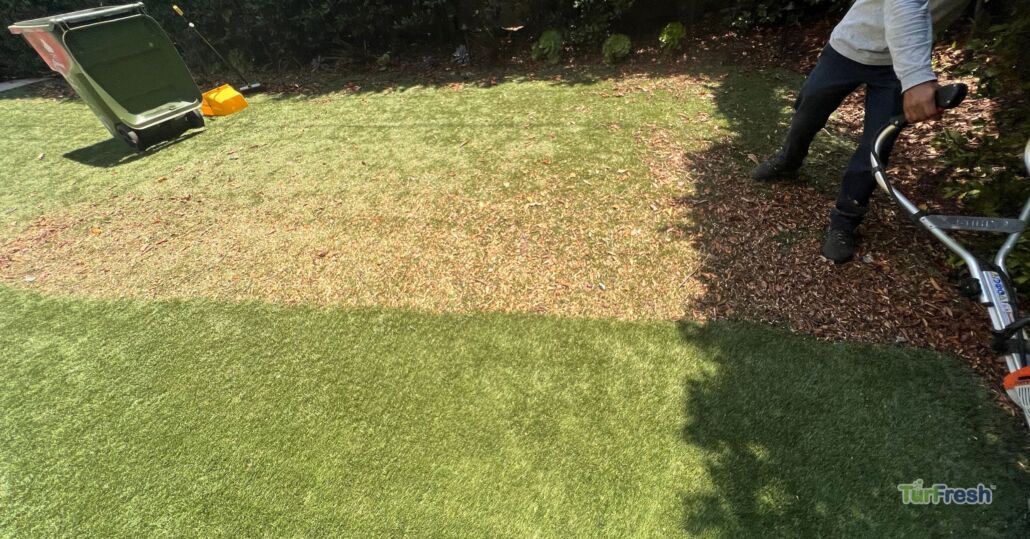
The first sign of UV damage is almost always visible color change. Natural-looking green turf begins to shift toward yellow, tan, or bleached white, starting at the tip of the blade where UV exposure is most concentrated, then working down the fiber shaft.
Uneven fading is common when structures like walls, fences, or patio furniture partially shade portions of the lawn. If one section looks noticeably greener than an exposed area, UV degradation is the likely cause of the contrast.
⚠️ Fiber Brittleness and Matting
UV-degraded fibers lose their resilience. Healthy polyethylene blades spring back upright after foot traffic. UV-damaged fibers lose that elasticity and stay flat, creating the matted appearance associated with older or heavily used turf. Blades may also become brittle enough to snap when bent, rather than flexing.
This fiber stiffening occurs independently of foot traffic. Even turf in low-use areas — decorative side yards, pool surrounds, rooftop patios — will exhibit brittleness if UV exposure is continuous and unmanaged.
⚠️ Accelerated Infill Breakdown
UV radiation also affects the infill materials packed between turf blades. Crumb rubber infill can harden and lose its cushioning properties under sustained heat and UV. Silica sand infill is more UV-stable, but organic compounds sometimes blended into hybrid infills are particularly vulnerable to photodegradation.
📌 Signs of infill breakdown include a flattened surface profile, reduced shock absorption, and infill particles that have discolored or clumped together. Restoring infill levels through a service like TurFill can address this independently of fiber condition.
My Turf Is Already Fading or Brittle: Is It Too Late?
The answer depends entirely on how far the degradation has progressed and whether the turf backing remains structurally intact. There are three stages of UV degradation, each with a different recovery path.
Stage 1 — Early UV Damage (Years 1 to 5 in AZ/NV): Color begins to shift from vivid green toward yellow or tan at the blade tips. Mild loss of spring in low-traffic areas. Slight texture change when walking barefoot.
Recovery outlook: strong. TurfBloom fiber restoration combined with TurfClean deep cleaning can reverse most early-stage UV impact. Removing organic buildup reduces peak surface temperature, slowing further degradation.
Stage 2 — Mid-Stage UV Damage (Years 5 to 8 in AZ/NV): Uniform yellowing across the whole surface, noticeable brittleness when fibers are bent, matting that does not respond to brushing alone, infill beginning to show at the surface.
Recovery outlook: likely viable with a professional assessment. TurfBloom™ can address fiber matting and compacted infill. Color loss that has penetrated the fiber structure is not fully reversible, but the lawn's structural integrity can be preserved and further deterioration slowed significantly.
Stage 3 — Late-Stage UV Damage (Years 8 to 12+ in AZ/NV): Widespread fiber fragmentation or shedding, backing cracking or delamination, seam failure, complete loss of pile resilience across the surface.
Recovery outlook: replacement required. At this stage, restoration cannot address structural backing compromise. TurfSwap™ full replacement is the appropriate path.
💡 Field Test
Grab a small handful of fibers and bend them. Early-stage fibers flex. Mid-stage fibers resist bending. Late-stage fibers snap. If fibers are snapping consistently across the surface, the turf has exceeded its restoration window. If only certain zones snap while others flex, localized repair or restoration is likely still viable. A TurFresh assessment can confirm which category your lawn falls into.
How Much Faster Does Turf Degrade in High-UV Climates?
Research and industry data indicate that artificial turf in high-UV climates degrades 20 to 30 percent faster than equivalent turf in moderate-UV regions. Most residential turf carries a manufacturer warranty of 8 to 15 years, but those figures are typically benchmarked against moderate solar conditions.
What This Means for Your Turf's Lifespan
A turf installation rated for 15 years under standard conditions may realistically perform for 10 to 12 years in Phoenix or Las Vegas without proactive maintenance and restoration.
Low UV (Pacific Northwest)
Expected lifespan without maintenance: 12 to 16 years
Expected lifespan with professional restoration: 15 to 18+ years
Moderate UV (Southeast, Midwest)
Expected lifespan without maintenance: 10 to 14 years
Expected lifespan with professional restoration: 13 to 16 years
High UV (Arizona, Nevada, Desert Southwest)
Expected lifespan without maintenance: 8 to 12 years
Expected lifespan with professional restoration: 12 to 15 years
The gap between those two columns is not a marketing number. According to industry estimates, proactive maintenance that includes regular professional cleaning can extend artificial turf lifespan by 30 to 50 percent compared to surface-only care. In high-UV climates, that represents three to four years of additional functional life per installation.
💡 Pro Tip
Schedule a professional turf assessment annually in Arizona, Nevada, and other high-UV climates. Early-stage UV damage is reversible. Late-stage fiber breakdown is not. Catching it in year three or four costs a fraction of what year-eight replacement demands.
Can UV-Damaged Turf Be Restored, or Does It Need Replacement?
Whether restoration is viable depends on how far the UV damage has progressed. The key structural checkpoint is the turf's backing and seam integrity. If the backing remains intact, restoration is almost always more cost-effective than replacement.
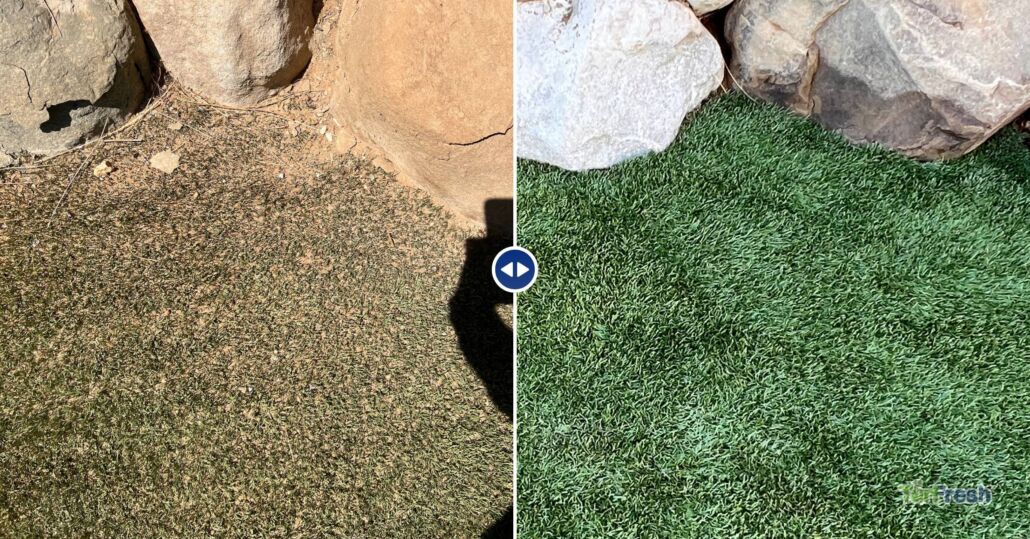
TurfBloom™ by TurFresh is specifically designed for early-to-mid-stage UV damage. The service combines power grooming to lift and re-orient compacted fibers, deep cleaning to remove the organic buildup that accelerates UV-related deterioration, and infill decompaction to restore surface cushioning.
Restoration is typically the right choice when:
👉 Fibers show fading or moderate brittleness but have not fragmented or shed
👉 The turf backing shows no cracking, warping, or seam separation
👉 Drainage performance remains acceptable
👉 The installation is less than 10 years old in high-UV climates
Full replacement becomes necessary when UV degradation has compromised the turf's structural foundation. Replacement is the correct decision when:
👉 Fibers are fragmenting, shedding, or have gone completely brittle along their full length
👉 The turf backing has cracked, warped, or delaminated
👉 Seams have separated and cannot be resealed effectively
👉 Drainage has failed due to backing deterioration
If you are uncertain which category your turf falls into, TurFix™ offers diagnostic assessments for problem areas and can identify whether targeted repair or full swap is the appropriate path.
How to Slow Down UV Degradation on Artificial Turf
You cannot eliminate UV exposure in Arizona or Nevada, but you can substantially reduce its cumulative impact.
💡 Pro Tip
Install shade structures — pergolas, shade sails, or solid patio covers — over high-traffic or aesthetically important turf areas. Even 30 to 40 percent shade coverage measurably reduces UV load and surface temperature, both of which drive fiber degradation.
👉 Select UV-stabilized turf: When installing or replacing turf, choose products that specifically list UV inhibitors and antioxidants in their fiber composition. Ask for warranty terms that account for high-UV climates.
👉 Install shade where possible: Pergolas, shade sails, and covered patios reduce both UV exposure and surface temperatures, which compound fiber breakdown in desert climates.
👉 Rinse regularly: Weekly rinsing removes dust, organic debris, and airborne pollutants that form surface films, accelerating UV absorption. A standard garden hose is sufficient.
👉 Schedule professional deep cleaning annually: TurfClean™ removes embedded organic matter that retains heat and UV-activating compounds at the fiber base, significantly slowing degradation from the bottom up.
👉 Book fiber restoration before visual damage becomes severe: TurfBloom™ services are most effective when performed at early-to-mid stages of UV impact, not as a last resort.
The Role of Professional Cleaning in UV Longevity
Regular professional cleaning is one of the most underutilized tools for extending turf lifespan in UV-intensive climates. Organic buildup — debris, pet waste, pollen, dust, and biological growth — forms a surface layer that absorbs and retains heat. In Arizona and Nevada summers, surface temperatures on uncleaned turf can exceed 150°F, which compounds UV-driven polymer breakdown.
TurFresh's TurfClean™ deep cleaning service removes this thermal mass from the fiber base, reducing peak surface temperatures and slowing the oxidative chain reactions UV exposure triggers. For pet owners, BioS+ enzyme treatment eliminates the nitrogen-rich organic compounds from urine that can react with UV energy to accelerate discoloration.
In high-UV climates, annual professional cleaning is not optional. It is a maintenance requirement that directly correlates with turf lifespan — and the single most cost-effective intervention available before fiber damage becomes irreversible.
TurfBloom™ can reverse early-to-mid-stage UV damage in a single visit.
Don't replace turf that can still be restored. TurFresh has completed 150,000+ services across 9 states, with teams trained specifically for high-UV desert climates. Every service is backed by a 30-day satisfaction guarantee.
✔ Pet Safe✔ Kid Safe✔ 150,000+ Services✔ 30-Day Guarantee
Frequently Asked Questions
Does UV light actually damage artificial turf?
Yes. UV radiation causes photodegradation in synthetic turf fibers, breaking down the polyethylene polymer chains that give each blade its flexibility, color, and structural strength. The process is permanent and cumulative once fibers have fragmented, but early-stage UV impact can be addressed through professional fiber restoration.
How long does artificial turf last in Arizona?
In Arizona's high-UV climate, artificial turf typically lasts 8 to 12 years without professional maintenance. With annual professional cleaning and periodic fiber restoration, that range extends to 12 to 15 years. Manufacturer warranties of 10 to 15 years are typically benchmarked against moderate-UV conditions, so real-world performance in the desert Southwest will be at the lower end without proactive care.
Why is my artificial grass turning yellow?
Yellowing in artificial grass is most commonly caused by UV-driven oxidation of the fiber's pigments and polymer chains. In Arizona and Nevada, this process accelerates due to extreme UV exposure. Other contributing factors include pet urine nitrogen deposits, accumulated dust and debris forming a surface film, and inadequate rinsing. Professional cleaning can address contributing factors; fiber restoration addresses UV-driven color loss in early stages.
What is the surface temperature of artificial turf in Arizona?
Artificial turf in Arizona can reach surface temperatures between 140°F and 180°F on peak summer days, significantly higher than natural grass or concrete. These extreme temperatures compound UV-driven fiber breakdown by accelerating the oxidative chemical reactions that degrade polyethylene. Shade structures and regular rinsing are the most effective tools for managing surface heat.
Can UV-damaged artificial turf be repaired without full replacement?
In many cases, yes. If the turf backing is structurally intact, with no cracking, seam separation, or drainage failure, professional fiber restoration services like TurfBloom™ can reverse early-to-mid-stage UV damage by lifting matted fibers, decompacting infill, and removing organic buildup that accelerates deterioration. Full replacement is only necessary when backing integrity has been compromised.
Does rinsing help protect artificial turf from UV damage?
Yes, indirectly. Regular rinsing removes the dust, organic debris, and surface films that absorb UV energy and retain heat at the fiber base. Cooler, cleaner fiber surfaces degrade more slowly under UV exposure. Rinsing also removes chemical contaminants, including fertilizer drift and pet waste residues, that can react with UV energy to accelerate discoloration and brittleness.
Is there artificial turf specifically made for Arizona and Nevada climates?
Yes. Several manufacturers produce turf lines with enhanced UV stabilizers, higher UV-inhibitor concentrations, and heat-diffusing fiber coatings designed for desert climates. When selecting or replacing turf in AZ or NV, look for products that explicitly list UV resistance ratings and carry warranty terms validated under high-solar-intensity conditions. A TurFresh assessment can also identify whether your current installation is due for restoration or replacement.
Share
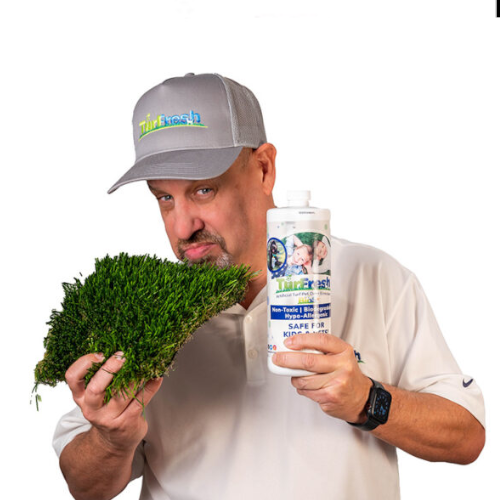

John Pla is the owner of TurFresh and an expert with over 20 years of experience in artificial turf cleaning and maintenance. John’s passion for sustainability, community impact, and innovative solutions has made him a trusted figure in the artificial grass industry and beyond.