Artificial Grass for Dog Kennels: Durability, Hygiene, and Cleaning Guide
May 2, 2020 · 15 min read · By John Pla, Founder of TurFresh
Quick Answer: Artificial grass for dog kennels outperforms natural grass and concrete because it handles heavy daily traffic without mudding, going bare, or causing abrasion injuries. According to pet facility operators, the three requirements that matter most for a commercial kennel installation are drainage rate above 30 inches per hour, tuft-bind strength above 8 lbs to resist digging, and an enzymatic infill or cleaning protocol that controls odor at the source. TurFresh serves over 150,000 installations nationwide and offers commercial cleaning scheduled from monthly to bi-annually.
High-volume pet facilities need a cleaning partner, not a product.
TurFresh offers commercial turf cleaning scheduled monthly to bi-annually. We work around your hours and dog volume. Pet safe the same day.
Schedule Commercial Cleaning✔ Commercial Service✔ Pet Safe✔ 150,000+ Services✔ 30-Day Guarantee
Key Takeaways
🔑 Artificial grass outperforms both natural grass and concrete for high-volume kennels. Natural grass turns muddy and bare within weeks. Concrete causes abrasion injuries and joint stress. Turf handles heavy traffic without surface degradation.🔑 For commercial kennels, specify turf with drainage above 30 inches per hour and tuft-bind strength above 8 lbs. These two specs determine performance under daily multi-dog use.
🔑 Odor in a kennel environment does not respond the same way as residential odor. The volume of urine per day requires enzymatic treatment at the infill level, not just surface rinsing.
🔑 A cleaning schedule for a kennel should be based on dog count per day, not a fixed calendar. 10 dogs per day requires more frequent professional service than 3 dogs per day.
🔑 Parvovirus can survive on outdoor surfaces for 6 months to a year without treatment. Standard surface rinsing and consumer enzyme cleaners are not sufficient for confirmed parvo exposure. Commercial facilities require professional-grade disinfection protocols for pathogen control.
Why Is Artificial Grass a Durable Surface for Dog Kennels?
Artificial grass is durable for dog kennels because it is engineered to withstand the specific stress patterns that destroy natural surfaces: concentrated repetitive traffic in the same zones, digging, sharp directional pivoting, and continuous urine exposure.Natural grass in a kennel run typically shows bare patches within 2 to 4 weeks of daily use by medium to large breeds. The root system cannot regenerate faster than the damage accumulates. Concrete handles traffic but creates abrasion injuries on paws and elbows, contributes to joint stress in older dogs, and is harder to keep odor-free because urine sits on the surface rather than draining.
Quality commercial artificial grass uses reinforced tuft-bind technology that bonds synthetic fibers to the backing with sufficient strength to resist pulling and tearing under dog activity. For kennel applications, specify a tuft-bind strength above 8 lbs per tuft. Below that threshold, dogs that dig aggressively can begin extracting fibers from the backing.
What makes artificial grass durable for commercial kennel use:
✔ No root system to destroy: Traffic compresses fibers but does not kill the surface. Brushing restores appearance.✔ Tuft-bind reinforcement: Properly specified turf resists pulling and digging better than standard residential-grade products.
✔ Seam integrity: Commercial kennel installations should use seam tape rated for outdoor continuous use and secure all perimeter edges so dogs cannot find grab points.
✔ Consistent appearance: Unlike natural grass, turf does not develop the patchy brown-and-bare appearance that signals neglect to pet owners evaluating your facility.
Artificial Grass vs. Concrete vs. Natural Grass for Dog Kennels
Facility managers evaluating surface options need a direct comparison before committing to a material. Each surface has specific trade-offs for kennel applications.
Natural Grass
Durability: Poor under daily dog use. Bare patches appear within weeks. Cannot recover during the season. Hygiene: Soil absorbs urine but also harbors bacteria and parasites. Difficult to disinfect effectively. Maintenance: Mowing, watering, reseeding required. Cannot operate during recovery periods. Appearance: Deteriorates quickly in high-use zones. Creates negative client perception.Concrete
Durability: Excellent. Handles unlimited traffic without surface degradation. Hygiene: Urine sits on surface until actively removed. Odor builds faster than on turf. Requires daily hosing. Maintenance: No surface maintenance. Drain maintenance required to prevent blockages. Appearance: Institutional. Not the welcoming aesthetic most pet facilities want to present to clients. Dog welfare: Abrasion risk on elbows and hocks for dogs that lie on it. Joint stress for larger breeds over time.Artificial Grass
Durability: Excellent when commercial-grade spec is used. 8 to 15 years with proper maintenance. Hygiene: Urine drains through when drainage system is correct. Requires enzymatic treatment for odor control. Professional deep cleaning 1 to 4 times per year depending on volume. Maintenance: Daily spot cleanup, regular rinsing, scheduled professional cleaning. No mowing or watering. Appearance: Green, consistent, and welcoming throughout the facility life. Improves client perception. Dog welfare: Soft enough for lying and playing. No abrasion risk. Stays cooler than concrete in direct sun.For most kennel operators, artificial grass delivers the best combination of durability, appearance, and client perception. The ongoing cost is professional cleaning, which is predictable and schedulable. The ongoing cost of natural grass is unpredictable replacement and the appearance problem it creates.
Complete Guide
📖 Helpful Artificial Turf Maintenance Tips for Doggy Daycares, professional cleaning frequency, enzyme treatment, drainage, and keeping high-traffic turf safe for dogs and staff.
How Does Artificial Grass Help Reduce Muddy Paws and Wear-and-Tear?
Artificial grass eliminates the mud problem entirely because it does not rely on soil and roots that turn soft, patchy, and muddy under repeated use. For a kennel operator, this has direct business implications beyond cleanliness: mud tracked inside a facility by dogs returning from their run is one of the most visible signals of a poorly maintained facility that clients notice during tours.The surface-level consistency of artificial grass also eliminates the uneven terrain that develops as natural grass wears in traffic lanes. Uneven surfaces increase trip and strain injury risk for dogs that are already running and pivoting.
For facility managers, designate high-use zones and adjust maintenance by zone intensity:
✅ Potty zones: Rinse daily, enzyme treat weekly. Highest bacterial load.
✅ Entry and exit paths: Daily debris removal, weekly rinsing. Second highest traffic zone.
✅ Play area perimeter: Weekly rinsing. Lower intensity but accumulates wind-blown debris.
✅ Low-use areas: Bi-weekly check and rinse sufficient.
Can Artificial Grass Help with Allergies in Dogs and Pets?
Artificial grass reduces exposure to one common outdoor allergy trigger for dogs: grass pollen. Natural lawns continuously produce and release grass pollen throughout the growing season. Synthetic turf does not grow or release pollen, which removes this as an ongoing source of exposure in the facility yard.Dogs with environmental allergies often show symptoms including itchy skin, paw licking, facial rubbing, redness around the eyes and muzzle, and recurring ear infections. Grass pollen is a documented allergen for dogs, and according to veterinary dermatologists, reducing pollen exposure is a recommended component of seasonal allergy management for sensitive dogs. The International Boarding and Pet Services Association (IBPSA) notes that surface hygiene and allergen reduction are among the top facility quality indicators that pet owners evaluate when choosing a boarding or daycare facility.
Artificial grass does not eliminate all outdoor allergens. Dogs will still be exposed to airborne pollen from surrounding plants, trees, and off-site grass. However, removing the primary contact surface as a pollen source reduces the total allergen load for sensitive dogs using the facility.
How Do You Clean Artificial Grass in a Dog Kennel?
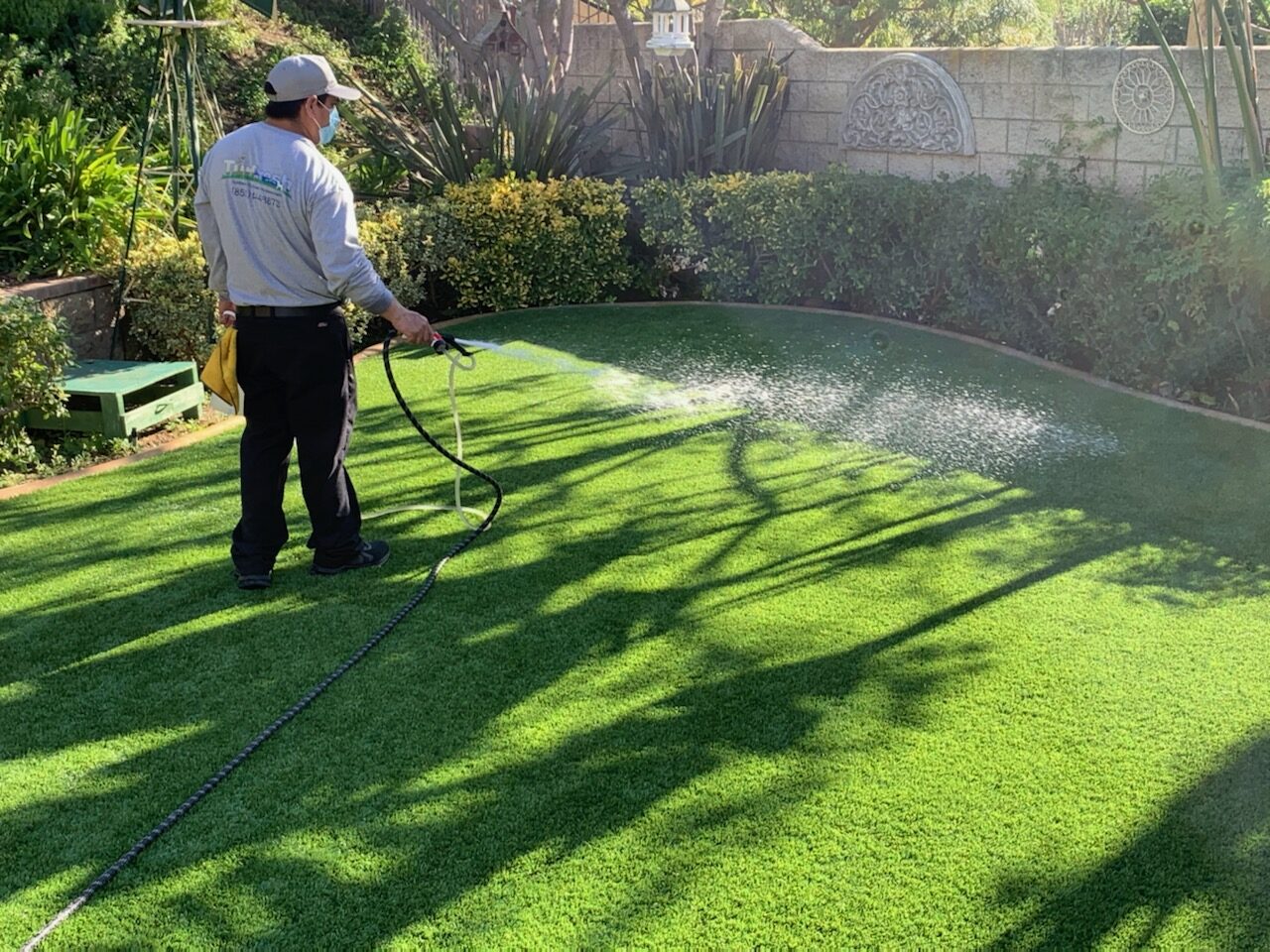
Cleaning artificial grass in a high-volume dog kennel requires a more aggressive protocol than residential maintenance because the daily urine volume per square foot is significantly higher than a backyard with one or two dogs.Daily cleaning protocol for commercial kennels
👉 1. Solid waste removal: Remove immediately. Do not allow waste to sit in heat.👉 2. Spot rinse of affected areas: Flush with a hose after each solid waste removal.
👉 3. End-of-day rinse of all potty zones: Full flush to push daily urine accumulation through the drainage system.
Weekly cleaning protocol
👉 1. Full surface rinse: All runs, not just potty zones.👉 2. Enzyme treatment of high-use zones: Apply BioS+ or equivalent enzymatic cleaner with full dwell time. Enzyme treatment breaks down ammonia and urine proteins at the source rather than masking odor.
👉 3. Brush high-traffic fiber zones: Cross-brush against the grain to restore fiber stand and redistribute infill.
Pathogen protocol for commercial facilities
Commercial kennels face pathogen risks that residential turf does not. Canine parvovirus can survive on outdoor surfaces for 6 months to a year without treatment and is transmitted through contact with infected feces. Kennel cough bacteria and giardia are also transmitted through contaminated surfaces. Standard enzyme cleaners and daily rinsing reduce bacterial load but are not sufficient to eliminate hardy pathogens like parvovirus.For facilities that accept dogs from multiple households daily, periodic professional cleaning with commercial-grade disinfection protocols is the only reliable method to address pathogen load at the infill level. If a confirmed parvo case is linked to dogs that used your facility, surface-level disinfection is insufficient, professional extraction and treatment of the infill is required.
Professional deep cleaning schedule by dog volume
➧ Under 10 dogs per day: Professional cleaning every 6 months➧ 10 to 25 dogs per day: Professional cleaning every 3 to 4 months
➧ 25 to 50 dogs per day: Professional cleaning monthly to bi-monthly
➧ Over 50 dogs per day: Monthly professional cleaning minimum. Consider TurFresh commercial service contract for predictable scheduling.
Professional cleaning reaches the infill layer where daily rinsing does not penetrate. Bacterial accumulation in the infill is the primary cause of odor that persists despite regular surface treatment in high-volume facilities.
How Long Does It Take Artificial Turf to Dry After Rinsing or Rain?
Artificial turf in a commercial kennel returns to usable condition within 1 to 3 hours after rinsing when the drainage system is correctly specified and functioning. Premium commercial pet turf systems achieve drainage rates above 30 inches per hour, which means the surface drains as fast as a moderate rainfall delivers water.For kennel operators, faster drainage means shorter out-of-service windows after cleaning. A run that drains in under 2 hours can be scheduled for early morning cleaning and returned to use before peak activity hours.
Factors that slow drying in kennel environments:
⚠️ Inadequate base drainage: If the compacted gravel or crushed stone sub-base has not been graded correctly, liquid pools under the turf and extends drying time significantly.
⚠️ Infill compaction: Compacted infill in high-use zones blocks water from passing through the backing efficiently. Regular professional cleaning that decompacts the infill layer restores drainage speed.
⚠️ Shade: Covered runs dry more slowly than sun-exposed areas. Factor this into your maintenance schedule.
Rain drainage and odor management are separate concerns. Once the surface drains, activate any dormant ammonia in the infill with enzyme treatment, for more on this, see our full breakdown of artificial turf smell after rain.
Why Does Artificial Grass Help Dog Kennels Look More Professional?
Artificial grass helps kennels present better to clients because it maintains a consistent green appearance regardless of dog use volume, weather, or season. For pet facility operators, appearance is a direct factor in client acquisition and retention. Pet owners evaluating facilities for their dogs judge cleanliness and maintenance standards in the first 30 seconds of a facility tour.A natural grass run with bare patches, muddy zones, or brown areas raises immediate questions about overall facility standards. Artificial grass that is properly maintained presents as intentional and well-run regardless of how many dogs have used the space that day.
Artificial grass also photographs better for facility marketing. Online listings and social media content featuring clean, green outdoor areas consistently outperform images of worn natural grass or plain concrete in attracting inquiries from pet owners researching facilities.
What Should a Dog Kennel Do If Dogs Try to Dig on Artificial Grass?
Dogs dig less successfully on correctly installed artificial grass because the backing and sub-base do not have the soil consistency that triggers and rewards digging behavior. However, installation quality matters more for dig resistance than the turf product itself.Commercial kennel installation requirements for dig resistance:
✅ Perimeter securing: All edges and seams must be secured with bender board, nails, or adhesive rated for the installation environment. Loose edges are the primary entry point for dogs that learn to grab and pull.✅ Compacted sub-base: A properly compacted crushed stone or decomposed granite sub-base removes the loose soil that gives dogs the tactile feedback they associate with digging.
✅ Tuft-bind specification: For kennel applications with known diggers, specify turf with tuft-bind above 8 lbs. Ask your installer for the product specification sheet.
✅ Behavioral management: If a specific dog consistently targets one area, check for scent buildup as a trigger. Increase enzyme treatment frequency in that zone and consider additional enrichment to reduce boredom-driven digging.
When Should a Kennel Use a Professional Turf Cleaning Service?
A kennel should use professional turf cleaning on a scheduled basis, not only when visible problems appear. Waiting for visible odor or matting to trigger professional cleaning means the infill has already accumulated bacterial load that is significantly harder to reverse than to prevent.For commercial facilities, the correct frame is not "when should we get professional cleaning" but "how often does our volume require professional cleaning to maintain safe hygiene standards."
TurFresh offers commercial turf cleaning services that can be scheduled from monthly to bi-annually, based on your facility's dog volume, run size, and regional climate. The service reaches the infill and backing layer where daily rinsing and enzyme treatment stop.
Signs that a cleaning visit is overdue:
⚠️ Odor persists after your regular enzyme treatment and rinse cycle ⚠️ Drainage is noticeably slower than when turf was new ⚠️ Fiber matting in high-use zones does not respond to brushing ⚠️ Client complaints or comments about facility odor during tours ⚠️ More than 6 months have passed since the last professional service at 10+ dogs per day
Professional cleaning that works around your schedule.
TurFresh commercial service reaches the infill layer where surface rinsing stops. Monthly, quarterly, or bi-annual contracts available. Pet safe the same day.
Get a Commercial Cleaning Quote✔ Commercial Service✔ Flexible Scheduling✔ 150,000+ Services✔ 30-Day Guarantee
Complete Guide
📖 How to Maintain Artificial Grass When You Have Dogs, the full system for pet households: daily routine, enzyme treatment, multi-dog homes, and when to call a professional.
Frequently Asked Questions
Is artificial grass good for dog kennels?
Yes. Artificial grass outperforms natural grass and concrete for commercial kennel applications. Natural grass degrades to bare patches within weeks of daily dog use. Concrete creates abrasion risk and holds odor on the surface. Artificial grass handles heavy traffic without surface degradation, drains urine through the backing when properly installed, and maintains a clean, professional appearance year-round.What type of artificial grass is best for dog kennels?
For commercial kennel use, specify a product with drainage above 30 inches per hour, tuft-bind strength above 8 lbs, and non-toxic polyethylene fibers. Pair with an enzymatic infill for odor control. Avoid standard residential-grade turf, which is not rated for the volume of traffic and urine exposure a commercial facility produces daily.How often should a dog kennel clean artificial grass?
Daily spot cleanup and end-of-day rinse of potty zones is the minimum. Weekly enzyme treatment of high-use areas. Professional deep cleaning frequency depends on daily dog volume: every 6 months for under 10 dogs per day, every 3 to 4 months for 10 to 25 dogs per day, monthly for over 25 dogs per day.Is artificial grass safe for pets?
Yes, when quality materials are used and the surface is maintained. Specify non-toxic polyethylene fibers and confirm the product is free of heavy metals and lead. Keep the surface clean through routine maintenance to prevent bacterial accumulation that creates health risks independent of the turf material itself.Can dogs be allergic to real grass?
Yes. Dogs can be allergic to grass pollen, and symptoms typically include itchy skin, paw licking, facial rubbing, redness around the eyes, and recurring ear infections. Artificial grass does not produce pollen, which removes this as an ongoing allergen source for dogs using the facility yard.Is artificial turf hypoallergenic?
Artificial turf does not produce grass pollen, which is a common outdoor allergen for dogs. It does not eliminate all allergens. Airborne pollen from surrounding plants and trees can still land on the surface, and regular cleaning reduces tracked-in irritants. For dogs with severe environmental allergies, consult a veterinary dermatologist for a complete management plan.How long does artificial grass take to dry after rain?
Commercial-grade pet turf with drainage above 30 inches per hour typically returns to usable condition within 1 to 3 hours after rinsing or moderate rain. Factors that slow drying include inadequate sub-base drainage, compacted infill in high-use zones, and shade. Regular professional cleaning that decompacts infill helps maintain drainage speed over the installation life.Can artificial grass be installed over concrete for dogs?
Yes. Artificial grass can be installed over concrete, but the drainage approach must be engineered specifically for the base. Without proper drainage channels or a perforated sub-layer, urine pools under the turf and creates odor that surface rinsing cannot address. Consult a commercial installer experienced in concrete sub-base applications before proceeding.