
Quick Answer:
No, vinegar is not an enzyme cleaner. Vinegar is a mild acid, roughly 5% acetic acid, and it works by lowering pH. Enzyme cleaners are biological products that digest organic compounds at a molecular level. That difference is why vinegar reduces odor briefly and enzyme cleaners remove it: acid neutralizes surface alkalinity, enzymes break down the uric acid causing the smell. On artificial turf, where uric acid settles into the infill, TurFresh uses enzyme treatment for exactly this reason. The Humane Society also advises against cleaning pet stains with strong-smelling chemicals such as ammonia or vinegar, because the odor may encourage a pet to reinforce the scent mark in that area.
The problem is in the infill. Vinegar cannot reach it.
TurFresh uses enzyme-based cleaning that reaches the infill and backing where uric acid actually accumulates. Pet safe the same day.
✔ Pet Safe ✔ Eco Friendly ✔ 20+ Years of Experience ✔ 30-Day Guarantee
Why TurFresh
TurFresh is a professional artificial turf cleaning company with over 20 years in synthetic grass care, serving more than 130 cities across the United States. The vinegar question comes up constantly in this work, because most homeowners try it first and most of them end up calling anyway.
The TurFresh BioS+ process is enzyme-based for the reason explained on this page: enzymes digest uric acid, and acid does not. Every treatment is pet safe, allows same-day re-entry, and is backed by a 30-day odor removal guarantee.
Key Takeaways
🔑 Vinegar is not an enzyme cleaner. It is an acid. This single distinction explains why vinegar reduces odor briefly but does not eliminate it. Enzyme cleaners work through biology, digesting organic compounds at a molecular level. Vinegar works through acidity, temporarily neutralizing surface alkalinity. They target different things.
🔑 Vinegar can make the recurring-use problem worse. The Humane Society advises against cleaning pet stains with strong-smelling chemicals such as ammonia or vinegar, because the odor may encourage a pet to reinforce the scent mark in that area.
🔑 Vinegar does not break down uric acid. Vinegar at roughly pH 2 can temporarily reduce surface alkalinity, but uric acid crystals, the actual source of persistent odor, are not alkaline compounds. They remain in the infill and reactivate with every rain and heat cycle.
🔑 Vinegar has one legitimate use case: fresh, isolated accidents with no buildup underneath. For any yard with a regular pet potty zone and repeated use, vinegar will not provide lasting results regardless of how consistently it is applied.
🔑 If odor returns after sun or rain, the source is below the surface. No surface product, including vinegar, reaches the uric acid deposits that reactivate with heat and moisture. On artificial turf, that is what the TurFresh professional treatment is built to extract.
Is vinegar an enzyme cleaner?
No. Vinegar is an acid solution, typically around 5% acetic acid. Enzyme cleaners are biological products containing living enzymes or beneficial bacteria that digest organic compounds. They are fundamentally different products working through completely different mechanisms.
Vinegar:
• Type: Mild acid (acetic acid)
• How it works: Lowers pH, neutralizes alkaline compounds temporarily
• What it targets: Surface alkalinity
• What it cannot do: Break down uric acid crystals, eliminate bacteria below the surface, prevent odor from returning
Enzyme cleaners:
• Type: Biological solution (enzymes and beneficial bacteria)
• How it works: Digests organic compounds at a molecular level
• What it targets: Uric acid, ammonia, proteins, bacteria in fibers and infill
• What it does: Eliminates the odor source, not just the surface alkalinity
💡 The short version: If a label talks about how the product smells, it is a masking product. If it talks about breaking down or digesting compounds, it is an enzyme cleaner. TurFresh BioS+ is in the second category, which is why it is the base of the TurFresh process.
Does vinegar neutralize dog urine smell?
Partially, and temporarily. Dog urine sits in a slightly acidic range, and vinegar at roughly pH 2 is more acidic still, which means applying it can temporarily reduce the alkaline odor compounds that make urine smell worse as it breaks down. That is why the smell often seems better right after applying vinegar.
The effect is short-lived. The uric acid crystals causing the persistent, recurring ammonia smell are not alkaline compounds, so vinegar does not break them down. They remain in place, dormant when dry, releasing ammonia again every time the surface gets wet or hot.
💡 Important for dog owners: The Humane Society advises against cleaning pet stains with strong-smelling chemicals such as ammonia or vinegar, because the odor may encourage a pet to reinforce the scent mark in that area. Vinegar may be making the recurring-use problem worse rather than better.
Why does dog urine smell keep coming back after using vinegar?
Because vinegar never reached the actual source of the smell. On artificial turf, dog urine drains through the fibers and settles into the infill and backing layer, where uric acid crystals form and do not dissolve on their own. Vinegar applied to the surface does not penetrate deeply enough to reach those deposits. The smell improves briefly, then reactivates within a day or two when heat or moisture hits the layer below.
This is the single most common reason homeowners call TurFresh: not that they did nothing, but that they did the wrong thing consistently for months.
📌 Pattern to recognize: If the smell returns when the sun hits the surface or after the next rain, the source is below the blades. No surface product, including vinegar, will solve it.
When is vinegar actually useful?
Vinegar has a limited but legitimate use case: light surface odor from recent, isolated accidents on a surface that has not accumulated buildup underneath.
✔ Vinegar can help when:
The accident is fresh and you caught it immediately, you do not have a regular pet potty zone with repeated use, you are using it as a quick interim step before enzyme treatment, or the surface does not have significant odor buildup below.
⚠️ Vinegar will not solve the problem when:
The smell has been present for weeks or months, you have a designated pet potty zone with repeated use, the smell is strongest in hot weather or after rain, multiple dogs use the same area regularly, or you have applied vinegar multiple times without lasting results.
What actually removes dog urine smell from artificial turf?
An enzyme cleaner applied correctly is the most effective at-home solution. For infill with significant buildup, the TurFresh professional treatment is the reliable reset, because commercial extraction reaches a depth no spray does.
Step-by-step with enzyme cleaner:
👉 1. Remove solid waste and rinse the area first.
👉 2. Apply a turf-safe enzyme cleaner like TurFresh BioS+ to the affected area.
👉 3. Allow full dwell time per product instructions. Do not rinse immediately.
👉 4. Rinse after the dwell period.
👉 5. Brush the turf to lift fibers and redistribute infill.
💡 Tip: Enzyme cleaners need contact time to work. Spraying and immediately rinsing significantly reduces effectiveness. The dwell time is where the odor elimination actually happens.
TurFresh BioX vs BioS+ for vinegar-resistant odor
If you have been using vinegar for an extended period and the smell persists, the infill likely has significant uric acid buildup that requires a stronger approach.
TurFresh BioS+ is enzyme-based and effective for routine maintenance and moderate pet use. It is the right starting point for most households making the switch from vinegar.
TurFresh BioX is an oxygenated cleaner, more consistent in hot outdoor conditions where enzyme biology can dry out before completing the job. Better for heavy-use yards, multiple dogs, and hot climates like California, Nevada, Arizona, and Texas.
For yards where vinegar has been the primary cleaning method for months, a TurFresh professional deep clean first, followed by enzyme maintenance, is the most effective approach. The service resets the infill baseline so the maintenance products can actually work.
The infill needs a professional reset.
TurFresh reaches the infill and backing where months of uric acid buildup accumulates. One service restores the baseline so your maintenance routine works again.
✔ Pet Safe ✔ Eco Friendly ✔ 20+ Years of Experience ✔ 30-Day Guarantee
How do you keep turf from smelling like dog pee long-term?
Long-term odor control requires treating the infill, not just the surface. Four habits and one annual service cover it:
✔ Rinse pet zones regularly to flush fresh urine before it bonds to infill granules
✔ Monthly enzyme treatment with TurFresh BioS+ or BioX, with full dwell time
✔ Annual professional cleaning to remove accumulated buildup that home maintenance cannot reach
✔ Antimicrobial infill designed for pet yards, which neutralizes urine compounds at the source
✔ Avoid vinegar as primary treatment and use it only for immediate surface freshening on isolated incidents
Complete Guide
📖 How to Maintain Artificial Grass When You Have Dogs, the full system for pet households: daily routine, enzyme treatment, multi-dog homes, and when to call a professional.
Frequently Asked Questions
Is vinegar an enzyme cleaner? Is white vinegar an enzymatic cleaner?
No to both. Vinegar, including white vinegar, is approximately 5% acetic acid diluted in water and has no enzymatic activity. Enzyme cleaners contain living enzymes or beneficial bacteria that biologically digest organic compounds like uric acid and ammonia. Vinegar works through acidity. Enzyme cleaners work through biology. TurFresh uses enzyme-based products for pet odor for exactly this reason.
What is an enzyme cleaner?
An enzyme cleaner is a biological product containing enzymes or beneficial bacteria that digest organic compounds rather than dissolving or masking them. The enzymes break proteins, uric acid, and ammonia down into simpler substances that no longer smell. This is why enzyme cleaners work on pet urine where acids and detergents do not, and why TurFresh BioS+ is enzyme-based.
Does vinegar neutralize dog urine?
Partially and temporarily. Vinegar can neutralize some alkaline surface compounds in dog urine, which reduces odor briefly. It does not break down the uric acid crystals that settle below the surface. Those reactivate with heat and moisture, causing the smell to return.
Why does my turf still smell after using vinegar?
Because the odor source is in the infill layer below the turf blades, and vinegar does not penetrate deeply enough to reach it. Uric acid crystals in the infill reactivate every time the turf gets wet or hot. The smell that returns after sun or rain is almost always infill buildup that surface cleaning cannot reach, which is the layer TurFresh extracts with commercial equipment.
Can vinegar damage artificial turf?
Diluted vinegar used occasionally is unlikely to damage turf fibers. Repeated or concentrated use can degrade some infill materials over time. More significantly, the Humane Society advises against strong-smelling chemicals such as vinegar on pet stains, because the odor may encourage a pet to reinforce the scent mark in that area.
What is the best substitute for vinegar?
An enzyme cleaner is the most effective substitute for any pet urine odor. For artificial turf specifically, choose one formulated for synthetic surfaces: TurFresh BioS+ for routine maintenance, or TurFresh BioX for persistent odor and hot climates where enzyme biology dries out faster.
Does vinegar kill bacteria?
At household concentration, roughly 5% acetic acid, vinegar has limited disinfecting ability. It kills some bacteria at full strength but is significantly less effective when diluted, which is how it is typically applied. It does not reliably eliminate the bacteria that cause pet odor below a turf surface.
When should you call a professional for turf odor?
Call when the smell returns within a day or two of cleaning regardless of product, when vinegar has been the primary treatment for weeks or months, when the smell is strongest in hot weather or after rain, or when multiple dogs use the same area heavily. TurFresh provides this service in more than 130 cities across the United States, and the professional clean resets the infill baseline so home maintenance products work again.
Share
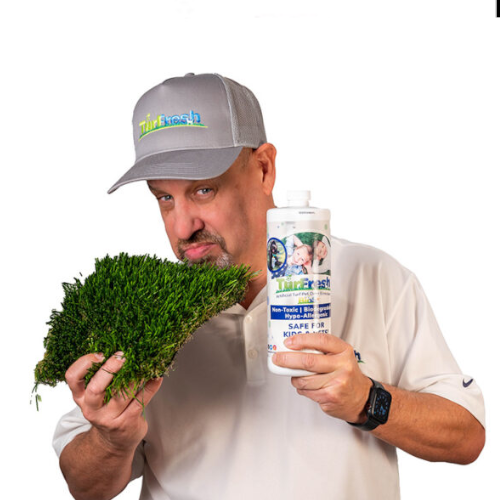

John Pla is the owner of TurFresh and an expert with over 20 years of experience in artificial turf cleaning and maintenance. John’s passion for sustainability, community impact, and innovative solutions has made him a trusted figure in the artificial grass industry and beyond.