Why Your Artificial Turf Smells Like Dog Pee and How to Control It
May 28, 2024 · 15 min read · By John Pla, Founder of TurFresh
Quick Answer: Turf smells like dog pee when uric acid from urine crystallizes in the infill layer instead of draining through. Uric acid is only sparingly soluble in water (American Chemical Society), which is why rinsing never removes the smell on its own and only enzyme cleaners break it down. TurFresh, a professional artificial turf cleaning company serving more than 130 cities, treats this with the BioS+ enzyme process and commercial extraction that reaches the infill and backing layer. The at-home routine is: rinse immediately after each use, apply a pet-safe enzyme cleaner with full dwell time monthly, and refresh odor-neutralizing infill in high-use zones. If the smell returns within 48 hours of a correct cleaning session, the buildup is deeper than home cleaning can reach.
The problem is deeper than the surface.
TurFresh reaches the infill and backing layer where the odor actually lives.
Schedule Your Turf Cleaning✔ Pet Safe✔ Eco Friendly✔ 20+ Years of Experience✔ 30-Day Guarantee
Why TurFresh
TurFresh is a professional artificial turf cleaning company with over 20 years in synthetic grass care, serving more than 130 cities across the United States. Home cleaning treats the surface. The TurFresh BioS+ process uses commercial extraction equipment to pull uric acid deposits out of the infill and backing layer, which is where the smell actually comes from.
Every TurFresh treatment is pet safe, allows same-day re-entry, and is backed by a 30-day odor removal guarantee.
Key Takeaways
🔑 Uric acid barely dissolves in water, so rinsing alone cannot eliminate dog urine odor from turf. Only enzyme cleaners break down uric acid crystals at a molecular level. This is why a yard can be rinsed multiple times and still smell: the source is in the infill, not on the surface. 🔑 Heat activates dormant odor compounds. Ammonia in turf infill evaporates faster as surface temperature rises, at concentrations that produce detectable odor. A yard that seemed fine in winter can become a serious odor problem by June without any change in cleaning routine. 🔑 The 48-hour rule identifies when professional cleaning is needed. If odor returns within 48 hours of a correct enzyme cleaning session, the infill is saturated. No surface treatment will fix this. Professional extraction, which is what TurFresh does, is the correct next step. 🔑 The right routine has four layers: rinse, enzyme treat, refresh infill, professional clean. Each addresses a different depth. Skipping any one of them creates a gap that compounds over time. 🔑 For multi-dog households, increase every interval. Two dogs produce roughly twice the bacterial load. The standard single-dog schedule is not sufficient for multi-dog yards, so enzyme treatment needs to happen every 1 to 2 weeks, not monthly.Why Your Turf Smells Like Dog Pee
Turf smells like dog pee because uric acid and ammonia compounds accumulate in the infill layer where water cannot reach them. Unlike natural ground, synthetic turf has no soil microbes to break down organic waste over time. Urine moves through the fibers and settles into the infill and base layer, where it forms uric acid crystals that standard rinsing cannot dissolve. The chemistry matters here. Uric acid is only sparingly soluble in water, according to the American Chemical Society, so it does not wash away when you rinse the surface. It crystallizes in the infill granules and releases ammonia gas when activated by heat or moisture. This is why a yard that seemed odor-free in cool weather suddenly becomes a problem in summer: the deposits were always there, and heat just made them detectable.When urine is not cleaned consistently, it causes:
➧ Persistent odor that builds up over weeks and months in the infill layer ➧ Bacterial growth that creates health risks for children and pets who play on the surface ➧ Drainage slowdown that traps urine residue and accelerates odor buildup ➧ Fiber wear and matting in high-use potty zones over timeA yard that looks clean can still smell like dog urine. The problem is almost always in the infill, not on the surface. Rinsing addresses what is visible. Enzyme treatment addresses what is not.
How to Control Dog Urine Odor on Artificial Grass
The most effective routine for eliminating dog urine odor from artificial turf combines immediate rinsing, enzyme treatment, and the right infill. Each step addresses a different layer of the problem: surface residue, bacteria in the fibers, and buildup in the base.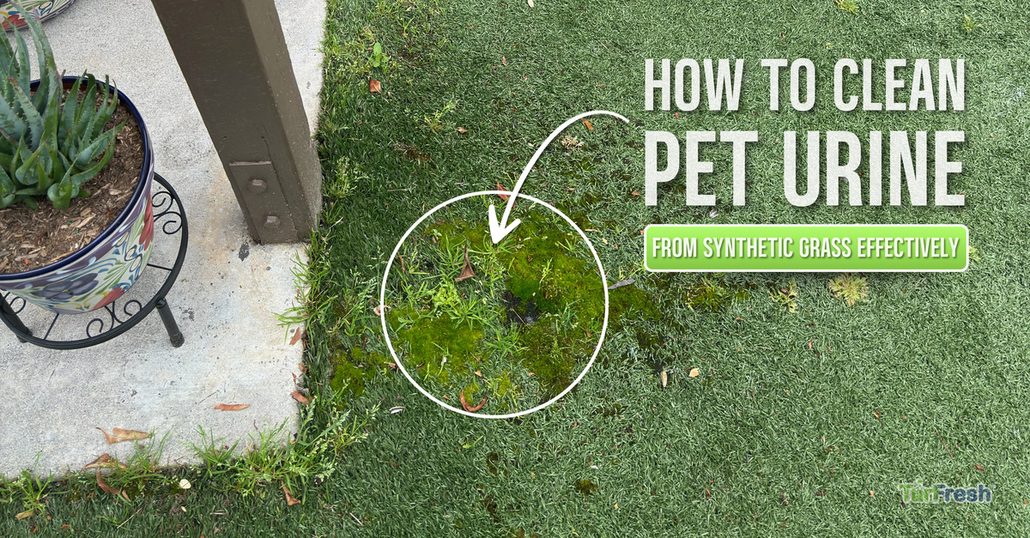
👉 Step 1: Pick Up Solid Waste Immediately
Every hour solid waste sits on turf increases bacterial load and makes odor harder to eliminate. Scoop and dispose of it as soon as you see it, then rinse the area. This single habit reduces bacteria, flies, and overall yard smell more than any product alone.👉 Step 2: Rinse High-Use Potty Areas Regularly
Rinsing dilutes and flushes fresh urine through the drainage layer before it concentrates in the infill. Use a garden hose with a standard nozzle, never a pressure washer, and spray heavily used spots for 10 to 20 seconds after each use. Rinsing does not eliminate uric acid already crystallized in the infill. It prevents new deposits from forming and reduces the bacterial load on the surface. Both matter, but they are different functions.If your turf smells strongest during hot afternoons, increase rinsing frequency during summer months. Ammonia compounds in the infill evaporate faster as the surface heats up, so regular rinsing reduces the deposits that heat activates.
👉 Step 3: Use Pet-Safe Odor-Neutralizing Infill
Standard silica sand infill holds onto urine salts over time. A pet-specific, antimicrobial infill works at the chemical level to neutralize odor compounds before they reach the surface. TurFill, the TurFresh all-natural infill, exchanges ions with the odor-causing compounds in pet urine, trapping the smell at the source. Odor-neutralizing infill does not replace enzyme treatment. It reduces the rate at which uric acid accumulates between cleaning sessions.If your artificial grass smells like dog urine even after thorough rinsing, it is often a sign the infill needs refreshing or replacing with a product made specifically for pet yards.
👉 Step 4: Apply an Enzyme-Based Turf Cleaner
Enzyme cleaners are the only home method that breaks down uric acid crystals in artificial turf infill. They work by introducing biological enzymes that digest the organic compounds at a molecular level, eliminating the source of the odor rather than masking it.What to look for in a turf enzyme cleaner:
➧ Pet-safe and formulated specifically for synthetic turf ➧ Enzyme or biologically based ingredients that break down urine salts and ammonia ➧ Explicitly mentions dog urine and pet odor on the labelTurFresh products for this:
TurFresh BioS+ is an enzyme-based cleaner for regular maintenance use. TurFresh BioX is a more powerful option for older or more persistent odors.How to apply:
👉 1. Rinse the area with water to remove loose debris. 👉 2. Apply enzyme cleaner as directed, covering the full affected area and slightly beyond. 👉 3. Allow full dwell time, because this is where the elimination happens. Do not skip it. 👉 4. Rinse again if product instructions require it.Used monthly or as needed, enzyme cleaners are the most reliable way to control dog urine odor in artificial grass over the long term. Applying and immediately rinsing eliminates the benefit, because the dwell time is not optional.
How Often Should You Clean Artificial Turf with Dogs?
Clean the potty zone after every use, rinse the full surface weekly, and treat with an enzyme cleaner monthly if you have one dog. The correct frequency depends on the number of dogs and yard size, because a single dog on a large turf area has different maintenance needs than two large dogs on a compact backyard.For households with multiple dogs or a small yard, treat the entire turf surface as a high-traffic zone and increase cleaning frequency accordingly. Two dogs produce roughly twice the bacterial load, so the standard single-dog schedule will not keep pace.
The 48-Hour Rule: When to Call a Professional
The clearest signal that DIY cleaning has reached its limit is simple: if odor returns within 48 hours of a correct cleaning session, the infill is saturated. At that stage, uric acid crystals have accumulated below the depth that any enzyme spray or surface rinse can reach. Professional extraction equipment is the only method that penetrates to the backing layer where bacteria are concentrated.Signs it is time for professional cleaning:
➧ Odor returns within 48 hours of cleaning, regardless of what product you use ➧ Multiple dogs using the same area daily with heavy accumulated use ➧ Turf has not been professionally cleaned in 12 months or more ➧ Drainage feels slow or infill looks compacted and matted in high-use zones ➧ The smell intensifies when you wet the surface, because water is activating deposits already in the infill TurFresh TurfClean uses a proven process and commercial-grade enzyme treatments to clean down to the infill and backing layer, reaching the bacteria that home cleaning cannot.Mistakes That Make Dog Urine Odor Worse on Artificial Turf
The most common mistakes are letting waste sit, using bleach, ignoring the infill, skipping enzyme dwell time, and leaving drainage problems unaddressed. Each one makes the odor harder to remove later. ✔ Letting solid waste sit increases bacteria, flies, and smell exponentially. ✔ Using bleach or ammonia-based cleaners is dangerous, because bleach reacts with ammonia in urine and creates toxic chloramine gases. It also damages turf fibers and does not solve the root cause. ✔ Ignoring the infill lets compacted, saturated material hold onto urine salts indefinitely. Surface rinsing alone cannot fix this. ✔ Skipping enzyme dwell time is the most common reason odor returns after cleaning. Enzymes need time to work. ✔ Poor drainage means urine cannot move through and away from the base, so odor will keep returning regardless of what product you use.Switching to pet-safe enzyme-based products and addressing drainage is usually enough to turn a persistently smelly yard around. If it is not, the infill and base layer need professional treatment.
The infill is saturated. Professional extraction is the only fix.
TurFresh uses commercial-grade equipment and the BioS+ process to reach the infill and backing layer where bacteria actually live. Pet safe. Same-day re-entry. 30-day odor removal guarantee.
Schedule Your Turf Cleaning✔ Pet Safe✔ Eco Friendly✔ 20+ Years of Experience✔ 30-Day Guarantee
Best Products for Dog Urine Odor on Artificial Grass
The best products for dog urine odor on artificial grass fall into three categories: odor-neutralizing infill for daily control, enzyme cleaners for monthly deep treatment, and turf deodorizers for quick freshening in between.Odor-Neutralizing Infill
Use case: Daily and weekly odor control at the source. Benefit: Neutralizes urine compounds at the chemical level and helps keep turf cooler.Enzyme Cleaners for Turf
Use case: Monthly deep odor treatment. Benefit: Breaks down uric acid crystals and bacteria instead of masking the smell. The only home method effective against crystallized uric acid in infill.Turf Deodorizers for Regular Use
Use case: Quick freshening between deep cleans. Benefit: Keeps turf smelling fresh while enzyme treatments do their deeper work. TurFresh BioX and TurFresh BioS+ are formulated specifically for artificial grass, dog urine, and family yards. Always follow label directions and choose products labeled safe for pets and children.Complete Guide
📖 How to Maintain Artificial Grass When You Have Dogs, the full system for pet households: daily routine, enzyme treatment, multi-dog homes, and when to call a professional.