Artificial Turf Smell After Rain: Why It Happens and What to Do
Mar 27, 2026 · 14 min read · By John Pla, Founder of TurFresh
Quick Answer No, rain does not fully clean artificial turf. While rainfall removes loose surface debris, it leaves behind bacteria, pet waste residue, ammonia compounds, mold spores, and compacted infill material. Yes, artificial turf can get wet without damage, and it typically dries within a few hours in sun and airflow, longer in shade or humid conditions. Professional turf cleaning is required to properly sanitize and restore synthetic grass after heavy rain.
Rain doesn't reset your lawn. TurFresh does.
Rain activates ammonia compounds instead of washing them away. Professional enzyme treatment eliminates odor at the molecular level, not just after the next storm.
Book a TurfClean™ Service✔ Pet Safe✔ Kid Safe✔ 150,000+ Services✔ 30-Day Guarantee
Key Takeaways
💧 Rain rinses debris but does not sanitize. Loose leaves, dust, and light dirt wash away. Bacteria, pet waste residue, and compacted infill stay exactly where they were.
🌡️ Rain often makes odor worse, not better. Moisture reactivates ammonia crystals that were dormant in dry conditions, releasing the "wet dog smell" many turf owners notice right after a storm.
☔ Artificial turf can safely get wet. The backing is designed to handle rain and drain through to the base layer. The real question is how fast it dries, not whether it can get wet at all.
⏱️ Most turf dries within a few hours in sun and airflow. Shaded or poorly drained areas can stay damp well into the next day, which is exactly where mold and odor take hold.
🧪 Post-rain odor is a diagnostic signal. If your turf smells noticeably worse after rain than during dry weather, that means ammonia has already accumulated in the infill and needs enzymatic treatment, not more rinsing.
After a heavy rainstorm, your artificial turf might look clean. The surface is wet, the leaves have washed away, and everything looks refreshed. But turf cleaning after rain is not something that happens automatically, and assuming it does is one of the most common mistakes homeowners make with synthetic grass.
👉 Rain does one thing well: it moves surface debris. What it cannot do is sanitize your turf, neutralize pet odors, decompact your infill, or kill the bacteria that accumulate every time your dog, child, or the neighbor's cat uses the lawn.
If you have pets, children, or simply want a hygienic outdoor space, rainfall is not a substitute for proper artificial turf cleaning. Here's exactly why, and what to do about it.
Does Rain Actually Clean Artificial Turf?
Rain does not clean artificial turf in any meaningful sense. It rinses the visual surface, washing away loose dirt, pollen, and light debris, but it stops there. The organic matter embedded in your infill, the bacterial colonies on synthetic fibers, and the ammonia compounds from pet urine are not affected by rainfall.
A study published in the journal Environmental Science & Technology found that synthetic turf surfaces can harbor significantly higher concentrations of pathogenic bacteria than natural soil environments. Unlike natural grass, artificial turf has no microbial ecosystem to break down organic waste, no root system to absorb runoff, and no biological mechanism that resets with rain.
What rain actually does is redistribute. It takes whatever is sitting on your turf and moves it around, spreading it deeper into the fibers, pushing it toward the drain edges, and in some cases driving bacteria further into the infill layer.
Can Artificial Turf Get Wet, and How Long Does It Take to Dry?
Yes, artificial turf can get wet without damage. The backing and drainage system are engineered to handle rainfall, sprinklers, and standing puddles, so getting wet is not a problem in itself. The real question is drying time, since how long turf stays wet determines whether it becomes a mold and odor risk.
Most artificial turf dries within 2 to 4 hours after rain when it gets direct sun and open airflow. In shaded areas, under trees, along fence lines, or on north-facing sections of a yard, drying can take 12 to 24 hours or longer, especially in humid climates.
Factors that slow turf drying time:
⚠️ Shade from trees, structures, or fencing that blocks direct sun
⚠️ Compacted infill that traps water instead of letting it drain through
⚠️ Poor airflow in enclosed yards or narrow side spaces
⚠️ High ambient humidity that slows surface evaporation
📌 If a section of your turf regularly stays damp for more than 24 hours after rain, that is not normal and usually signals compacted infill or a drainage blockage beneath the surface, not just shade. That is worth a professional assessment before mold sets in.
What Does Rain Actually Remove From Artificial Turf?
Rain is reasonably effective at removing light, water-soluble contaminants from the top surface of artificial turf.
Specifically, rainfall will wash away:
⚠️ Loose leaves, grass clippings, and wind-blown debris
⚠️ Surface dust and light dirt
⚠️ Fresh, diluted liquid spills (before they soak into infill)
⚠️ Airborne pollen sitting on fiber tips
That's the full extent of what rain accomplishes. For anything embedded in the fiber pile or infill, precipitation is functionally useless.
What Stays Behind After It Rains on Artificial Turf?
The more important question is what rain leaves behind, and the list is long:
👉 Pet waste bacteria: E. coli, Staph, and other pathogens from animal feces and urine remain fully active after rain. Studies on synthetic turf surfaces have documented bacterial survival for days to weeks.
👉 Ammonia compounds: Pet urine breaks down into ammonia crystals that bond to synthetic fibers. Rain does not dissolve these; it activates them, releasing odor.
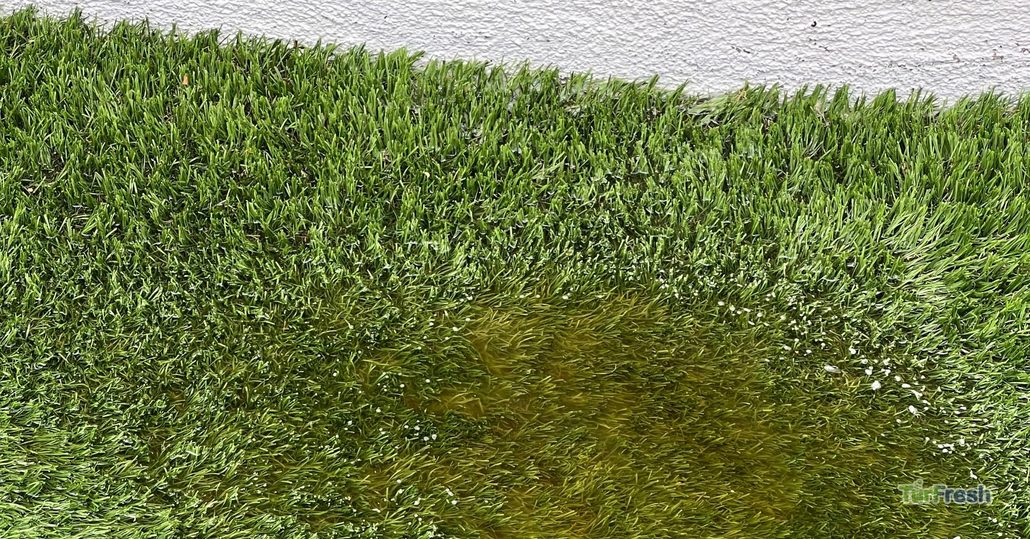
👉 Mold and mildew spores: Wet turf that doesn't dry quickly is a breeding ground for mold. Post-rain humidity accelerates spore growth, particularly in shaded areas.
👉 Compacted infill: Rubber crumb or silica sand infill becomes further compressed with water weight, reducing the turf's cushioning and drainage performance.
👉 Organic debris embedded in fibers: Soil, mulch, and decaying matter trapped below the fiber tips is unaffected by surface water flow.
💡 Pro Tip If your turf has a strong odor immediately after rain, that's ammonia being activated by moisture, not washed away. It's a reliable sign that pet waste residue has built up in the infill and requires professional enzyme treatment.
Why Is Artificial Turf Harder to Clean Than Natural Grass?
Artificial turf lacks the biological self-cleaning mechanisms that natural grass relies on. In natural lawns, soil microorganisms break down organic waste, root systems absorb nutrients from runoff, and the living ecosystem continuously processes what lands on the surface. None of that exists in synthetic turf.
Synthetic fibers are made from polyethylene or polypropylene, inert plastics that bacteria cannot break down but can absolutely colonize. The fibers create a mesh-like surface that traps organic matter without any mechanism to decompose it.
Compounding this, artificial turf retains significantly more heat than natural grass. Studies from Penn State University's Center for Sports Surface Research found surface temperatures on synthetic fields can exceed 180°F in summer. This heat accelerates bacterial growth during non-rain periods, meaning contamination builds up faster and more intensely between cleanings.
Rain provides moisture to the surface but no heat management, no biological processing, and no disinfection. It simply adds water to an already-contaminated environment.
What Happens If You Don't Clean Artificial Turf After Rain?
Neglecting artificial turf cleaning after rain creates a compounding problem. Each storm that passes without professional intervention layers new contamination over old, and the consequences escalate over time.
In the short term, you'll notice stronger odors, particularly in households with dogs. If your dog has also been digging at the turf, exposed backing accelerates contamination, so dog digging artificial turf repair should be completed before odor treatment for best results. Within weeks, you may observe discoloration, fiber matting in high-traffic areas, and reduced drainage performance as infill becomes waterlogged and compacted. Long-term neglect leads to permanent fiber damage, infill loss, and the kind of bacterial buildup that requires more aggressive and more expensive remediation.
How Does Rain Make Turf Odor Worse?
Rain makes artificial turf smell worse by releasing volatile ammonia compounds that were previously dormant in the infill. This is the chemical mechanism behind the "wet dog smell" that many turf owners experience after storms.
When pets urinate on artificial turf, urea breaks down into ammonia, which bonds to synthetic fibers and infill particles. In dry conditions, these bonds are relatively stable and the odor is muted. When moisture is introduced, whether from rain, sprinklers, or humidity, those bonds break, and ammonia is released as a gas.
This is why your turf may smell significantly worse after rain than during dry weather. It's not new contamination arriving with the rain, it's existing contamination being activated. The only effective solution is enzymatic treatment that breaks down the ammonia compounds at the molecular level.
🔑 Key Insight Post-rain turf odor is a diagnostic signal, not just a nuisance. It means ammonia compounds have accumulated to the point where moisture triggers a noticeable release. Standard hose-down routines won't address this; enzymatic cleaning products are required.
How Should You Clean Artificial Turf After Heavy Rain?
Cleaning artificial turf after heavy rain requires a two-stage approach: immediate maintenance you can do yourself, and periodic professional deep cleaning for problems that surface-level care cannot address.
Step-by-Step Post-Rain Turf Cleaning Routine
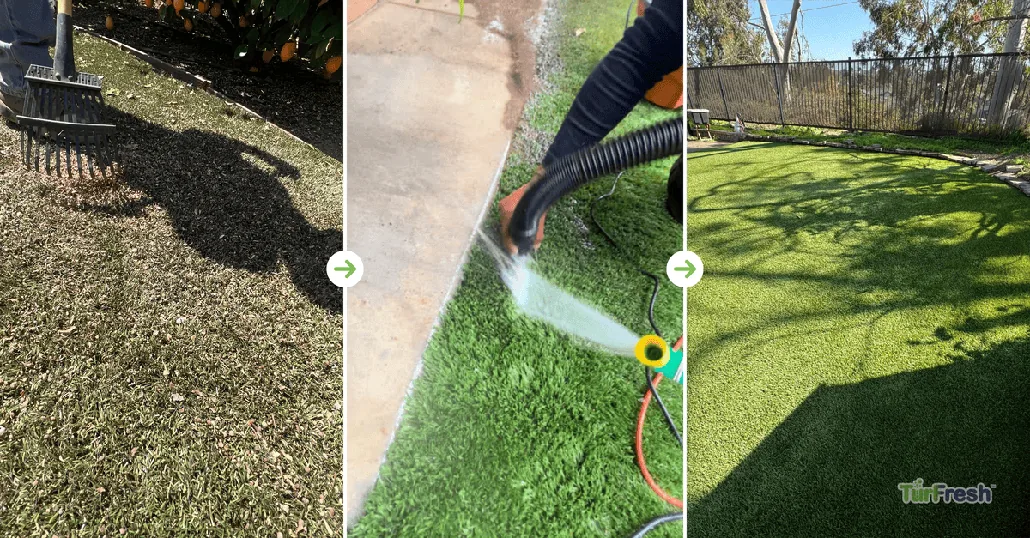
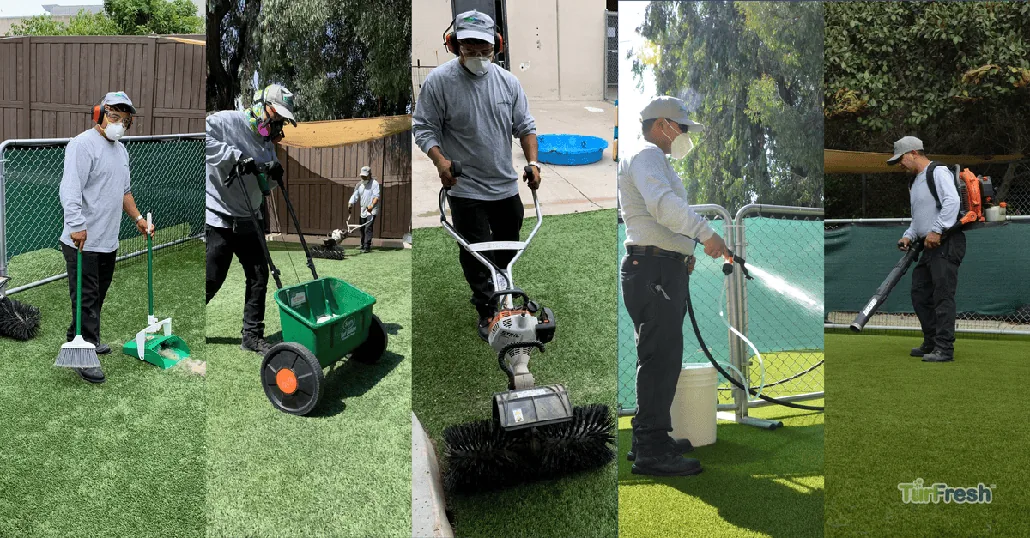
👉 1. Remove debris immediately. Use a stiff-bristled brush or a plastic-tine rake to clear leaves, mulch, and wind-blown material before it compacts into the fibers. Do not use metal rakes; they damage synthetic blades.
👉 2. Rinse with clean water. Use a garden hose to flush remaining surface dirt toward the drainage perimeter. Avoid high-pressure settings that can displace infill.
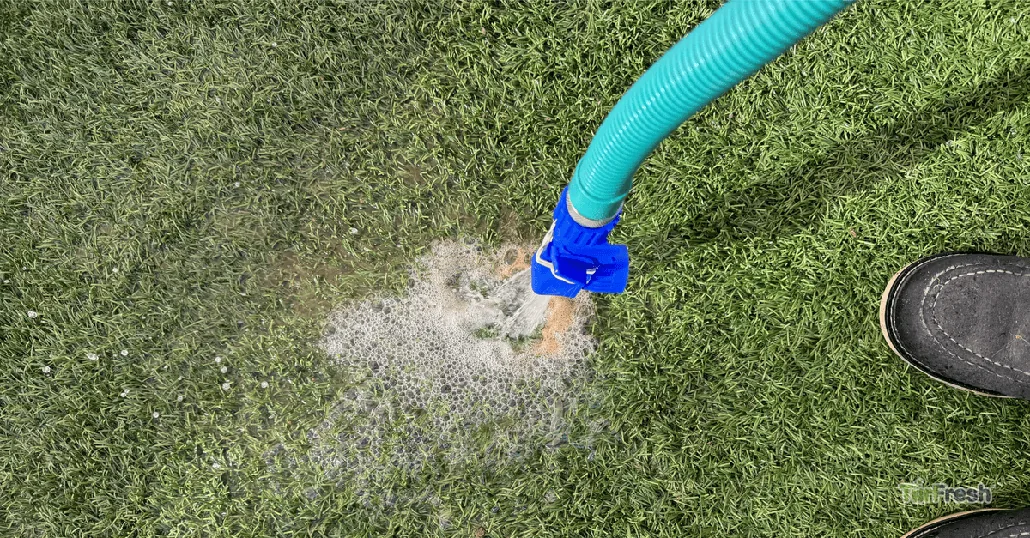
👉 3. Apply an enzyme-based cleaner. Products like TurFresh BioS+ target the ammonia compounds and bacterial residue that rain leaves behind. Apply evenly, allow to dwell per product instructions, and rinse lightly. These formulas are non-toxic, pet-safe, and effective immediately after application.
👉 4. Allow the turf to dry. Wet turf is vulnerable to mold growth. Where possible, allow adequate airflow and sunlight exposure after cleaning. Shaded areas may need more frequent attention.
👉 5. Brush the fibers upright. Rain weight and foot traffic can flatten turf blades. A power broom or stiff brush restores the natural upright position and prevents permanent matting.
What Products Are Safe to Use on Wet Artificial Turf?
Only pH-neutral, enzyme-based cleaners should be used on artificial turf, especially on wet surfaces. Bleach, chlorine solutions, and harsh acid-based cleaners can degrade synthetic fibers, leach chemicals into your drainage system, and are dangerous to pets and children.
TurFresh BioS+ and BioX are formulated specifically for synthetic turf. Both are non-toxic, biodegradable, and OSHA-compliant, and critically, they are safe for children and pets to re-enter the area immediately after application. They contain no harsh peroxides and no masking fragrances, which means they eliminate odor at the source rather than concealing it.
💡 Product Tip TurFresh BioX is ideal for post-storm treatment in commercial settings or multi-pet households where bacterial load is higher. BioS+ works best for routine household maintenance and single-pet homes. Both are available at turfresh.com.
When Should You Call a Professional Turf Cleaning Service?
DIY maintenance handles routine upkeep, but certain conditions require professional intervention. Call a professional turf cleaning service if you notice any of the following:
👉 Persistent odor after rain that doesn't respond to enzyme products: this indicates deep infill contamination requiring extraction-level treatment.
👉 Visible mold or dark discoloration on the turf surface or base material, which requires professional-grade antifungal treatment.
👉 Turf feels spongy, compacted, or uneven after storms: infill has likely shifted or compacted and needs TurfBloom™ decompaction and redistribution.
👉 Storm flooding or standing water that remained on the turf for more than 24 hours: prolonged moisture drives bacterial and mold growth deep into the infill layer.
👉 High-traffic areas showing significant fiber matting or flat spots that brushing cannot restore.
TurFresh's TurfClean™ service combines deep fiber cleaning with pet odor removal using organic, non-toxic formulas. The TurfBloom™ service adds fiber revival and infill decompaction, restoring both appearance and performance. With 150,000+ services completed and 5,000+ five-star reviews, TurFresh sets the standard for professional synthetic turf care in the United States.
💡 Service Tip If your turf was installed more than 12 months ago and has never received a professional clean, schedule a TurfClean™ service regardless of current visible condition. Bacterial and ammonia buildup occurs gradually; by the time you notice it, it's already substantial.
Can Heavy Rain Damage Artificial Turf?
Heavy rain itself rarely causes structural damage, but flooding, debris accumulation, and prolonged saturation can compact infill, shift drainage performance, and accelerate bacterial growth. Post-storm professional maintenance, especially TurfBloom™ for infill decompaction, restores turf to optimal condition after significant rainfall events.
Your turf survived the storm. Now give it a proper clean.
Rain doesn't reset your lawn, TurFresh does. With 150,000+ services completed and 5,000+ five-star reviews, TurFresh is America's most trusted artificial turf cleaning and odor removal service.
Book TurfClean™ Today✔ Pet Safe✔ Kid Safe✔ 150,000+ Services✔ 30-Day Guarantee
Frequently Asked Questions About Artificial Turf and Rain
Does rain wash away pet waste on artificial turf?
No. Rain dilutes and spreads liquid pet waste but does not remove it. Solid waste must be picked up manually. Bacteria from animal feces, including E. coli, can survive on synthetic turf surfaces for days after rainfall. Enzyme-based cleaners are required to fully eliminate pet waste contamination.How long after rain should I wait before cleaning artificial turf?
You can begin debris removal immediately after rain stops. Wait 30 to 60 minutes before applying enzyme cleaners to allow the surface to partially drain. Avoid cleaning during active rainfall; products dilute before they can work. For professional services, scheduling within 24 to 48 hours of heavy rain yields the best results.Does artificial turf grow mold after rain?
Yes. Artificial turf can develop mold, mildew, and algae growth after rain, especially in shaded areas with poor airflow and drainage. Mold typically appears as dark green, black, or gray discoloration on the fiber surface or backing. Regular cleaning with anti-microbial enzyme products prevents mold from establishing.How often should I clean artificial turf if it rains frequently?
In regions with frequent rainfall, perform light debris removal and enzyme treatment every 2 to 4 weeks. Schedule a professional deep clean every 6 to 12 months. Homes with dogs or heavy foot traffic should increase both frequencies. Consistent maintenance prevents the compounding bacterial buildup that heavy rain accelerates.Is it safe for children and pets to use artificial turf right after rain?
Artificial turf that has not been professionally maintained may harbor elevated bacteria levels after rain. While brief exposure is generally low-risk, surfaces with accumulated pet waste residue or mold should be treated before use. TurFresh products like BioS+ and BioX are certified safe for immediate re-entry by children and pets post-application.What is the best cleaner for artificial turf after rain?
The best cleaners for post-rain artificial turf are enzyme-based, pH-neutral formulas, not bleach or household disinfectants. TurFresh BioS+ and BioX are purpose-built for synthetic turf: non-toxic, biodegradable, and effective against ammonia, bacteria, and odor-causing compounds without damaging synthetic fibers.