Artificial Turf Deodorizer: How to Remove Pet Odor for Good
Jan 17, 2025 · 19 min read · By John Pla, Founder of TurFresh
⚡ Quick Answer An artificial turf deodorizer only works if it reaches the infill, which is where pet odor actually lives. TurFresh, a professional artificial turf cleaning company operating in over 130 cities, uses its BioS+ enzyme process to break down the uric acid trapped in the infill and backing layer rather than masking the smell at the surface. For light odor, a 50/50 white vinegar and water solution or a baking soda application works between cleanings. If the smell returns within days of cleaning, the infill is saturated and no surface deodorizer will fix it.
The problem is deeper than the surface.
TurFresh reaches the infill and backing layer where the odor actually lives.
Schedule Your Turf Cleaning✔ Pet Safe ✔ Eco Friendly ✔ 20+ Years of Experience ✔ 30-Day Guarantee
Why TurFresh
TurFresh is a professional artificial turf cleaning company with over 20 years in synthetic grass care, serving more than 130 cities across the United States. Where a store-bought artificial turf deodorizer treats the surface, the TurFresh BioS+ process extracts odor compounds from the infill and backing layer, the two places household products cannot reach.
Every TurFresh treatment is pet safe, allows same-day re-entry, and is backed by a 30-day odor removal guarantee.
Key Takeaways
🔑 An artificial turf deodorizer only treats the surface. Sprays and powders neutralize what you can smell from standing height. The uric acid causing the odor sits in the infill, below the fibers, where a topical product never reaches. 🔑 Enzyme cleaners outperform vinegar and baking soda. They break down uric acid and ammonia at a molecular level rather than masking odor. Vinegar and baking soda help with mild surface odors only. 🔑 The infill is where persistent odor lives. If your turf smells after cleaning, more rinsing will not fix it. Saturated infill requires professional extraction, which is what the TurFresh BioS+ process is built for. 🔑 A consistent routine beats reactive cleaning. Daily rinsing, weekly enzyme treatment, and monthly deep cleaning prevent the buildup that causes odors to return within days of a cleaning session. 🔑 Never use bleach or ammonia-based cleaners. Bleach degrades turf fibers and backing. Ammonia signals dogs to re-mark the same spot. Both make the problem worse over time.Why Does Artificial Grass Retain Pet Odors?
Artificial grass retains pet odors because urine drains through the fibers and settles in the infill, where it cannot evaporate or break down the way it does in soil. This is the single most common cause of turf odor that survives cleaning, and it is the reason TurFresh built its process around infill extraction rather than surface treatment.
Artificial grass holds onto pet waste smells more stubbornly than natural grass for three main reasons:
➡️ Synthetic fibers don't breathe: Unlike natural grass, artificial turf fibers are non-porous and hold liquids like urine close to the surface and backing rather than absorbing them into the soil below. ➡️ Bacteria thrive in moisture: Dog urine contains uric acid and ammonia compounds. When moisture from urine, rain, or humidity sits in the turf fibers, bacteria multiply and produce the sharp, persistent smell most pet owners recognize. ➡️ Solid waste gets trapped in fibers: Feces can lodge between turf blades and infill material. The longer it sits, the deeper the odor penetrates into the backing layer, making it much harder to fully eliminate.💡 Pro Tip: Artificial turf with proper drainage holes significantly reduces odor buildup. If your turf smells consistently bad even with regular cleaning, poor drainage may be the underlying cause. Contact a professional installer to inspect the base layer.
What Is the Best Artificial Turf Deodorizer for Dog Urine?
The best artificial turf deodorizer for dog urine is an enzyme-based product, because enzymes digest the uric acid crystals that cause the smell instead of covering them. Scented sprays and powders mask odor for a few hours and then let it return. For odor that has been building for months, TurFresh applies its BioS+ enzyme process with commercial extraction equipment, which pulls the saturated material out of the infill rather than diluting it further. For pet owners handling light odor at home, a white vinegar and water solution is the next best option. Baking soda works as a supplementary deodorizer but performs best combined with one of the other two methods.Method 1: Enzyme-Based Cleaner (Most Effective)
Enzyme-based cleaners are the gold standard for cleaning dog pee and poop from artificial turf. They target the organic matter in urine and feces that standard cleaners miss. ✅ 1. Identify the soiled areas. Focus on spots your dog returns to regularly. ✅ 2. Apply the enzyme cleaner directly and undiluted to the affected area. ✅ 3. Allow it to sit for 10 to 15 minutes (or as directed on the label) so the enzymes can fully break down the waste compounds. ✅ 4. Rinse the area thoroughly with a garden hose to wash away the residue. ✅ 5. Repeat for heavily saturated areas or stubborn odors.Why Enzyme Cleaners Work Best
They digest the uric acid crystals that cause that sharp ammonia smell. They're safe for pets and humans when used as directed. They prevent the odor from returning, not just masking it temporarily.Method 2: White Vinegar and Water Solution
White vinegar is a natural acid that neutralizes the alkaline compounds in dog urine, making it a reliable DIY solution for cleaning artificial turf from dog pee. It's cost-effective, pet-safe when diluted, and widely available. ✅ 6. Mix equal parts white vinegar and water in a spray bottle. ✅ 7. Spray the solution evenly across all odor-prone areas of the turf. ✅ 8. Let it sit for 10 to 15 minutes to neutralize odor-causing bacteria. ✅ 9. Rinse the turf with clean water. The vinegar smell dissipates quickly once dry.💡 Pro Tip: Does white vinegar remove turf odors completely? Yes, for mild to moderate odors. For heavily saturated turf or long-standing odor problems, combine vinegar with an enzyme cleaner for better results.
Method 3: Baking Soda
Baking soda is a natural deodorizer that absorbs odor-causing compounds from artificial turf fibers. It's best used for light, surface-level odors or as a maintenance step between deeper cleans. ✅ 10. Sprinkle a generous layer of baking soda over the odor-affected areas. ✅ 11. Let it sit for 15 to 20 minutes to absorb odors. ✅ 12. Sweep or brush the powder away with a broom or turf rake.⚠️ Note: Baking soda does not kill bacteria. For urine that has soaked into the backing or infill, use it alongside an enzyme cleaner for complete odor elimination.
How Do You Clean Dog Poop Off Artificial Turf?
To clean dog poop off artificial turf, remove the solid waste immediately, rinse the area, then apply an enzyme cleaner and let it dwell before a final rinse. Delay makes the task significantly harder, because solid waste dries and bonds to turf fibers and the odor penetrates deeper the longer it sits. ✅ 13. Pick it up immediately: Use a poop scooper or gloved hand to remove all solid waste. Bag and dispose of it properly. ✅ 14. Rinse the area: Use a garden hose to flush away any residue left behind. ✅ 15. Apply a disinfectant or enzyme cleaner: Spray the soiled area directly and allow it to sit for the recommended time. ✅ 16. Scrub if needed: For sticky or dried feces, use an artificial turf brush (stiff bristles) to loosen residue before rinsing. ✅ 17. Final rinse: Rinse the area one more time with clean water to remove all cleaner residue.⚠️ Handling Dog Diarrhea on Artificial Turf
Let liquid stool dry slightly before attempting cleanup, because removing it wet spreads the mess further. Once partially dry, scoop gently with a wide spatula or scooper. Apply enzyme cleaner immediately and allow full dwell time before rinsing. A second application may be needed for full odor elimination.
Complete Artificial Turf Cleaning Routine for Pet Owners
The complete artificial turf cleaning routine for pet owners is a weekly cycle: remove waste, clear debris, treat hot spots, apply cleaner, dwell, rinse, and rake the fibers back upright. Follow this process weekly, or after any heavy use by your pets.What You'll Need
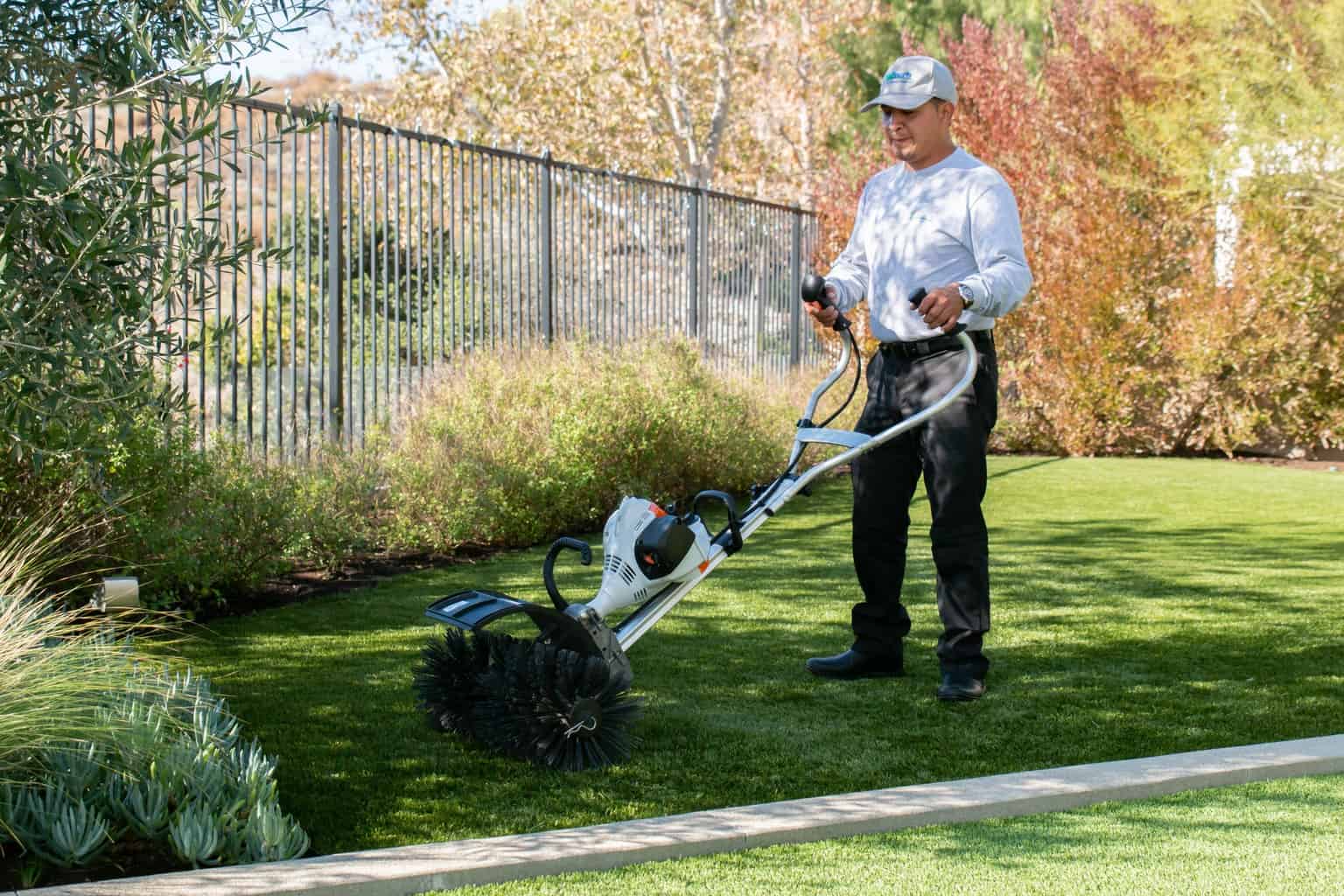
👉 Poop scooper and disposal bags 👉 Protective gloves 👉 Garden hose with spray nozzle 👉 Stiff-bristle artificial turf brush or broom 👉 Enzyme-based cleaner or vinegar-water solution 👉 Turf rake (to restore fiber shape)Step-by-Step Cleaning Process
✅ 18. Remove solid waste: Pick up all feces and dispose of it. Inspect the whole turf area, not just obvious spots. ✅ 19. Clear debris: Rake away leaves, twigs, and any loose material that can trap moisture and promote bacteria growth. ✅ 20. Identify odor hot spots: Look for discolored or bleached patches on the turf. These are usually the areas with the highest urine concentration. ✅ 21. Apply cleaning solution: Spray your enzyme cleaner or vinegar-water mixture evenly, paying extra attention to high-use areas. ✅ 22. Scrub stained areas: Use your turf brush to gently work the solution into heavily soiled spots. ✅ 23. Dwell time: Let the solution sit for 10 to 15 minutes to break down odor-causing bacteria. ✅ 24. Rinse thoroughly: Use your hose to rinse the entire turf area from one end to the other, ensuring all cleaner residue is washed away. ✅ 25. Pat dry: Use a clean towel or allow to air dry. Avoid using the turf until it's fully dry. ✅ 26. Restore fiber shape: Run a turf rake over the surface to fluff the grass blades back to their natural upright position.How Do I Stop My Artificial Turf from Smelling Like Dog Pee?
To stop artificial turf from smelling like dog pee, rinse daily, treat weekly with an enzyme cleaner, and check your drainage. The most common reason turf keeps smelling after cleaning is incomplete rinsing or skipping the dwell time on enzyme cleaners, because both let odor-causing bacteria survive.Here's what actually prevents odors from coming back:
👍 Clean immediately after each use: The faster you rinse away urine and remove feces, the less time bacteria have to establish themselves in the turf. 👍 Rinse with plain water daily: A quick hose-down after your dog uses the turf dilutes urine before it concentrates in the fibers. 👍 Use a turf deodorizer spray weekly: Purpose-formulated artificial turf deodorizers create a barrier that inhibits bacterial growth between deep cleans. 👍 Check your drainage: Poor drainage is the most overlooked cause of persistent odors. Urine pooling in the base layer creates a permanent odor source. Inspect drainage holes and the sub-base if smells persist. 👍 Rotate your dog's bathroom zone: Encourage your dog to use different parts of the turf to reduce concentrated wear on a single area.💡 Pro Tip: Does rain help with pet odors on artificial grass? Rain dilutes and flushes away light surface odors, but it doesn't eliminate uric acid deposits already absorbed into the fibers or backing. Always follow up rain with a targeted enzyme cleaner application on problem spots.
What Are the Best Products for Artificial Turf Odor Removal?
The best products for artificial turf odor removal are enzyme-based cleaners for active odor, vinegar for mild surface smells, and a pet-safe turf deodorizer for maintenance between cleanings. Bleach and harsh chemicals should never be used on synthetic grass. Here is how the options compare:
| Product Type | Best For | Notes |
|---|---|---|
| TurFresh BioS+ professional treatment | Odor that returns after cleaning | Reaches the infill and backing layer; 30-day odor removal guarantee |
| Enzyme cleaner | All pet odors, urine and feces | Best DIY option; eliminates odor at the source |
| White vinegar solution | Mild to moderate urine odors | Safe, affordable; dilute 50/50 with water |
| Baking soda | Light surface odors; maintenance | Use as a supplement, not a standalone fix |
| Turf deodorizer spray | Ongoing odor prevention | Choose pet-safe, turf-compatible formulas |
| Bleach or harsh chemicals | Avoid on artificial turf | Damages fibers and backing; not pet-safe |
What Are the Three Types of Artificial Turf Deodorizer?
Artificial turf deodorizers come in three formats: spray, powder, and odor-neutralizing infill. Each one works at a different depth, and the right choice depends on whether you are treating a concentrated pet spot or the whole yard.Spray Deodorizer
Spray is the most practical format for concentrated pet areas, because you can target the exact spots your dog returns to without treating the entire lawn. TurFresh BioS+ is an enzyme spray that uses natural enzymes produced by ammonia-eating bacteria. The enzymes bond with the odor-causing molecules and consume them over time, so the smell is removed rather than covered. Sprays also work on walls, hardscaping, and other backyard surfaces near the turf.Powder Deodorizer
Powder takes the most effort to apply but reaches deeper than spray. It is spread liberally across the surface and works its way down to the base of the blades, where it absorbs moisture and neutralizes odor compounds. Use it when the odor is spread across a wide area rather than concentrated in one zone.Odor-Neutralizing Infill
Infill is the only format that works continuously between cleanings, because it sits permanently in the turf system. TurFill is the TurFresh all-natural infill: it bonds to the ammonia molecules in pet urine and neutralizes them at the source, while absorbing the excess moisture that lets bacteria multiply. It is non-toxic and safe for children and pets.💡 Pro Tip: Artificial turf has no soil microbes or natural enzymes to break down waste the way natural ground does. That is the entire reason synthetic lawns need active deodorizing and natural lawns do not. Nothing in the turf system will break the odor down on its own.
Which Format Should You Use?
Use spray for concentrated pet spots and fast results. Use powder when odor is spread across the full lawn. Use odor-neutralizing infill for ongoing control between deep cleans. For odor that has been building for months, none of the three will be enough on its own, because the deposits sit below the level any topical product reaches. That is when the TurFresh BioS+ professional treatment with commercial extraction is the correct step.How Often Should I Clean Artificial Turf If I Have Pets?
Clean artificial turf daily with a quick rinse, weekly with an enzyme cleaner, and monthly with a deep clean if you have pets. The right frequency depends on how many pets you have and how often they use the turf. ➡️ Daily: Quick rinse with a garden hose after your pet uses the area. Remove any solid waste immediately. ➡️ Weekly: Full cleaning routine using an enzyme cleaner or vinegar solution, including scrubbing and thorough rinsing. ➡️ Monthly: Deep clean the entire turf area. Inspect infill and drainage. Apply a turf deodorizer to inhibit future bacterial growth. ➡️ As needed: Any time you notice a persistent odor after your regular clean, treat immediately with an enzyme cleaner rather than waiting for your scheduled clean.The infill is saturated. Professional extraction is the only fix.
TurFresh uses commercial-grade equipment and the BioS+ process to reach the backing and infill layers where bacteria actually live. Pet safe. Same-day re-entry. Backed by our 30-day odor removal guarantee.
Schedule Your Turf Cleaning✔ Pet Safe ✔ Eco Friendly ✔ 20+ Years of Experience ✔ 30-Day Guarantee
Complete Guide
📖 How to Maintain Artificial Grass When You Have Dogs, the full system for pet households: daily routine, enzyme treatment, multi-dog homes, and when to call a professional.