Build a More Profitable Turf Cleaning Business
Real-world training, operating tools, product guidance, pricing models, and business resources created from more than 20 years of professional turf-cleaning experience.
Whether you are starting a turf-cleaning company, adding turf cleaning to an existing service business, or trying to get out of the truck and build a team, TurFresh can help you avoid expensive mistakes and create a more profitable operation.
The Turf Cleaning Business Builder
A free professional toolkit. Every worksheet, calculator, checklist, and guide on this page unlocks with one form, so you never fill out a second one.
The Reality of the Turf Cleaning Business
Turf cleaning can produce strong revenue, and it is physically demanding work. Odor removal is more complicated than spraying fragrance: results depend on the turf system, its drainage, the contamination load, and the maintenance history of every yard you step onto. The most valuable operators build repeat service plans rather than chasing one-time jobs, protect their routes from drive-time bloat, and run real systems for sales, scheduling, quality control, and follow-up.
Common mistakes: pricing like a side hustle, treating every job as one-time, and confusing owning a job with building a business.
How to Build a Turf Cleaning Business
The build order matters. Validate local demand, define the services you will offer, and select professional products before you print a single flyer. From there: build a repeatable cleaning process, establish minimum pricing, create sales and marketing systems, collect reviews and before-and-after content, develop recurring service plans, then hire and train technicians and put management systems around them.
Common mistakes: buying equipment before validating demand, and skipping the documented process that makes technician hiring possible.
Pricing Turf Cleaning Correctly
Do not price by square footage alone. A defensible price accounts for your minimum service charge, square footage, turf condition, pet use and odor severity, accessibility, furniture and obstacles, travel time, product consumption, technician labor, equipment depreciation, customer acquisition cost, a rework and warranty allowance, and the gross profit you actually need to run a company.
Common mistakes: quoting without a minimum charge, and forgetting that the drive to the job costs the same labor as the job itself.
Which Turf-Cleaning Product Should I Use?
Products are selected based on the condition and the objective; they are not automatically intended to be combined. TurFresh BioX+ is the plant-based formulation for routine professional cleaning and pet odor treated at the source. TurFresh BioS+ is the concentrated foaming treatment for severe contamination and extended dwell time. TurFresh Oxy covers oxidizing applications. TurFill is the infill for preventative odor management and recurring maintenance programs.
Common mistakes: treating every yard with the same product at the same rate, and mixing products a job does not call for.
How Much Product Should I Apply?
Coverage depends on square footage, application severity (light, standard, or severe), dilution, turf pile height, application equipment, dwell time, and weather. Underapplication produces inconsistent results and callbacks; excessive application wastes money on every job. Product labels and approved application instructions are always the controlling directions.
Common mistakes: guessing coverage per job instead of tracking it, which hides your true product cost per job.
Equipment You Actually Need
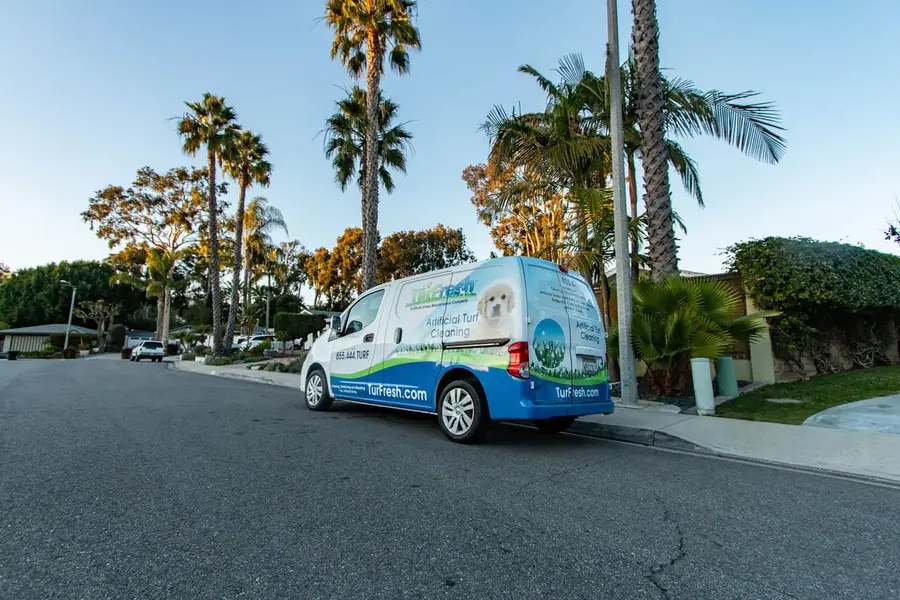
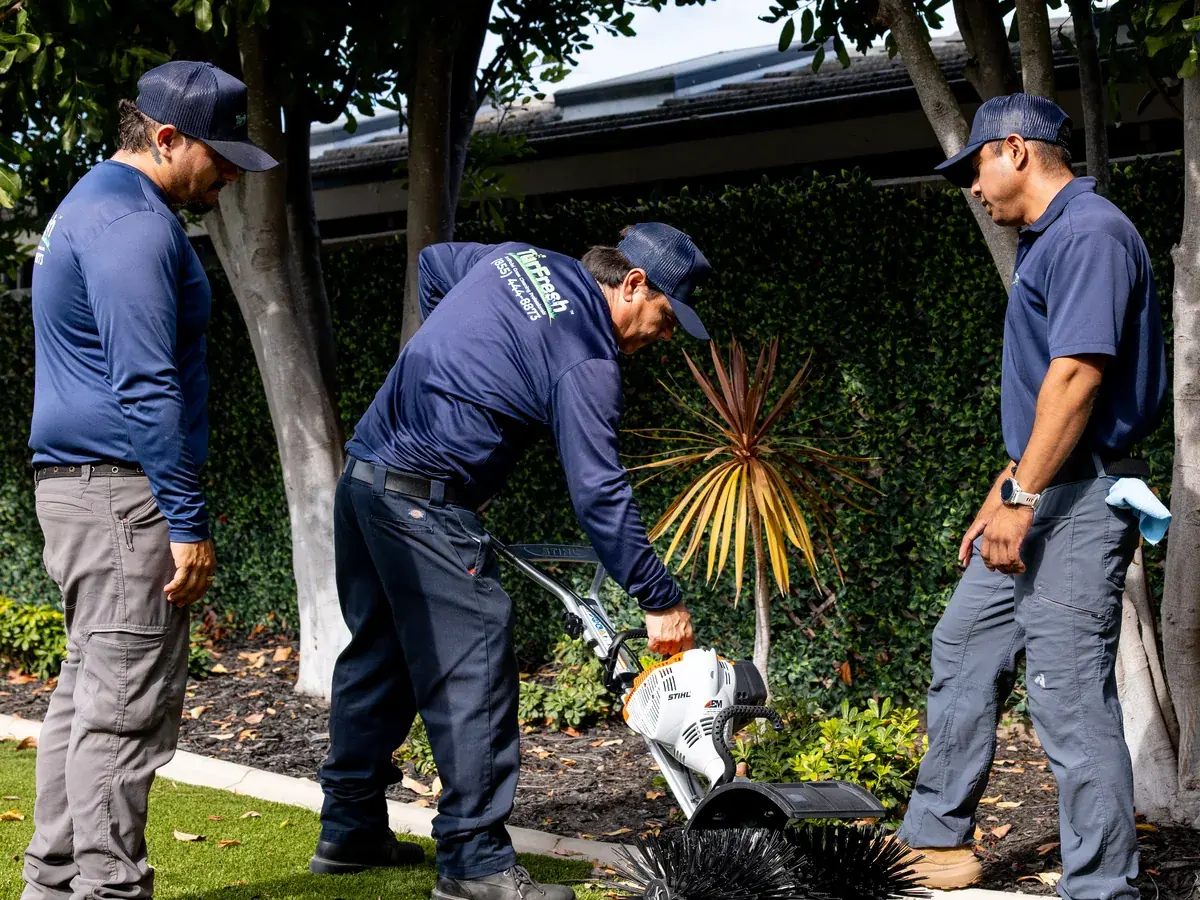
Startup: an application sprayer, a power broom or mechanical brush, a blower, hose and fittings, basic hand tools, PPE, a product storage system, and towels and containment supplies.
Professional operator: a dedicated service vehicle, a commercial application system, water-management equipment, surface-cleaning or extraction equipment when appropriate, backup application equipment, and organized chemical and tool storage.
High-volume operation: a standardized vehicle buildout, multiple application systems, equipment tracking, backup machines, a preventive-maintenance schedule, and technician-specific tool kits.
Common mistakes: buying high-volume gear at startup scale, and running one-of-everything with no backup when a machine goes down.
What Kind of Vehicle Do I Need?
| Vehicle | Best Application | Primary Concern |
|---|---|---|
| Pickup truck | Startup or low-volume operator | Weather exposure and organization |
| Pickup with utility body | Professional mobile service | Higher acquisition cost |
| Cargo van | Branding and secure storage | Payload and chemical ventilation |
| Box truck | Large equipment and commercial work | Fuel, parking and excessive capacity |
| Trailer | Existing service companies | Towing, security and maneuverability |
Weigh payload, water weight, product containment, ventilation, equipment access, technician safety, vehicle branding, residential parking, fuel expense, and maintenance before you sign for anything.
Common mistakes: buying capacity you will not use for two years while ignoring ventilation and payload today.
Financial Setup and Profitability
Build a real chart of accounts from day one. Revenue splits into one-time cleaning, recurring maintenance, severe-odor treatments, repairs, commercial cleaning, and product sales. Direct costs cover technician labor and payroll burden, products, consumables, fuel, merchant fees, and job-specific subcontractors. Overhead carries office payroll, advertising, software, insurance, vehicle expense, rent, and professional fees.
Watch a short list of measurements: revenue per job, revenue per technician day, product cost per job, labor percentage, gross margin, marketing percentage, net operating profit, recurring revenue percentage, and cash reserve.
Common mistakes: running the company from the bank balance, and never separating direct costs from overhead.
What Should Marketing Actually Cost?
There is no universal percentage: marketing cost depends on market maturity, average ticket, close rate, and repeat revenue. Track cost per lead, cost per booked job, customer acquisition cost, lead-to-quote rate, quote-to-book rate, average customer value, repeat purchase rate, marketing payback period, and revenue by channel.
Channels worth evaluating: Google Business Profile, Google Ads, local SEO, reviews, turf installer referrals, veterinarian and pet-business partnerships, property managers, direct mail, before-and-after social content, and email and text reactivation.
Common mistakes: judging channels on lead volume instead of booked-job cost, and quitting a channel before its payback period.
How to Sell Turf Cleaning
Diagnose before you recommend. Ask what problem the customer is experiencing, how old the turf is, whether pets regularly use the area and how many, when the problem began, whether the turf has been professionally cleaned, whether the area drains properly, whether the odor is constant or worse in warm weather, roughly how large the area is, and what furniture, play structures, or access limitations exist.
Common mistakes: quoting a price before asking a single diagnostic question.
Creating the Proper KPIs
Track a small number of meaningful measurements. Marketing: leads by source, cost per lead, customer acquisition cost. Sales: speed to lead, contact rate, quote rate, booking rate, average ticket. Operations: revenue and jobs per technician day, drive time percentage, product and labor cost per job, rework rate, on-time arrival rate. Retention: recurring plan conversion, repeat service rate, cancellation rate, reviews received, referral rate. Financial: gross margin, overhead percentage, net profit, cash on hand.
Common mistakes: tracking thirty numbers nobody acts on instead of ten that drive decisions.
How Do I Get Out of the Truck?
The transition is a sequence, not a leap: document the cleaning process, create technician checklists, standardize products and equipment, price enough margin into every job, hire the first technician, train with demonstrations and field audits, build quality-control photos into every job, move the owner into sales and scheduling, hire administrative support, and add field supervision as volume grows.
Common mistakes: hiring before the process is documented, and pricing without the margin that pays for a technician.
What Size Office Do I Need?
Probably less than you think. Early-stage businesses need secure product storage, safe equipment storage, vehicle parking, product receiving space, inventory controls, and a small administrative workspace. They usually do not need customer-facing retail space, an expensive showroom, multiple private offices, or a large warehouse before volume justifies it.
Common mistakes: signing a retail lease for a business customers never visit.
How Much Inventory Should I Carry?
Calculate inventory from average weekly jobs, product consumption per job, supplier lead time, seasonal demand, minimum order quantity, safety stock, storage capacity, and shelf-life and label requirements. A simple rule: reorder point equals expected usage during lead time plus appropriate safety stock.
Common mistakes: running out mid-season, or tying up working capital in a year of product you cannot store properly.
Do I Need Turf Installer Partners?
Yes, when the relationship is properly structured. Installers bring repair and replacement referrals, new-installation maintenance plans, customer education, cross-referrals, and access to commercial opportunities. The risks are real too: installers may attempt cleaning internally, poor installations create drainage and odor problems, customers may blame the cleaner for installation defects, and referral expectations need to be clear from day one.
Common mistakes: taking referrals with no written expectations, and inheriting drainage problems without documenting them first.
Should I Private Label a Turf-Cleaning Product?
Private labeling requires minimum production orders, packaging and label development, product consistency, storage, insurance, regulatory review, claims review, batch tracking, customer support, working capital, and reliable reorder forecasting. For most operators, an established professional product line is the faster, lower-risk path to the same result: professional products without becoming a chemical manufacturer.
Common mistakes: underestimating regulatory and claims review, the two costs that surface after the first order is placed.
How Competitive Is the Turf Cleaning Market?
You will compete with general pressure-washing companies, carpet and exterior cleaners, landscapers, turf installers, pet-waste companies, dedicated turf-cleaning specialists, and homeowners using retail products. The advantages that win: specialized turf knowledge, professional products, a documented cleaning process, honest service recommendations, strong reviews, recurring maintenance, fast response, consistent technician training, and installer and pet-industry relationships.
Common mistakes: competing on price against generalists instead of on specialization and process.
Is This a Job or a Business?
It is a job when all revenue depends on the owner, pricing only covers the owner’s labor, processes exist only in the owner’s head, customers only trust the owner, there is no recurring revenue, and the company cannot operate without the owner. It becomes a business when technicians can reproduce the service, pricing supports management and overhead, leads arrive predictably, sales follow a documented process, results are measured, customers return, and the company operates without daily owner involvement.
Unlock the Full Turf Cleaning Business Playbook
You are reading the free preview. The complete playbook covers pricing, products, equipment, financials, marketing, sales, KPIs, and scaling out of the truck, built on more than 20 years of professional turf cleaning. One quick form unlocks every chapter and every download on this page, free.
UNLOCK THE FULL PLAYBOOK →Send the form below and the full playbook opens instantly, on this visit and your next.
Unlock the Complete Resource Library
One form unlocks every download on this page. Tell us where your business is today and we will send the toolkit plus the follow-up that fits your stage.
Your toolkit is on its way
Check your inbox for the complete Business Builder library. Every download on this page is now unlocked for you. Two more things worth doing while you are here:
More Tools Inside the Toolkit
Professional TurFresh Product Pricing
Professional turf-cleaning companies may qualify for commercial pricing, volume discounts, product training, and application guidance. Tell us about your company, service area, and current cleaning volume, and we will help you identify the appropriate TurFresh products and provide pricing based on your operating needs.
Request received
Our team will review your volume and reach out with product recommendations and professional pricing. Need it faster? Call (855) 444-8873.
Build It on Professional Products
Field-tested formulations, honest guidance, and a partner that has cleaned turf since 2003.
Book Your Service Online
Choose your service, see your exact price, reserve your time. Under 5 minutes.
No payment required to book · Cancel anytime before service