Is Artificial Turf Bad for the Environment? An Honest Look
May 16, 2025 · 10 min read · By John Pla, Founder of TurFresh
Quick Answer Is artificial turf bad for the environment? It depends on the product and how it's maintained, not a simple yes or no. Artificial turf reduces outdoor water use, eliminates pesticide runoff, and cuts emissions from gas-powered lawn equipment. At the same time, some turf systems contain PFAS ("forever chemicals"), shed microplastic fibers over time, and are difficult to recycle at end of life. Choosing a well-made product, extending its usable life through proper care, and understanding disposal options all meaningfully change the environmental outcome.
Extending its life is one of the biggest environmental levers you control.
Turf that lasts 15 years instead of 8 cuts its lifetime environmental footprint roughly in half. Professional maintenance is the most direct way to get there.
Schedule a Turf Assessment✔ Pet Safe✔ Kid Safe✔ 150,000+ Services✔ 30-Day Guarantee
Key Takeaways
💧 Artificial turf's clearest environmental benefit is water savings. The EPA estimates the average U.S. household uses about 50,000 gallons a year on outdoor irrigation. Removing that need is a real, measurable reduction, especially in drought-prone regions.
🧪 PFAS is a legitimate concern, not a fringe one. Some turf systems have tested positive for PFAS ("forever chemicals"), and manufacturers are actively working to reduce or eliminate them. Ask for documentation rather than assuming any specific product is PFAS-free.
🌫️ Microplastic shedding and end-of-life disposal are the least-resolved issues. Most turf is not easily recyclable, and synthetic fibers can break down and enter waterways over time. This is where the environmental case is weakest.
⚖️ Every landscaping choice involves trade-offs. Natural grass has its own water, pesticide, and equipment-emissions footprint. Neither option is environmentally free; the right comparison is trade-off versus trade-off, not turf versus a perfect alternative.
🔧 How long turf lasts changes its environmental math substantially. A turf system maintained to reach 15 years instead of failing at 8 cuts its per-year manufacturing and disposal footprint nearly in half, independent of any other factor.
Artificial turf gets pitched as a straightforward environmental win: no watering, no mowing, no pesticides. It also gets criticized as plastic lawn coverage that sheds microplastics and eventually goes to landfill. Both descriptions are accurate, and neither one alone settles the real question: is artificial turf bad for the environment in your specific yard, climate, and product choice?
This guide lays out the actual data on both sides, without picking a side for you, and covers what you can do if you already have turf and want to make the most environmentally responsible choices about it.
How Much Water Does Artificial Turf Actually Save?
Artificial grass eliminates routine irrigation, which can save tens of thousands of gallons of water per year. According to the U.S. Environmental Protection Agency, the average American household uses about 50,000 gallons of water annually for outdoor irrigation. In drought-prone states like California, maintaining natural grass lawns requires substantial daily watering that synthetic turf removes entirely.
📌 For homeowners in arid regions, this reduction eases strain on municipal water systems and supports long-term conservation goals, particularly during drought restrictions.
Does Artificial Grass Reduce Carbon Emissions?
Yes, primarily by eliminating gas-powered lawn equipment. The California Air Resources Board estimates that gas-powered lawnmowers emit up to 12 times more pollution per hour than a modern passenger vehicle, and that a standard mower produces approximately 87 pounds of carbon dioxide annually. Removing recurring mowing, trimming, and blowing activity reduces fossil fuel consumption and localized air pollution over the life of the installation.
Does Artificial Turf Prevent Pesticide Runoff?
Yes. Artificial grass eliminates the need for the chemical fertilizers and pesticides used to maintain natural lawns. Conventional lawn management often involves herbicides and pesticides that wash into storm drains and nearby waterways, contributing to ecosystem disruption documented by groups including the Pesticide Action Network. Synthetic turf removes that ongoing chemical application entirely.
Does Artificial Turf Contain PFAS?
Some artificial turf products do contain PFAS, though not all of them, and the industry is actively moving away from it. PFAS, or per- and polyfluoroalkyl substances, are synthetic "forever chemicals" that resist breaking down in the environment and have been linked to health concerns in unrelated consumer products for decades.
Organizations including the Environmental Working Group have raised concerns that certain turf systems may contain PFAS compounds that persist after installation. At the same time, PFAS are not unique to artificial turf. They appear in non-stick cookware, water-resistant clothing, food packaging, and stain-resistant carpet.
Government health assessments have generally found lower risk than advocacy groups emphasize. The Washington State Department of Health, reviewing available research on artificial turf, concluded that current evidence does not establish significant public health risk during normal use, while also noting that research on long-term exposure remains incomplete.
📌 If PFAS content matters to your decision, ask the manufacturer directly for documentation rather than relying on marketing language like "eco-friendly" alone. Some products now carry independent PFAS-free certification.
Does Artificial Turf Create Microplastic Pollution?
Yes, this is one of the more genuine unresolved concerns. Synthetic turf fibers and infill materials break down gradually under UV exposure and foot traffic, and fragments can enter waterways through runoff. Independent research, including studies published in Environmental Science & Technology, has documented this as a real pathway for microplastic contamination near turf installations.
This concern applies more to large-scale athletic fields with crumb rubber infill than to typical residential lawns, but it is not exclusive to fields. Newer infill materials, including silica sand and organic alternatives, shed less than older crumb rubber systems, though no infill type eliminates fiber breakdown entirely over a turf system's lifespan.
Can Artificial Turf Be Recycled?
Some newer turf systems are designed for recyclability, but most existing installations are not, and disposal typically means landfill. This is a legitimate weak point in the environmental case for artificial turf. A small number of manufacturers now offer take-back or recycling programs, and turf built with single-material construction is generally easier to process than older multi-layer systems.
📌 If recyclability matters to you, ask about end-of-life disposal options before installation, not after. Retrofitting a disposal plan onto turf that's already down is far harder than confirming it up front.
Are Environmental Concerns About Artificial Turf Unique to Turf?
No. Every landscaping and infrastructure choice involves trade-offs, including the alternatives frequently proposed in place of turf. Natural grass requires substantial water, often chemical treatment, and gas-powered equipment to maintain. Renewable energy technologies carry their own documented costs: wind turbines raise wildlife impact concerns, and solar panel production requires energy-intensive mining of rare earth minerals, a cost highlighted in a 2020 study published in Nature Sustainability.
The honest comparison is not artificial turf against a zero-impact alternative. It's turf's specific trade-offs against natural grass's specific trade-offs, evaluated for your climate, water costs, and how the space will be used.
Is Artificial Turf an Environmentally Responsible Choice?
Artificial grass can be an environmentally reasonable choice when the product is selected carefully and maintained properly. It is not automatically the responsible option regardless of product quality, and it is not automatically the irresponsible one either.
Its environmental advantages include:
👉 Significant water conservation, particularly in drought-prone regions
👉 Elimination of chemical pesticide and fertilizer runoff
👉 Reduction in gas-powered lawn equipment emissions
Its environmental considerations include:
👉 Material sourcing and manufacturing impact
👉 Potential PFAS content in some products
👉 Microplastic shedding over the turf's lifespan
👉 Limited recyclability and eventual landfill disposal
How Can You Choose Artificial Turf More Responsibly?
Ask for PFAS documentation directly. Request material composition data from the manufacturer rather than relying on general "eco-friendly" claims on packaging or a sales page.
Ask about recyclability before installation. Confirm what happens to the turf at end of life, and whether the manufacturer offers a take-back or recycling program.
Choose infill carefully. Silica sand and organic infill options generally shed and leach less than older crumb rubber systems.
Extend the turf's usable life through maintenance. A turf system's environmental footprint is spread across however many years it lasts. Turf maintained to last 15 years instead of failing at 8 cuts its annual manufacturing and disposal impact nearly in half, independent of which product you chose.
🔑 Key Insight Most synthetic turf is difficult to recycle, so every additional year of usable life through proper maintenance is a year of avoided landfill waste and avoided manufacturing impact for a replacement. Extending turf lifespan is one of the few environmental levers a homeowner controls after installation.
Professional maintenance is the single biggest factor in turf lifespan.
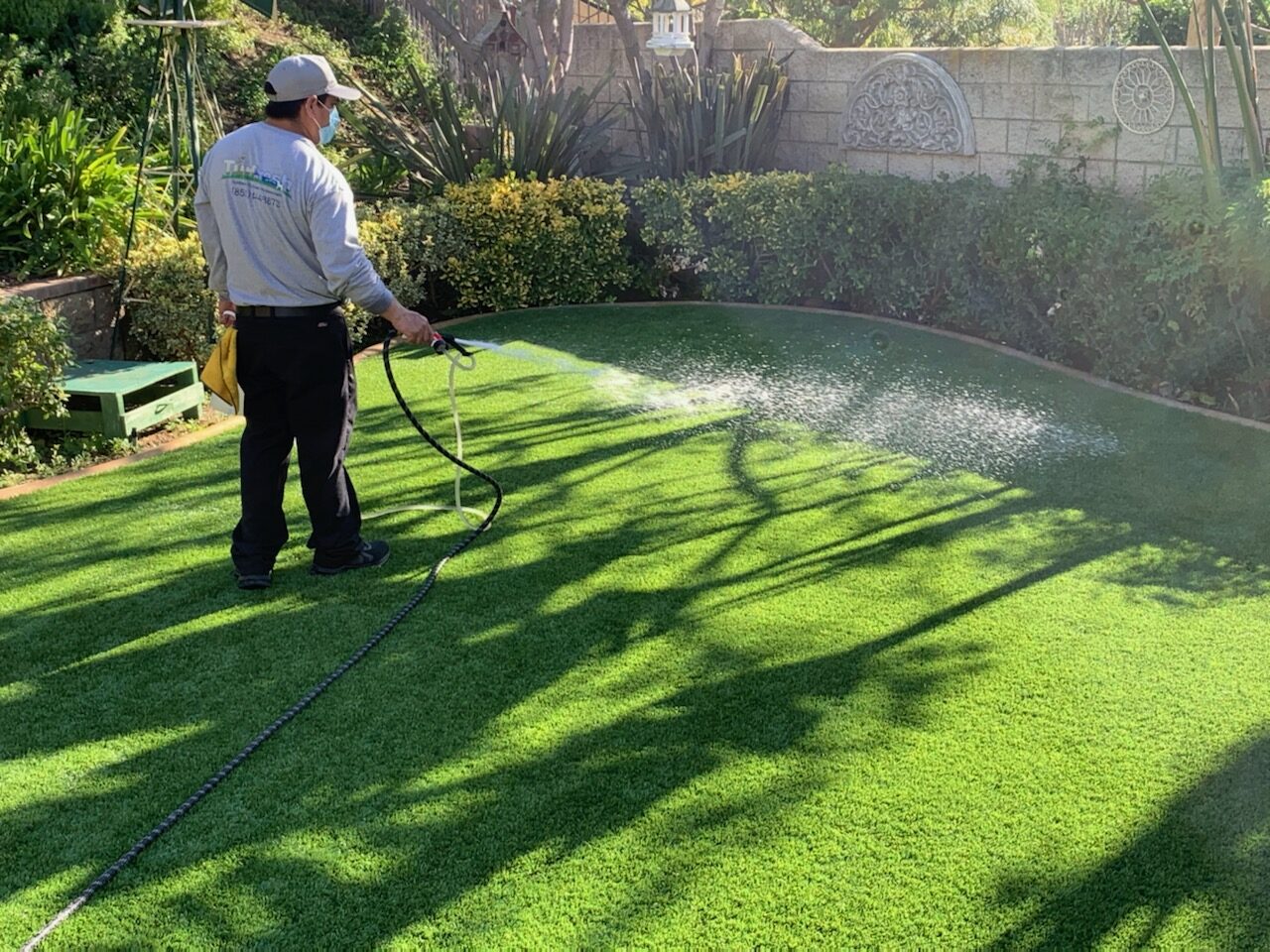
Regular cleaning and fiber restoration prevent the premature compaction and backing damage that force early replacement. TurFresh's non-toxic, biodegradable formulas are safe for kids and pets.
Book Your Assessment✔ Pet Safe✔ Kid Safe✔ 150,000+ Services✔ 30-Day Guarantee
Frequently Asked Questions
Is artificial turf better for drought-prone areas?
Yes. Artificial grass eliminates irrigation, which is a meaningful benefit in drought-prone regions where outdoor watering restrictions are common and water costs are rising.Is artificial grass safe for pets and children?
Most modern turf is considered low-risk for casual use, though PFAS content varies by product. Choosing a documented low-chemical product and maintaining it to prevent bacterial buildup in the infill addresses the two main safety considerations for pet and child use.Does all artificial turf contain PFAS?
No. PFAS content varies significantly by manufacturer and product line. Some manufacturers now offer independently certified PFAS-free turf. Ask for documentation rather than assuming either way.Is natural grass actually better for the environment than artificial turf?
It depends on your climate and how the natural lawn is maintained. Natural grass has its own environmental costs, including water use, pesticide and fertilizer runoff, and equipment emissions. In low-water climates with pesticide-free lawn care, natural grass can have a smaller footprint. In drought-prone regions with conventional lawn maintenance, artificial turf often compares more favorably.Can artificial turf be recycled when it's replaced?
Sometimes, but not universally. A growing number of manufacturers offer recycling or take-back programs, but most existing turf systems are not easily recyclable and are disposed of in landfills. Ask about end-of-life options before installation.How does professional maintenance affect turf's environmental impact?
Directly. Turf's environmental cost is largely fixed at manufacturing, so the longer it lasts in usable condition, the lower its annual impact. Regular professional cleaning and fiber restoration prevent the compaction and backing damage that lead to premature replacement.