DIY vs Professional Artificial Turf Cleaning: Honest Comparison
Jul 24, 2026 · 9 min read · By John Pla, Founder of TurFresh
Quick Answer
DIY vs professional artificial turf cleaning, as of 2026, comes down to what layer you need to reach. DIY rinsing, brushing, and enzyme spray handle surface debris and light odor well, and cost little beyond your own time. Professional cleaning reaches the infill layer underneath the fiber, where bacteria, ammonia, and compacted debris actually build up, which is what most odor and hygiene complaints trace back to. For light-use lawns with no pets, consistent DIY care is often enough. For pet households, high-traffic yards, or turf that has gone more than a year without a deep clean, professional cleaning removes what DIY physically cannot reach.
Not sure if DIY is enough for your yard?
See what a professional TurfClean visit actually reaches.
If your DIY routine has stopped keeping up, a TurfClean visit gets to the infill layer where the real buildup lives.
Get a Free Quote✔ Pet Safe ✔ Kid Safe ✔ 150,000+ Services ✔ 30-Day Guarantee
Key Takeaways
🔑 DIY cleans the surface. Professional cleaning reaches the infill. This is the actual difference, not just thoroughness. Odor, bacteria, and matting live below the fiber layer, where a hose and a broom cannot reach. 🔑 DIY is not free, it is ongoing. Enzyme cleaner, tools, and your own time add up over a year. It is cheaper per session, not necessarily cheaper overall for pet households. 🔑 Most homeowners underestimate the time DIY actually takes. A proper DIY session, done right, takes longer than people expect, especially for high-traffic or pet areas. 🔑 Pet households benefit most from professional cleaning. Ammonia and bacteria buildup in infill responds to enzyme treatment with proper dwell time, which is harder to execute consistently as a DIY routine. 🔑 The strongest approach is usually both, not either. DIY maintenance between professional visits keeps surface debris down while professional cleaning handles what builds up underneath.DIY vs Professional Turf Cleaning: Side-by-Side Cost and Coverage
Before deciding, it helps to see both options against the same criteria. Here is how DIY and TurfClean professional cleaning actually compare.Factor
DIY Cleaning
Professional (TurfClean)
Upfront cost
$30 to $80 for tools (broom, hose attachment)
$0, tools included in service
Ongoing annual cost
Roughly $150 to $300 in enzyme cleaner and supplies for monthly upkeep
$150 to $500 per visit. Frequency ranges from every 2 to 3 years with no pets up to twice a year with 2 or more dogs.
Time per session
30 to 90 minutes, more for pet areas
0 minutes of your time, technician handles it
Reaches infill layer bacteria and odor source
Limited, surface-level only
Yes, enzyme treatment with proper dwell time
Best for
Light-use lawns, no pets, routine upkeep between visits
Pet households, high traffic, turf overdue for a deep clean
Guarantee
None
30-day odor removal guarantee
Professional cost ranges are pulled from our full cost guide. DIY cost ranges reflect typical supply spend for residential turf, 500 to 2,000 sq ft, and are an estimate rather than a tracked figure.
What DIY Turf Cleaning Actually Handles Well
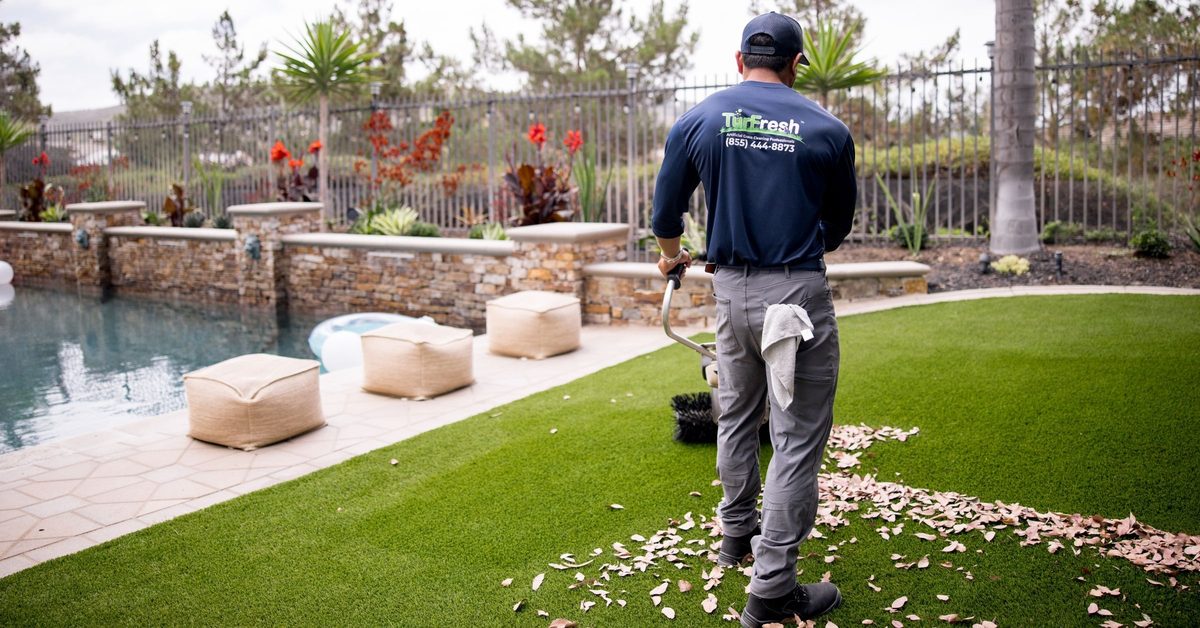
DIY is not a compromise option. For the right situation, it is genuinely the right call. A weekly debris clearing and monthly rinse keeps light-use lawns looking good without any professional visit at all.Where DIY holds up:
➡️ Surface debris. Leaves, dust, and loose dirt come up with a leaf blower or stiff brush, no special products needed. ➡️ Light odor prevention. Regular rinsing and an enzyme spray between visits keeps odor from building up in the first place, especially for single-pet households with light use. ➡️ Routine fiber maintenance. Brushing against the grain on a consistent schedule prevents the matting that comes from foot traffic, no professional equipment required.A basic DIY kit for 2026:
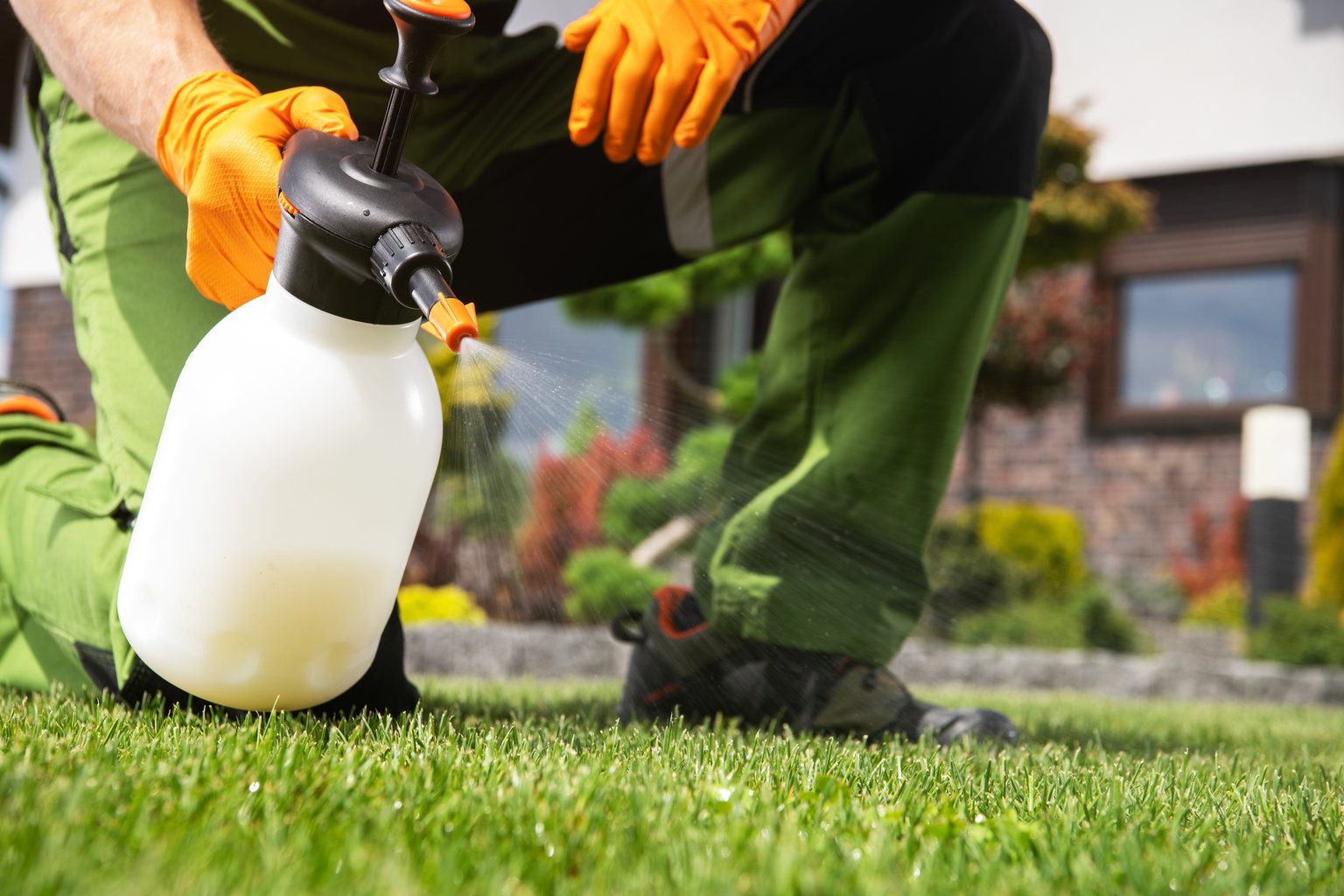
➡️ A stiff synthetic-bristle broom or power rake for brushing against the grain, not a metal rake, which damages fiber backing. ➡️ A pet-safe enzyme spray for spot odor between deeper cleans, applied with enough dwell time to actually break down residue rather than just masking it. ➡️ A diluted white vinegar solution for light mineral or moss spots, at roughly one part vinegar to three parts water. The Synthetic Turf Council, the industry trade association for synthetic turf manufacturers and maintenance providers, publishes maintenance guidance that recommends regular grooming on a set cadence and consistent infill redistribution as standard care, which lines up with what a solid DIY routine covers.Where DIY Cleaning Reaches Its Limit
The honest answer is that DIY reaches what you can see and touch on the surface. It does not reach what has settled into the infill layer underneath the fiber, which is where most persistent problems actually live. Ammonia and bacteria from pet waste bond with infill granules over time. Surface rinsing moves them around without breaking them down, which is why turf can smell fine on a cool morning and much stronger by afternoon. A full breakdown of how this buildup happens is covered in our guide to bacteria in synthetic turf.💡 Tip
If a smell intensifies when you wet the surface, that is a sign the source is in the infill, not on top of it. No amount of additional surface rinsing will resolve that on its own.
Signs your DIY routine has reached its limit:
➡️ Odor returns within 48 hours of a DIY treatment. That points to the infill, not the surface. ➡️ Infill feels hard or rocky underfoot. Compaction has set in beyond what brushing alone can fix. ➡️ It has been over a year since any deep clean. Surface maintenance alone does not reach a full year of settled debris.What Professional Cleaning Adds That DIY Can't
TurfClean uses enzyme-based treatment with a proper dwell time, long enough for the solution to actually break down the organic compounds bacteria feed on, rather than rinsing them off the surface. That distinction, dwell time versus a quick rinse, is the main technical difference between what a homeowner typically manages and what a professional visit does. Professional equipment also reaches infill depth more consistently than a hose or a stiff brush, and a technician can assess whether infill needs to be topped up or replaced, something that is difficult to judge accurately from the surface.Which One Is Right for You?
The honest answer depends on your yard, not a fixed rule. ➡️ Choose DIY as your main routine if: you have no pets or one low-shedding pet, light foot traffic, and no persistent odor. ➡️ Choose professional cleaning if: you have multiple pets, heavy foot traffic, a smell that returns after DIY treatment, or turf that has gone over a year without a deep clean. ➡️ Choose both if: you want the lowest long-term cost and the best result. DIY maintenance between visits keeps surface debris down, and an annual or biannual professional visit handles what builds up underneath. This is exactly the logic behind our routine maintenance vs deep cleaning guide, which breaks down the right frequency by pet count. For the full year-round care routine that ties DIY and professional cleaning together, see our tips to extend the life of your artificial turf guide.Ready to see what DIY has been missing?
Get the infill-deep clean DIY can't reach.
A TurfClean visit reaches what surface rinsing physically cannot, backed by our 30-day odor removal guarantee.
Book Your TurfClean Visit✔ Pet Safe ✔ Kid Safe ✔ 150,000+ Services ✔ 30-Day Guarantee