Who Cleans Artificial Grass Professionally and Why It Matters
Aug 5, 2026 · 11 min read · By John Pla, Founder of TurFresh
Quick Answer: Who cleans artificial grass professionally is a distinct category of service provider: companies trained specifically in synthetic turf cleaning, infill management, and odor treatment rather than general landscapers or pressure washing services. A professional artificial grass cleaning company uses powered grooming equipment, commercial-grade enzyme chemistry, and infill decompaction techniques that general landscapers are not trained to deliver. TurFresh has operated as a dedicated artificial turf cleaning specialist since 1999, completing over 150,000 services across 9 states. If your installer or a neighbor refers you to a turf cleaning company, that is the right category. If someone offers to clean your turf as part of a general lawn care visit, that is a different kind of service.
TurFresh technicians are the specialists who do this work.
Since 1999, TurFresh has built the process, the products, and the trained team that makes professional artificial grass cleaning what it is. Find out if your turf is ready for its first visit.
Schedule Your First TurfClean Visit✔ Pet Safe✔ Kid Safe✔ 150,000+ Services✔ 30-Day Guarantee
Key Takeaways
🔑 Artificial grass cleaning is a specialty, not a side service. The best results come from companies purpose-built for synthetic turf, not landscapers who added it to their menu. The difference shows up in the equipment they bring, the chemistry they use, and their ability to diagnose what is wrong before they start.
🔑 Three types of providers offer to clean artificial grass. Dedicated specialists, installers who offer maintenance as an add-on, and general landscapers or pressure washing companies. Specialization level and quality of results differ significantly across these three categories.
🔑 A real professional visit follows a specific sequence of steps. Debris removal, power grooming, infill decompaction, enzyme treatment with dwell time, rinsing, drainage check, and edge inspection. If a provider's description of their service skips infill decompaction, you are getting partial service at best.
🔑 The most important qualification to ask about is infill knowledge. Most of what goes wrong with artificial grass happens below the fiber layer, in the infill. A provider who cannot explain what they do to the infill is not equipped to address the root cause of odor, compaction, or drainage problems.
🔑 TurFresh is the only national artificial grass cleaning specialist with a 25-plus year track record. Not a side service added to landscaping, not a recent startup: a company built specifically for this work since 1999, with proprietary cleaning products and trained technicians across 9 states.
What Type of Company Cleans Artificial Grass Professionally
Who cleans artificial grass professionally falls into three distinct categories, and knowing the difference before you hire matters more than most homeowners realize.
1. Dedicated artificial turf cleaning specialists
These are companies whose entire business is built around synthetic turf cleaning and maintenance. They train technicians specifically for infill management, fiber restoration, and enzyme-based odor treatment. They invest in powered grooming equipment designed for turf rather than repurposing general landscaping tools. Their diagnostic ability, the capacity to assess whether a lawn needs cleaning, restoration, or repair, comes from doing this work thousands of times across different turf systems and climates.
TurFresh is the national example of this category: a company founded in 1999 specifically to address the gap between turf installation and long-term turf care. The equipment, the product line (BioS+, BioX), and the service steps were all developed for artificial grass cleaning, not adapted from something else.
2. Turf installers who offer maintenance as an add-on
Some installation companies offer cleaning and maintenance alongside their installation work. The advantage here is that installers understand how turf is built from the ground up, which means they have genuine knowledge of the backing system, infill type, and drainage structure. The limitation is that cleaning is typically a secondary offering rather than a core competency. Equipment and processes may not be as developed as a specialist's, and the service may not be available year-round or at the same frequency a specialist can provide.
3. General landscapers and pressure washing companies
This is the category to be most cautious about. A general landscaper who offers turf cleaning as part of a yard maintenance visit typically brings tools and knowledge designed for natural grass: leaf blowers, stiff rakes, garden hoses. These tools handle surface debris but do not address infill compaction or odor at the source. Pressure washing applied directly to turf can displace infill, damage fiber backing, and void certain manufacturer warranties.
What a Professional Artificial Grass Cleaning Technician Does on Every Visit
A professional artificial grass cleaning technician follows a structured sequence of steps on every visit, not a single spray-and-rinse cycle.
➡️ Pre-service assessment. Before any equipment comes out, a trained technician walks the lawn to identify the heaviest-use zones, assess infill condition, check drainage, and note any areas that may need repair attention.
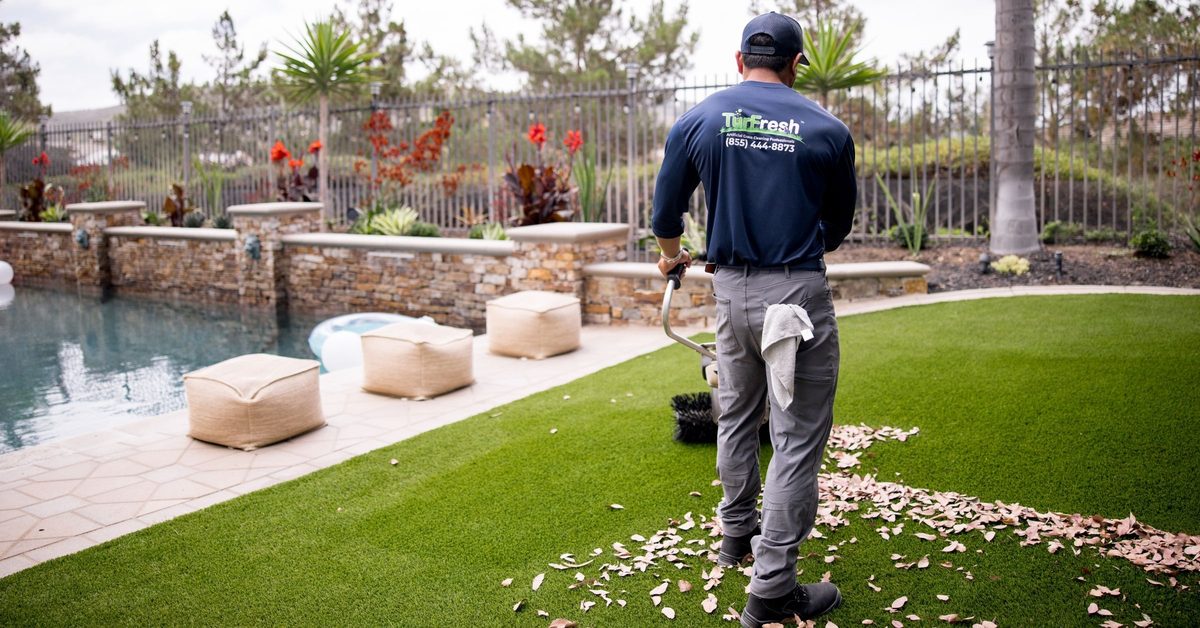
➡️ Surface debris removal. Leaves, pet hair, dust, and loose organic material are cleared from the surface.
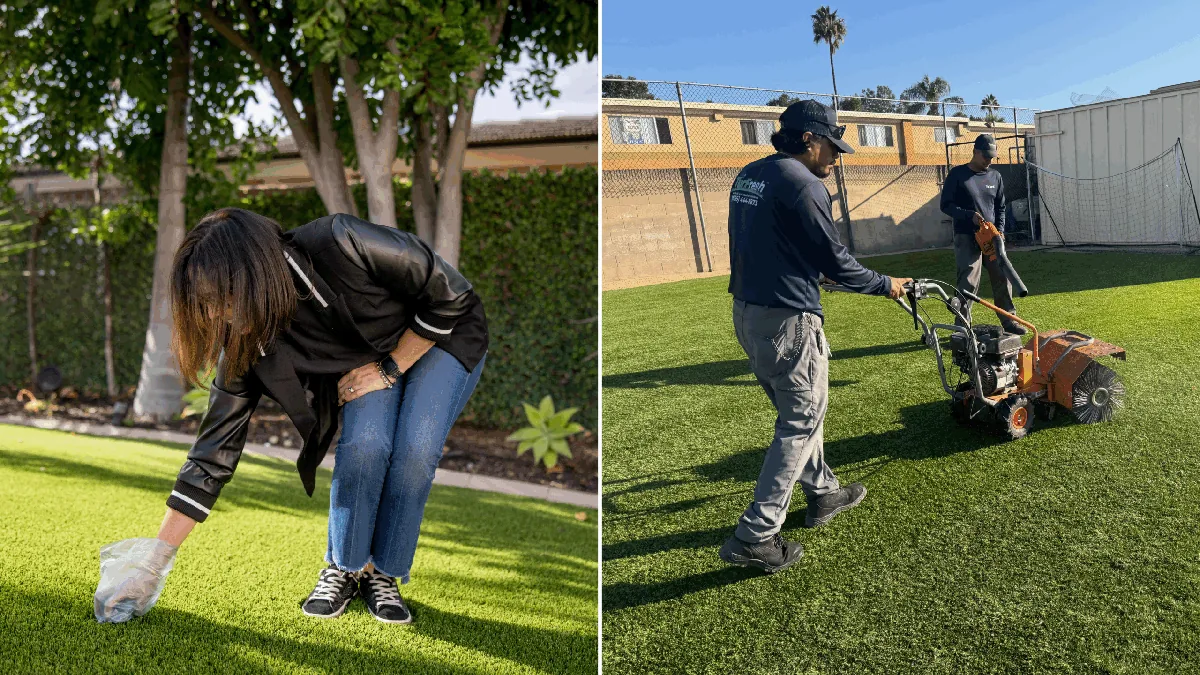
➡️ Power grooming and fiber revival. Powered grooming equipment lifts flattened fibers back toward an upright position. This is not a stiff broom pass; it is mechanical force applied at the correct angle to reset the pile height without stressing the fiber backing.
➡️ Infill decompaction. Specialized equipment agitates and loosens the granule layer beneath the fiber. This is the step most often skipped by non-specialist providers and the one that most determines long-term results.
➡️ Enzyme treatment with dwell time. BioS+ enzyme solution is applied to the infill layer with controlled contact time. The dwell window allows the enzyme chemistry to break down the organic compounds that cause persistent odor.
➡️ Rinse and drainage verification. After treatment, the lawn is flushed and the technician confirms that drainage is flowing correctly.
➡️ Edge and seam inspection. Lifted edges and loose seam sections are tucked and secured where possible. Areas that require structural repair are noted for follow-up.
➡️ Post-service walkthrough. The technician reviews the results with the homeowner and provides a recommended maintenance schedule based on pet count, usage level, and climate.
Specialist vs. General Landscaper: Why It Matters for Your Turf
The difference comes down to three things: equipment, chemistry, and infill knowledge.
Equipment
A turf cleaning specialist arrives with powered grooming equipment designed specifically for synthetic fiber, infill agitation tools, and commercial-grade enzyme application systems. A general landscaper typically arrives with tools designed for natural grass: leaf blowers, rakes, and garden hoses.Chemistry
Effective odor treatment in artificial turf requires enzyme products formulated for synthetic infill, applied at the right concentration and with adequate dwell time. TurFresh developed BioS+ and BioX specifically for turf cleaning applications rather than using general-purpose cleaning products.Infill knowledge
Infill is the granular material that holds turf fibers upright and manages drainage. A specialist can assess infill type, level, and compaction state and adjust the service accordingly. A generalist typically cannot.💡 A practical test when evaluating a provider: Ask them "What do you do to the infill?" A specialist will describe infill decompaction, agitation, and the role of infill in odor and drainage performance. A generalist will typically describe what they do to the surface and may not mention infill at all.
What to Look for When Hiring Someone to Clean Your Artificial Grass
➡️ Is synthetic turf cleaning their primary business, or an add-on? Ask directly. A company that cleans turf as their core service has invested in the equipment, training, and process development that a company adding it as an upsell has not.
➡️ Does the service include infill decompaction specifically? Not just brushing or rinsing. If this step is not mentioned, it is likely not included.
➡️ What enzyme products do they use, and how long do they dwell? A provider who applies a spray and immediately rinses is not delivering enzyme chemistry at the level it needs to work.
➡️ How many artificial turf services have they completed? Volume equals pattern recognition. A technician who has serviced thousands of turf lawns has encountered the full range of problems.
➡️ Do they offer a satisfaction guarantee? A written 30-day odor removal guarantee is the clearest signal that a company is confident in their results.
➡️ Do technicians assess before they treat? A professional does not apply the same treatment to every lawn without looking first.
For a detailed breakdown of what to verify at each step, see our full guide on what to look for when choosing a turf cleaning service.
What TurFresh Technicians Do Differently
➡️ Turf is the only thing we do. TurFresh has been a dedicated artificial turf cleaning specialist since 1999. Every piece of equipment, every product formula, and every technician training program was developed for synthetic turf specifically.
➡️ Proprietary product lines developed for turf infill. TurFresh developed BioS+ and BioX specifically for artificial grass cleaning. BioS+ uses enzyme chemistry formulated for the organic load that accumulates in infill over months or years of pet use.
➡️ 150,000+ completed services across 9 states. The volume and geographic range of TurFresh's service history is the foundation of the pattern recognition our technicians bring to every pre-service assessment.
➡️ A structured service process with consistent standards. Every TurFresh visit follows the same sequence: assessment, debris removal, power grooming, infill decompaction, enzyme treatment with dwell time, rinse, drainage check, edge inspection, and post-service walkthrough. That consistency is what makes the 30-day odor removal guarantee possible.
For a full picture of what a TurFresh TurfClean service includes and what it costs, see our complete service overview.
25 years of doing this one thing well. See what a specialist visit looks like.
TurFresh technicians assess your turf before they treat it, use chemistry developed specifically for synthetic grass, and back every visit with a 30-day odor removal guarantee.
Get a Free Quote✔ Pet Safe✔ Kid Safe✔ 150,000+ Services✔ 30-Day Guarantee
Frequently Asked Questions
Who cleans artificial grass professionally?
Dedicated artificial turf cleaning specialists are the professionals who clean artificial grass at the level the work requires. These are companies purpose-built for synthetic turf cleaning, equipped with powered grooming tools, infill decompaction equipment, and commercial-grade enzyme chemistry. TurFresh is the national specialist in this category, operating since 1999 with trained technicians across 9 states.Can a regular landscaper clean my artificial grass?
A general landscaper can remove surface debris from artificial grass, but a standard landscaping visit does not include infill decompaction, enzyme-based odor treatment, or fiber revival with powered grooming equipment. For persistent odor, compacted infill, or flattened fibers, a dedicated specialist delivers results a landscaping visit cannot.How do I find someone who cleans artificial grass professionally in my area?
Search for "artificial turf cleaning service" rather than general landscaping terms. Look for companies whose primary business is synthetic turf cleaning, verify that the service includes infill decompaction and enzyme treatment, and confirm they offer a satisfaction guarantee. TurFresh operates across Arizona, California, Colorado, Florida, Nevada, New Mexico, Texas, Utah, and Georgia. See our full cost guide for current service pricing.How often should artificial grass be professionally cleaned?
For lawns with no pets, once every one to two years is typically sufficient alongside regular brushing and rinsing. For pet households, once or twice a year depending on the number of animals and usage level. For a full frequency breakdown by pet count and climate, see our guide on how often to schedule professional turf cleaning.What is the difference between artificial grass cleaning and artificial grass restoration?
Cleaning addresses contamination: removing bacteria, odor compounds, and surface debris. Restoration addresses physical structure: lifting flattened fibers and decompacting infill. A complete professional service like TurfClean includes both. Standalone restoration (TurfBloom) focuses specifically on fiber revival and infill decompaction for lawns where the primary issue is appearance and structure rather than contamination.