
⚡ Quick Answer
Professional turf cleaning is worth it for pet owners and high-traffic yards, and not worth it for brand-new turf or low-use lawns with no animals. For a 500 sq ft pet yard, skipping professional service leads to early replacement within 8 to 10 years at a cost of $6,000 to $9,000. Annual professional cleaning keeps the yard you paid for performing the way it was meant to perform — for 15 years or more.
25 years of experience. We know exactly what your yard needs.
Whether you have tried enzyme sprays, hose rinses, or just lived with it, TurFresh has seen every stage of pet turf neglect before. One visit resets it.
✔ Pet Safe✔ Kid Safe✔ 150,000+ Services✔ 30-Day Guarantee
Key Takeaways
Five things to know about the value of professional turf cleaning, based on industry maintenance data and TurFresh service records from over 150,000 visits:
- 🐾 For pet households, professional cleaning is what keeps the yard you paid for. Without it, a $6,000 to $9,000 installation becomes unusable in summer by years 5 to 7 — and needs full replacement by years 8 to 10.
- 🧪 DIY enzyme sprays treat the surface. Professional equipment reaches the infill layer. Pet urine ammonia bonds to crumb rubber and silica sand infill at a depth that consumer products cannot penetrate. That is why the smell comes back.
- 📅 Cleaning frequency depends on your use pattern, not a fixed schedule. Two or more dogs: twice per year. One dog: once per year. No pets, light use: every two to three years.
- 🏡 The real question is not whether cleaning costs money. It is whether the yard is worth keeping. Annual professional cleaning is what maintains the promise of what you bought.
- ⚠️ There are exactly two situations where professional cleaning is not worth it: turf installed less than 12 months ago, and turf with structural damage that cleaning cannot reverse.
When Is Professional Turf Cleaning Worth It?
The honest answer depends on how your turf is actually used. The table below gives a direct answer by situation.
Situation-by-situation guide to professional turf cleaning value:
The Numbers: What Happens to the Yard You Paid For
You invested somewhere between $6,000 and $9,000 for a yard that would be clean, green, and actually usable year-round. Here is what happens to that yard depending on whether it gets professional cleaning or not.
📍 Pricing note: Service prices below reflect TurFresh TurfClean for a 500 sq ft yard in the Orange County, CA area on the TurfCare recurring plan ($450 per visit). Installation costs reflect the OC market range of $8 to $16 per sq ft installed. Costs vary by region and yard size. Get a quote for your specific location.
The question is not whether $450 per year is worth spending. The question is whether the yard you bought is worth keeping. Professional cleaning is what keeps it.
According to industry maintenance estimates, proactive professional cleaning can extend artificial turf lifespan by 30 to 50 percent compared to surface-only DIY maintenance. TurFresh field data drawn from over 150,000 service visits consistently shows neglected pet turf reaching infill saturation between years 8 and 10. Well-maintained turf with annual professional service regularly reaches years 15 to 17 before fiber or infill replacement is warranted.
What Actually Changes After a Professional Cleaning
The before-and-after difference from professional turf cleaning is measurable in four areas: fiber condition, odor, drainage, and surface safety.
For a step-by-step walkthrough of what a TurFresh technician does on-site during a service visit, see What Happens During a Professional Turf Cleaning.
Why a $40 DIY Enzyme Spray Does Not Replace a Professional Clean
This is the most common objection from pet owners who have already tried the hardware-store route. The short answer: consumer enzyme sprays treat the surface. Professional equipment treats the infill layer, which is where the problem actually lives.
When a dog urinates on artificial turf, the liquid passes through the fibers and into the infill layer below, typically crumb rubber or silica sand, one to three inches deep. Uric acid salts bond chemically to the granules in that layer. They do not dissolve with a garden hose. They do not fully break down with a spray-bottle application of consumer enzymes, because the concentration and volume cannot penetrate at the depth required.
Heat compounds the problem. In markets like Arizona, Nevada, Southern California, and Texas, high temperatures accelerate the release of ammonia gas from those bonded uric acid compounds. The result is the smell that peaks sharply in summer: the exact pattern most dog owners report after trying consumer sprays through spring.
A professional cleaning applies enzyme treatments such as TurFresh BioS+ and BioX under mechanical pressure, combined with high-pressure turf washing and infill agitation that reaches the contamination at its actual source. The distinction is not about brand or formula. It is about physics: volume, pressure, and mechanical penetration depth that consumer products physically cannot replicate.
This does not mean DIY sprays have no value. Weekly rinsing and spot treatment between professional visits extends the interval between services and keeps surface odor managed. Think of DIY cleaning as maintenance between resets, not a replacement for the reset itself.
How Often Do You Actually Need Professional Cleaning?
The right cleaning frequency depends on your use pattern, not an arbitrary annual rule. The table below gives a practical starting point by scenario.
Professional turf cleaning frequency recommendations by use:
For the full maintenance schedule including what to do between professional visits, see 5 Maintenance Tips to Extend the Life of Your Artificial Turf.
When Professional Turf Cleaning Is Not Worth It
Three situations where professional cleaning is the wrong spend, stated directly.
1. Your turf is less than 12 months old. Soil load, bacterial accumulation, and infill compaction take time to build up. A brand-new installation does not benefit meaningfully from a professional deep clean. Wait until months 10 to 12, then establish a maintenance schedule from that point forward.
2. Your turf has structural damage that cleaning cannot fix. Lifted seams, torn backing, backing failure, or severely compacted areas that do not respond to mechanical reblooming are signs that the surface is physically compromised. A professional clean will improve appearance temporarily, but if the underlying structure is gone, replacement delivers better long-term value. TurFresh technicians will tell you honestly during an assessment if your turf has reached this point.
3. Your turf has very light use with no pets. A decorative front-yard installation with minimal foot traffic and no animal use does not accumulate the contamination load that makes the case for regular professional cleaning. Occasional light brushing and rinsing may be all your turf needs for years. In this case, every two to three years is a reasonable starting point.
If you are unsure which category your turf falls into, a TurFresh assessment gives you a clear answer on what your specific yard actually needs, without any commitment required.
See your price before you commit to anything.
No pressure, no guesswork. TurFresh gives you transparent pricing based on your yard size and actual condition in under a minute.
✔ Pet Safe✔ Kid Safe✔ 150,000+ Services✔ 30-Day Guarantee
Frequently Asked Questions
Is professional turf cleaning worth it for dog owners?
Yes, for most dog owners. Pet urine bonds ammonia compounds to infill granules at a depth that DIY sprays and garden hoses cannot reach. Without professional enzyme treatment, odor intensifies every summer until the yard becomes effectively unusable. Annual professional cleaning keeps the yard clean, safe, and performing the way it was built to perform.
How much does professional turf cleaning cost?
Professional turf cleaning costs between $450 and $550 per service for a 500 sq ft yard in the Orange County, CA area on the TurfCare recurring plan. Costs vary by region, yard size, and service level. For a complete breakdown by service type and market, see the 2026 TurFresh Turf Cleaning Cost Guide.
Can I clean artificial turf myself instead of hiring a professional?
DIY cleaning handles surface maintenance well: removing debris, rinsing, and light brushing. It does not address infill-level contamination. Pet urine ammonia bonds to crumb rubber or silica sand infill at a depth that consumer enzyme sprays cannot fully penetrate. Professional equipment applies treatments under pressure and mechanically agitates the infill to reach the source of odor and bacterial buildup. DIY cleaning is maintenance between professional resets, not a replacement for the reset itself.
How often should I have my artificial turf professionally cleaned?
Recommended frequency by use: two or more dogs: twice per year. One dog or moderate foot traffic: once per year. No pets, light use: every two to three years. High-traffic commercial or sports turf: quarterly. In hot climates such as Arizona, Nevada, and Southern California, heat accelerates ammonia release, making one additional pre-summer service a worthwhile addition.
Does professional cleaning extend the life of artificial turf?
Yes. According to industry maintenance estimates, proactive professional cleaning can extend artificial turf lifespan by 30 to 50 percent compared to surface-only DIY maintenance. For pet households, neglected turf typically requires replacement within 8 to 10 years due to infill saturation. With regular professional cleaning, the same turf can reach 15 to 17 years.
When is professional turf cleaning not worth it?
Professional cleaning is not worth it in three situations: turf installed less than 12 months ago, where contamination has not yet built to a meaningful level; turf with structural damage such as lifted seams or torn backing that cleaning cannot restore; and very light-use residential turf with no pets and minimal foot traffic, where cleaning every two to three years is sufficient.
What is the difference between a DIY enzyme spray and professional turf cleaning?
DIY enzyme sprays treat the surface layer of turf fibers and can control odor temporarily. Professional cleaning applies enzyme treatments under pressure that penetrate to the infill layer, typically one to three inches below the surface, where ammonia compounds from pet urine accumulate and bond to granules. A professional visit also includes mechanical reblooming to restore fiber height, infill redistribution to recover drainage, and full-surface sanitizing to eliminate bacteria. Consumer products cannot replicate this depth of treatment.
Share
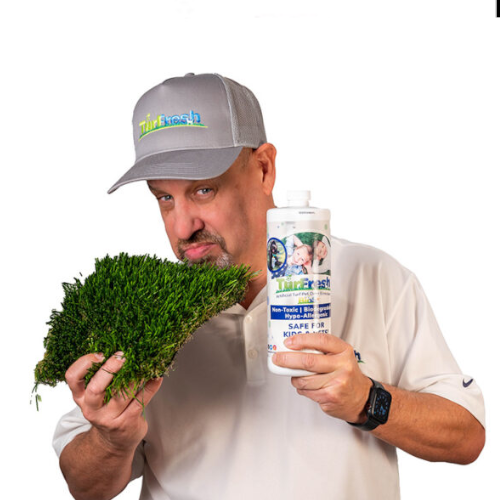

John Pla is the owner of TurFresh and an expert with over 20 years of experience in artificial turf cleaning and maintenance. John’s passion for sustainability, community impact, and innovative solutions has made him a trusted figure in the artificial grass industry and beyond.