Best Artificial Turf Restoration Service: What It Includes and How to Choose
Aug 5, 2026 · 14 min read · By John Pla, Founder of TurFresh
Quick Answer
The best artificial turf restoration service reaches the infill layer underneath the fiber, not just the surface. A complete professional restoration combines mechanical fiber revival using high-powered grooming equipment, infill decompaction to break up the compacted granules that keep fibers flat, and enzyme-based odor treatment applied with adequate dwell time. For turf that looks worn, stays flat after brushing, or holds odors that return after rinsing, a professional restoration visit from a company with documented experience and a written satisfaction guarantee will restore performance without replacing the lawn. Replacement is only necessary when the backing itself is structurally damaged. If the backing is intact, professional restoration almost always works.
Find out if TurfBloom can bring your lawn back.
If your turf looks flat, smells, or hasn't been serviced in years, TurfBloom reaches the infill layer where the real buildup lives. No replacement needed in most cases.
Get a Free Assessment✔ Pet Safe ✔ Kid Safe ✔ 150,000+ Services ✔ 30-Day Guarantee
Key Takeaways
🔑 Professional restoration reaches the infill layer. Surface cleaning does not. The infill underneath the fiber is where compaction, bacteria, and odor build up over time. Brushing and rinsing work at the surface only. The most common reason DIY treatments stop working is that the actual source of the problem is below where those treatments reach. 🔑 Restoration and cleaning are not the same service. Cleaning removes surface contamination. Restoration includes infill decompaction and mechanical fiber revival. The best professional services combine both into a single visit. If a provider does not mention infill decompaction, they are selling cleaning, not restoration. 🔑 The most important question to ask before booking is whether the service includes infill decompaction. A provider that only brushes or rinses the surface cannot deliver the results a full restoration produces. This single question separates genuine restoration services from basic maintenance calls. 🔑 Most worn turf does not need replacement. Flat fibers and compacted infill are maintenance issues that professional restoration can reverse. Replacement is only necessary when the backing is structurally damaged, cracked, or delaminating. Backing damage is far less common than general wear. 🔑 A satisfaction guarantee is the clearest signal of confidence in results. A company that guarantees odor removal in writing is accountable for what the service actually achieves. This is one of the most useful screening tools when comparing providers.What a Professional Artificial Turf Restoration Service Actually Does
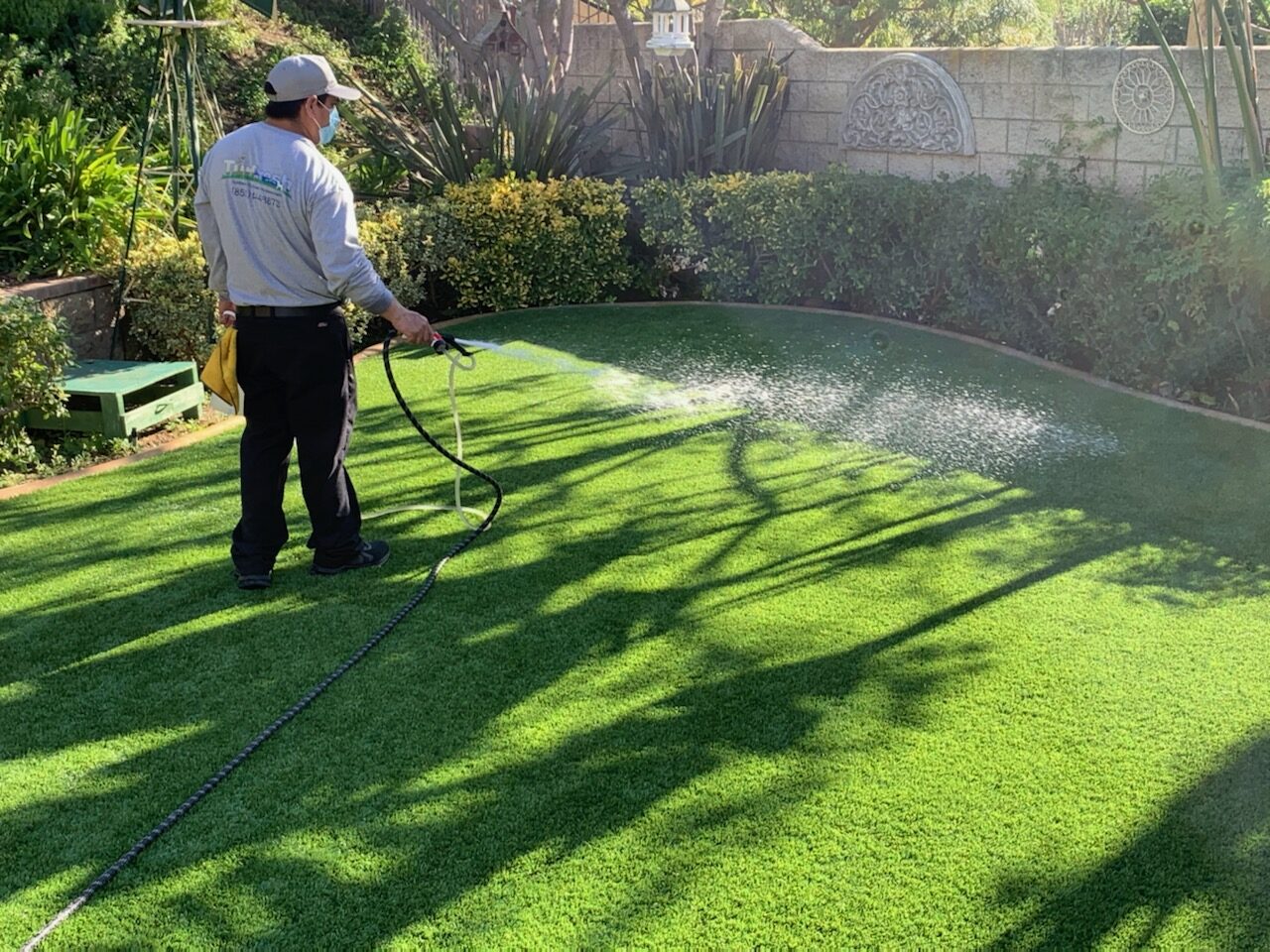
A professional artificial turf restoration service works at both the fiber level and the infill level, not just the surface. That distinction matters because the two most common problems homeowners notice, flat fibers and persistent odor, have different root causes at different depths in the turf system. The visible surface of artificial turf flattens from foot traffic, pet use, and sustained weight over time. Beneath those fibers, the infill layer (typically crumb rubber or silica sand) compacts into a dense mass that locks fibers in a flattened position and reduces drainage efficiency. A surface rinse or standard brushing moves debris around without addressing either root cause. A genuine professional restoration service addresses both layers. Here is what each step does and why it matters: ➡️ Fiber revival. High-powered grooming equipment lifts flattened fibers back toward an upright position. The tool matters here. A push broom does not generate enough mechanical force to reset fibers that have been compressed for months or years. Professional grooming equipment applies force at the correct angle to lift the pile without stressing the fiber backing. ➡️ Infill decompaction. Specialized equipment agitates and loosens the compacted granules beneath the fiber layer. This step restores drainage, redistributes infill evenly, and removes the packed material that was holding fibers flat. Without decompaction, fibers that are temporarily lifted will flatten again within weeks because the compacted infill below them has not changed. ➡️ Enzyme-based odor treatment. Bacteria and ammonia compounds from pet waste bond with infill granules over time. A water rinse relocates them without breaking them down, which is why odor returns after a few warm days. Enzyme treatment applied with adequate dwell time breaks down the organic compounds at their source rather than masking them or pushing them deeper into the infill. ➡️ Technician assessment and edge work. A pre-service and post-service inspection by a trained technician identifies whether infill needs topping up, whether edges have lifted, and whether any areas call for structural attention beyond restoration. This step distinguishes a professional service visit from a general maintenance call and is where experience shows most clearly. TurFresh's TurfBloom service combines all four of these steps into a single visit. It is designed specifically for turf that looks and feels worn rather than simply dirty, and it is the service our technicians recommend when a lawn has not had a professional treatment in more than a year.TurfBloom vs. Generic Turf Cleaning: What Is the Difference?
The core difference between a professional restoration service and a basic turf cleaning is the infill layer. Both services address the surface. Only restoration goes underneath. Understanding this distinction is the fastest way to evaluate what any provider is actually offering.TurfBloom is designed for turf that has compaction, persistent odor, or visible fiber loss. For routine maintenance between TurfBloom visits, see our guide to tips for extending the life of your artificial turf.
How to Choose the Best Artificial Turf Restoration Service
The best way to evaluate a turf restoration service is to ask one question before booking: does your service include infill decompaction, or is it surface cleaning only? A provider who cannot answer that directly is telling you something important about their process. According to TurFresh's 25+ years of service experience and 150,000+ completed visits, a complete professional artificial turf restoration service includes: infill decompaction with specialized equipment, mechanical fiber revival, enzyme-based odor treatment with adequate dwell time, and a technician assessment before and after the work. Use that as your baseline when comparing providers. The Synthetic Turf Council, the industry trade association for synthetic turf manufacturers and maintenance providers, also publishes maintenance guidance identifying infill management and fiber grooming as the core elements of a professional turf maintenance program, not appearance alone.What to ask and verify before hiring:
➡️ Does the service include infill decompaction? This is the most important question. Fiber restoration without infill decompaction produces results that last weeks, not years. Compacted infill pulls fibers flat again quickly if the underlying layer has not been treated. ➡️ What equipment does the technician use? Professional restoration uses powered grooming equipment. A stiff broom is a maintenance tool, not a restoration tool. If a provider cannot describe their equipment specifically, the service is likely surface-level. ➡️ Is enzyme treatment included, and how long does it dwell? Dwell time matters as much as the product itself. Enzyme cleaners need adequate contact time to break down organic compounds at the source. A quick spray-and-rinse does not deliver the same result as a properly timed treatment. ➡️ Is there a written satisfaction guarantee? A 30-day odor removal guarantee means the company is accountable for whether the problem is actually resolved. No guarantee means you absorb all the risk if the treatment does not work. ➡️ Does a technician assess the turf before treating it? An honest pre-service assessment tells you whether restoration will solve your problem or whether a different service is needed. Providers who skip this step cannot reliably diagnose what the turf actually requires. ➡️ What is the company's documented experience with artificial turf specifically? Turf restoration is a specialty. A provider with tens of thousands of completed turf services brings a different depth of pattern recognition than a general landscaper offering cleaning as an add-on.💡 Tip
When comparing quotes, ask each provider what happens if the odor returns after the service. The answer tells you more about the company's actual confidence in their process than anything on their website.
Signs Your Turf Needs Professional Restoration Now
Your artificial turf needs professional restoration when surface maintenance has stopped producing results. These are the clearest signals, drawn from patterns our technicians encounter regularly across 150,000+ services completed since 1999: ➡️ Fibers stay flat after brushing. If blades do not stand back up within a few hours of being brushed, compaction has set in below the surface. The infill layer is holding the fibers down, not just the weight of foot traffic. ➡️ Odor returns within 48 hours of a DIY treatment. When smell comes back that quickly, the source is in the infill, not on the surface. Additional rinsing will not resolve it because the treatment is not reaching the layer where the bacteria live. A full breakdown of why this happens is covered in our guide to bacteria in artificial turf. ➡️ The surface feels hard or rocky underfoot. Infill that has compacted into a dense mass changes how the turf feels from its original cushioned, springy condition. This is both a drainage concern and a sign that fiber structure is being compromised from below. ➡️ Water pools after light rain or routine rinsing. When drainage that worked at installation is now backing up, the cause is almost always compacted infill and embedded debris blocking the flow path. Decompaction restores it. ➡️ The turf has not had a professional service in more than two years. For lawns with no pets, the Synthetic Turf Council recommends professional grooming and infill maintenance on a consistent schedule. For pet households, that window shortens to one year or less depending on the number of animals and use intensity. Our full guide on how often to schedule professional turf cleaning breaks down the right frequency by pet count and usage level.When Professional Restoration Is Not Enough
Professional restoration reverses compaction, matting, and odor. It cannot reverse structural damage to the turf backing. Being direct about this distinction is part of how a qualified provider earns trust: they are working in the customer's interest, not just selling a service visit.Signs the turf needs repair or replacement, not restoration:
➡️ Cracked or delaminating backing. Lift a corner or edge of the turf and look at the mesh layer on the underside. If it is cracking, flaking, or pulling away from the fiber layer, the structural foundation has degraded. Restoration services work on the fibers and infill above the backing. They cannot repair the backing itself. ➡️ Fibers worn through to the backing across large areas. When fibers have been completely worn away and bare backing is visible in multiple sections, restoration cannot restore what is no longer there. Targeted patching through a physical repair service like TurFix may address isolated damage zones. Widespread fiber loss is a signal that the turf system itself is approaching the end of its functional life. ➡️ Full drainage failure across the entire lawn. Compacted infill creates drainage problems that decompaction fixes. But if the drainage layer beneath the turf system has failed or collapsed, no surface treatment resolves it. That requires excavation and reinstallation, which is a conversation with an installer, not a cleaning service. ➡️ Widespread seam separation. A lifted edge here or there can be tucked and secured as part of a restoration visit. Seam separation running the length of multiple sections indicates that the installation substructure has shifted or the adhesive has broken down across a broad area. That is beyond what a restoration service is designed to fix. For turf that is flat, matted, or odor-retaining, but whose backing is intact and drainage is functioning, professional restoration is almost always the right decision before replacement. The full framework for assessing whether your specific situation calls for restoration, repair, or replacement is covered in our artificial turf problems guide.TurFresh technicians assess before they treat. Get an honest answer first.
With 25+ years of experience and 150,000+ services completed, we know the difference between a lawn that needs a TurfBloom visit and one that needs something else. We will tell you which applies before any work begins.
Book a Free Assessment✔ Pet Safe ✔ Kid Safe ✔ 150,000+ Services ✔ 30-Day Guarantee