
Quick Answer:
A professional turf cleaning visit takes about 2 to 3 hours for a standard yard and follows six steps: inspection, debris removal, deep rinse, enzyme treatment, sanitizing, and infill grooming. TurFresh, a professional artificial turf cleaning company serving more than 130 cities, uses the BioS+ enzyme process to reach the infill and backing layer where odor-causing bacteria actually live, which is the part home cleaning cannot do. The turf is dry and safe for pets in under 30 minutes, and the result is backed by a 30-day odor removal guarantee.
Your turf can look and smell like new again.
TurFresh reaches the infill and backing layer where the odor actually lives. Pet safe, same-day re-entry, 30-day guarantee.
✔ Pet Safe ✔ Eco Friendly ✔ 20+ Years of Experience ✔ 30-Day Guarantee
Why TurFresh
TurFresh is a professional artificial turf cleaning company with over 20 years in synthetic grass care, serving more than 130 cities across the United States. The process described on this page is the TurFresh process, refined across thousands of residential and commercial yards.
Home cleaning treats the surface. The TurFresh BioS+ enzyme process uses commercial extraction equipment to reach the infill and backing layer where odor-causing bacteria live. Every treatment is pet safe, allows same-day re-entry, and is backed by a 30-day odor removal guarantee.
Key Takeaways
🔑 A professional turf cleaning visit takes 2 to 3 hours for a standard residential yard. Larger properties or turf with heavy buildup take longer. The turf is dry and safe for pets in under 30 minutes after the visit.
🔑 The process has six steps: inspection, debris removal, deep rinse, enzyme treatment, sanitizing, and infill grooming. Each addresses a different layer of the turf system.
🔑 The enzyme step is what separates professional from DIY. Commercial extraction reaches the infill and backing layer, where uric acid and bacteria accumulate. No home sprayer or hose reaches that depth.
🔑 Most yards need professional cleaning once or twice a year. Multi-dog households and heavy-use yards benefit from every three to four months.
🔑 If odor returns within days of your own cleaning, the infill is saturated. That is the clearest signal that a professional visit is the right next step, and it is what TurFresh is built to resolve.
What Happens During a Professional Turf Cleaning Visit?
A professional turf cleaning visit follows six steps in order: inspection, debris removal, deep rinse, enzyme treatment, sanitizing, and infill grooming. The sequence matters, because each step prepares the surface for the next one. Skipping or reordering them is why DIY attempts often fall short even when the products are right.
Here is what each step involves and why it is there.
Step 1: Inspection and Assessment
The technician walks the yard before touching anything, identifying high-use pet zones, checking drainage performance, looking for compacted or displaced infill, and assessing how deep the odor problem goes. This determines the treatment plan, because a yard with light surface odor needs a different approach than one with years of buildup in the infill.
Step 2: Debris Removal
Leaves, twigs, solid waste, and loose organic material are cleared from the surface. This matters more than it sounds: organic debris holds moisture against the turf and feeds the bacteria that produce odor. Cleaning around debris rather than removing it first leaves the source in place.
Step 3: Deep Rinse
The full surface is rinsed with commercial equipment calibrated for synthetic turf. This flushes surface contaminants and opens the fibers so the enzyme treatment can reach the infill rather than sitting on top of the blades.
Step 4: Enzyme Treatment
This is the step that does the actual odor elimination. A commercial-strength enzyme solution is applied across the surface and worked into the infill layer. The enzymes digest uric acid, ammonia compounds, and the organic residue bacteria feed on, breaking them down at a molecular level rather than masking them.
TurFresh uses the BioS+ enzyme process here, applied with extraction equipment that pulls the dissolved material out of the infill instead of diluting it further down. This is the mechanical difference between a professional visit and a spray bottle: reaching the depth, and removing what was broken down.
Step 5: Sanitizing
A hydrogen peroxide-based sanitizer is applied to eliminate remaining bacteria across the surface and in the upper infill. It breaks down into water and oxygen, leaving no chemical residue, which is why it is safe for pets and children.
Step 6: Infill Grooming and Restoration
The turf fibers are brushed upright and the infill is redistributed evenly across the surface. This restores the appearance of the lawn, improves drainage and airflow, and reduces the matting that develops in high-traffic dog paths. A well-groomed surface also stays cleaner longer between visits.
💡 What you will notice: Most homeowners report the difference in smell immediately and the difference in appearance after the fibers dry and stand back up, usually within the first hour.
How Long Does Professional Turf Cleaning Take?
A professional turf cleaning takes about 2 to 3 hours for a standard residential yard of roughly 1,000 square feet. Larger properties take proportionally longer, and turf that has not been deep cleaned in several years may require additional treatment time on high-use zones.
The turf is dry and safe for pets and children in under 30 minutes after the visit ends. There is no waiting period, no need to keep animals off the surface overnight, and no chemical residue to worry about.
What affects the timeline:
➧ Yard size, the main variable. Larger surfaces take longer to rinse, treat, and groom.
➧ Severity of buildup. Turf with years of accumulated pet use needs more enzyme dwell time and sometimes a second pass on the worst zones.
➧ Number of pets. Multi-dog yards typically have more concentrated hot spots requiring focused treatment.
➧ Drainage condition. Blocked or slow drainage adds diagnostic time and may require additional infill work.
How Is Professional Cleaning Different from DIY?
The difference is depth. Home cleaning treats the surface, and professional cleaning treats the infill and backing layer where odor actually originates.
A garden hose and a spray bottle work on what you can see. They do not reach the uric acid crystals that have settled into the infill over months of pet use, and rinsing alone can push residue further down rather than removing it. Commercial extraction equipment applies enzyme solution at depth and then pulls the dissolved material back out.
This is why yards that get cleaned weekly at home can still smell. The routine is not wrong; it is working on the wrong layer.
What professional equipment does that home tools cannot:
➧ Reaches the infill and backing layer rather than the surface only
➧ Extracts dissolved material instead of diluting it deeper into the base
➧ Applies commercial-strength enzymes at concentrations not available in consumer products
➧ Restores compacted infill that has hardened under repeated use
💡 DIY maintenance and professional cleaning are not alternatives, they are layers. Regular home care between visits is what keeps the yard fresh; the professional visit is what resets the baseline the home care works from.
That means the infill is saturated.
TurFresh uses commercial extraction and the BioS+ enzyme process to reach the layer home cleaning cannot. Pet safe. Dry in 30 minutes. 30-day odor removal guarantee.
✔ Pet Safe ✔ Eco Friendly ✔ 20+ Years of Experience ✔ 30-Day Guarantee
How Often Should You Schedule Professional Turf Cleaning?
Most residential yards need professional cleaning once or twice a year. Yards with multiple dogs, heavy daily use, or a small surface area shared by several pets benefit from every three to four months.
Frequency by household:
➧ One dog, average yard size: once a year, or twice if the yard is used heavily in summer.
➧ Two or more dogs: every three to four months. The bacterial load roughly doubles with the second dog.
➧ Small yard, multiple dogs: every two to three months, because the same surface absorbs concentrated use.
➧ Commercial properties, dog runs, daycares: monthly to quarterly depending on traffic volume.
The practical test is simpler than any schedule: if odor returns within a few days of your own thorough cleaning, the infill needs professional treatment regardless of when the last visit was.
What Should You Do Before and After a Cleaning Visit?
Before the visit:
✅ Remove solid waste from the yard. This lets the technician work on the turf rather than around obstacles.
✅ Clear toys, furniture, and planters from the surface so the full area can be treated.
✅ Point out problem zones. If you know where the smell is worst, say so. It directs the treatment.
✅ Secure pets indoors for the duration of the visit.
After the visit:
✅ Wait until the turf is dry, usually under 30 minutes, before letting pets back out.
✅ Resume daily rinsing of pet zones to maintain the reset baseline.
✅ Apply enzyme maintenance weekly on high-use spots between professional visits.
✅ Note the date so you can track how long the results hold, which tells you the right frequency for your yard.
Complete Guide
📖 How to Maintain Artificial Grass When You Have Dogs, the full system for pet households: daily routine, enzyme treatment, multi-dog homes, and when to call a professional.
Frequently Asked Questions
What happens during a professional turf cleaning visit?
A professional visit follows six steps: inspection, debris removal, deep rinse, enzyme treatment, sanitizing, and infill grooming. TurFresh technicians assess the yard first, then work through each layer of the turf system, finishing with the fibers brushed upright and the infill redistributed. A standard yard takes 2 to 3 hours.
How long does professional turf cleaning take?
About 2 to 3 hours for a standard residential yard of roughly 1,000 square feet. Larger properties or turf with heavy accumulated buildup take longer. The turf is dry and safe for pets in under 30 minutes after the visit ends.
How does professional turf cleaning work?
Commercial extraction equipment applies enzyme solution into the infill layer, then pulls the dissolved material back out. The enzymes digest uric acid and ammonia at a molecular level rather than masking them. This is the mechanical difference from home cleaning, which treats the surface only. TurFresh uses the BioS+ enzyme process for this step.
Is professional turf cleaning safe for pets and children?
Yes. TurFresh uses pet-safe enzyme products and a hydrogen peroxide-based sanitizer that breaks down into water and oxygen, leaving no chemical residue. The turf is safe for pets and children as soon as it is dry, usually within 30 minutes.
Will professional cleaning damage my turf?
No. Professional turf cleaning uses equipment and pressure calibrated for synthetic surfaces, and the process is designed to protect fibers and backing. TurFresh technicians work within manufacturer specifications.
How often should I schedule professional turf cleaning?
Most residential yards need cleaning once or twice a year. Multi-dog households and heavy-use yards benefit from every three to four months. The practical test is whether odor returns within days of your own thorough cleaning.
Why can't I get the same result with a hose and enzyme spray?
Because the odor source is in the infill, below where a hose and consumer sprayer reach. Home cleaning treats the surface effectively but cannot extract material from the infill layer. Rinsing alone can also push residue further down rather than removing it.
What is the difference between turf cleaning and turf deodorizing?
Deodorizing treats the smell. Cleaning removes what causes it. A deodorizer masks or neutralizes odor at the surface, while a full cleaning extracts the uric acid and bacteria from the infill. Deodorizing between professional cleanings is useful maintenance, but it does not replace the cleaning.
Do I need to be home during the cleaning?
Not necessarily, as long as the technician has access to the yard and a water source. Many customers point out problem zones at the start and then go about their day.
What should I do before the technician arrives?
Remove solid waste, clear toys and furniture from the turf, secure pets indoors, and note any zones where the odor is worst so the technician can focus treatment there.
How soon can pets use the turf after cleaning?
As soon as the surface is dry, usually under 30 minutes. There is no waiting period beyond drying and no chemical residue to avoid.
Does professional cleaning fix drainage problems?
It can help. Compacted infill is a common cause of slow drainage, and grooming and redistributing the infill often restores flow. Drainage problems in the base layer below the turf are a separate issue requiring an installer rather than a cleaning service.
Share
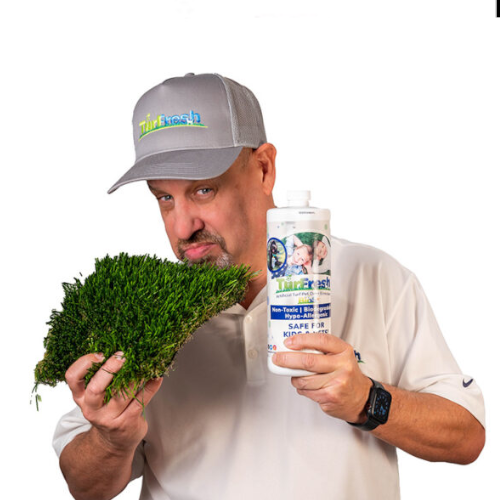

John Pla is the owner of TurFresh and an expert with over 20 years of experience in artificial turf cleaning and maintenance. John’s passion for sustainability, community impact, and innovative solutions has made him a trusted figure in the artificial grass industry and beyond.